
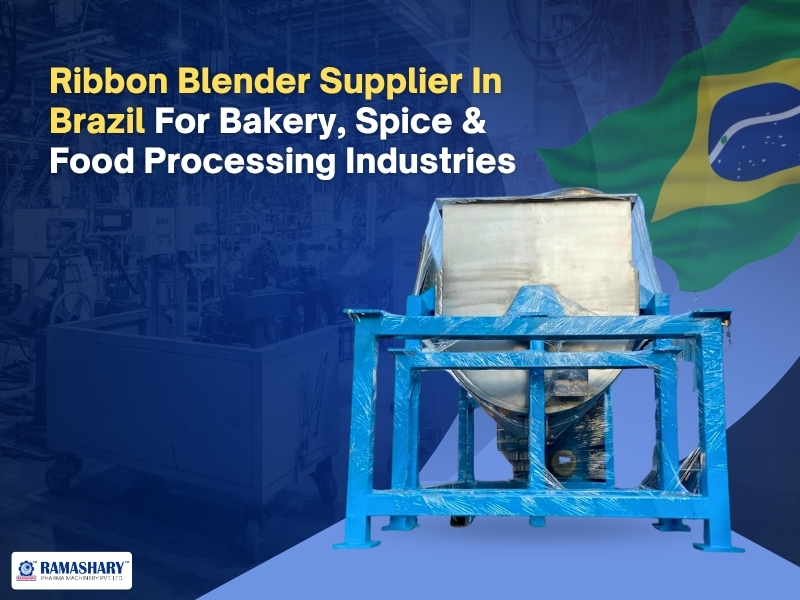
Ribbon Blender Supplier In Brazil For Bakery, Spice & Food Processing Industries
Your biggest manufacturing challenge might not be what you think. Brazil is one of the world’s leading food producers, supplying agricultural and food products at a scale few nations can match. The country’s food processing sector had a revenue of roughly R$1.388 trillion in 2025. It accounts for 10.9% of national GDP. Every day, on average, two new food factories opened somewhere in Brazil last year, adding to an industrial base of 42,000 companies that together processed 288 million tonnes of food. This is not a small regional industry. It is one of the largest food manufacturing bases globally, feeding domestic households and supplying 190 countries at the same time. Behind every one of those numbers is a factory floor where raw ingredients get turned into bread, biscuits, spice blends, sauces, snacks and powders. That kind of growth puts pressure on equipment. When a bakery in Sao Paulo doubles its output or a spice manufacturer in Rio de Janeiro adds a new product line, the mixing stage becomes important. Dry ingredients that used to blend evenly in a small batch mixer may show inconsistency at higher volumes. This is exactly where selecting a Ribbon Blender supplier in Brazil becomes important to a plant manager’s daily decisions. It is not a quick upgrade but the difference between a batch that passes quality control and one that gets reworked. A Ribbon Blender handles dry powders, granules and semi-solid mixes with a consistency that smaller or older equipment cannot match once volumes increase. That consistency keeps a bakery’s flour blend or a spice unit’s mix uniform from the first bag to the last. None of this means every plant needs to rush to purchase food machinery in Rio de Janeiro or any city. It means that when the time comes to replace old equipment or plan a new line, the choice of a Ribbon Blender supplier in Brazil matters as much as the choice of machine. A blender that arrives late, breaks down in its first year or lacks proper documentation can cost a plant far more than its purchase price. Overview Of The Food Industry In Brazil Brazil’s food processing sector is not a niche export business. It is said to be the largest economic sector in the country. 61% of the farm produce is processed in the Brazilian food industry. 68% of the products grown or raised by family-owned farms are bought by the food and beverage industry to manufacture food products. In 2025 alone, the industry invested R$41.3 billion, up 6.8% from the year before. Two-thirds of that capital went towards innovation and new production lines rather than simple replacement. Exports tell a similar story. Brazil shipped processed food worth around $66.3 billion in 2024. The food technology and equipment side of this ecosystem is growing in parallel. Brazil’s food technology market is projected to expand from roughly $4.2 to $4.8 billion in 2026 to as much as $8.2 billion by 2035. Import dependence for speciality ingredients and processing inputs still sits at 40 to 45% of total volume. Regulation adds another layer that shapes how factories operate. ANVISA requires food equipment and ingredient importers to register, provide certificates of analysis and maintain batch traceability. Associations like ABIA and ABIFISA emphasise compliance with international standards, but the process remains complex. For a plant head trying to partner with a food equipment supplier in Brazil, these considerations are not optional. It affects the lead times, documentation and the kind of after-sales support a buyer should expect. Put these threads together and a clear picture forms. Demand is rising, exports are climbing, investment is heavy and regulation is tightening. Growth on this scale cannot run on inefficient or undersized equipment. A factory that wants to keep pace with real sales growth needs food processing machines in Sao Paulo or any city in Brazil that are both high-capacity and properly documented. That combination is exactly what a genuine food machinery manufacturer brings to the table. Does Your Factory Setup Support Increasing Export Demands? Talk To Our Process Engineering Team Trends In Brazil’s Food & Beverage Manufacturing Industry A few factors are defining how Brazilian food plants invest and operate right now. 1. Rising Domestic Demand & Export Ambition ABIA’s own projections show real sales growth of 2 to 2.5% domestically in 2026, while export targets push past $70 billion. Plants are being asked to serve both markets from the same production lines, which increases expectations from a food equipment supplier in Brazil. 2. Clean Label & Natural Ingredients Terms like natural and no preservatives are not formally defined under Brazilian law yet, which has triggered enforcement actions against misleading claims. Manufacturers are responding with voluntary certification and tighter control over ingredient blending. This addresses the need for a dependable Ribbon Blender supplier in Brazil. 3. Heavy Dependence On Imported Speciality Ingredients Hydrocolloids, emulsifiers and enzymes make up more than 55% of ingredient value in bakery, dairy and beverage applications. 40 to 45% of total ingredients are imported. Any disruption in that supply chain puts pressure on the blending stage to make the most of every batch, with minimal waste, addressing the need for an experienced Ribbon Blender supplier in Brazil. 4. Raw Material Volatility Based On Climate Regional droughts have hit maize harvests that are important for bakery production. Beet shortages have disrupted alternative sweeteners used in sugar-reduced dairy. When raw material quality varies batch to batch, a Ribbon Mixer Blender in Brazil has to work harder to provide a uniform output. 5. Online Research Before A Purchase Buyers are researching suppliers online months before ever attending a trade exhibition. A food machinery manufacturer that is not visible during that research phase simply does not make it onto shortlists, no matter how good their machines are. This same shift applies to plants sourcing internationally. A plant manager in Sao Paulo comparing a domestic option against a food machinery manufacturer overseas will do that research digitally first. 6. Food Security Concerns A handful