

Switzerland’s pharma sector is growing. The question is whether manufacturing capacity can keep up.
The pharmaceutical industry in Switzerland is one of the world’s leading sectors, known for advanced manufacturing, strong research and high-value exports. The Swiss pharmaceutical market size reached USD 3.5 billion in 2025. Looking ahead, industrial analysts expect the market to reach USD 5.8 billion by 2034.
Prominent research and development hubs across Basel, Zurich, Zug and Lausanne contribute to this economic growth. These cities house research sites for many pharmaceutical companies. Also, the country is a prominent leader in cell and gene therapy and biomanufacturing.
Operating under strict Swissmedic regulation, local factories require highly precise processing machines to maintain hygiene and batch consistency. This addresses the need to partner with an experienced pharma machinery supplier in Switzerland.
Overview Of The Pharmaceutical Industry In Switzerland
Switzerland has built a pharmaceutical industry that competes on research, specialised manufacturing and high-value products rather than only production volume. The sector is closely connected to the country’s wider chemical and life sciences base. Its importance is also visible in Switzerland’s export figures.
In 2025, Swiss chemical and pharmaceutical exports reached CHF 152.1 billion, growing by 2.2%. They accounted for more than 52% of Switzerland’s total exports. This makes the pharma industry one of the country’s most important sources of foreign trade and a major contributor to economic activity.
That’s why there is a need for high-quality pharmaceutical equipment in Basel, Zurich, Bern and all across Switzerland that helps maintain quality even at high production volumes.
Technical directors demand specialised, high-yield pharmaceutical equipment in Basel to process complex active ingredients cleanly. On the other hand, integrating advanced pharmaceutical machinery in Zurich helps make sure that production lines conform to local and international drug safety requirements.
This tells us something important about the Swiss market. It is not simply a market that produces medicines for domestic consumption. A large part of its manufacturing activity is connected to international supply chains. In 2024, the United States was the largest market for Swiss chemical and pharmaceutical exports at CHF 33.7 billion.
For pharmaceutical manufacturers, this export orientation puts greater pressure on production systems. A manufacturing facility supplying multiple international markets has to maintain consistent product quality while meeting strict documentation and process requirements. Thus, pharmaceutical machinery in Zurich, Basel, Bern or across any manufacturing facility in Switzerland has to fit into a controlled manufacturing process.
Operating high-volume processing lines in this region requires exceptional machinery durability, hygienic designs and absolute accuracy. Slight errors in blending or drying can ruin entire batches, leading to product recalls and substantial financial losses.
To mitigate these operational risks, factory managers look for advanced manufacturing solutions that provide uniform active ingredient distribution and contamination control. That’s where a dependable pharma machinery supplier in Switzerland plays an important role.
This matters when manufacturers evaluate equipment for mixing, granulation, drying, coating and material handling. That’s why selecting a supplier is as important as selecting a Tray Dryer, Ribbon Blender or even an Ointment Manufacturing Plant in Switzerland.
Do Your Machines Support High Production Volumes?
Trends In Switzerland’s Pharmaceutical Industry
Switzerland’s pharmaceutical industry is changing how products are manufactured. The focus is moving towards biotech products, specialised therapies and more. For a pharma machinery supplier in Switzerland, this means pharmaceutical plants are looking for equipment that can handle tighter process requirements rather than simply higher production volumes.
1. Biotech Is Taking A Larger Role
The Swiss biotech sector reached CHF 7.5 billion in revenue in 2025. Reportedly, there were 334 biotech companies active in R&D with more than 21,000 full-time equivalent employees. Demand for specialised CDMO services was also a major factor behind the sector’s growth.
This matters for selecting a Tray Dryer, Ointment Plant or Powder Blender Machine in Bern, Zurich, Visp and all across Switzerland. Biotech manufacturing can involve sensitive materials and tighter control over temperature, contamination and process conditions. Thus, it is important to select a pharma machinery supplier in Switzerland that designs the machines around the formulation and process rather than only capacity.
2. CDMO Manufacturing Is Expanding
Contract development and manufacturing is becoming more significant in Switzerland. The growth was already visible in 2024 when the Swiss biotech sector added around 1,500 employees and passed 20,600 employees. Industry sources linked part of this growth to increased demand for CDMO services.
A CDMO rarely has the luxury of producing one product in one fixed configuration. Different clients can mean different formulations, batch sizes and production requirements.
That makes cleaning time, changeover efficiency, batch flexibility and equipment versatility practical concerns. A machine that performs one operation well but takes too long to prepare for the next product can introduce challenges. That’s where customised pharmaceutical machinery in Zurich, Bern, Visp and all across Switzerland plays an important role.
3. R&D Remains Closely Linked To Manufacturing
Reportedly, Switzerland invested more than CHF 25 billion in R&D annually, equivalent to around 3.4% of GDP. The pharmaceutical and chemical industry accounted for around 40% of private-sector R&D funding.
Pharmaceutical companies alone spent approximately CHF 5.5 billion on R&D in 2023, keeping pharmaceuticals as the largest business-sector investor in Swiss R&D despite a decline from earlier years.
For manufacturers, this creates a familiar challenge: moving from development work to repeatable commercial production. Thus, a Powder Blender or a Tray Dryer in Visp or across any city in Switzerland needs to accommodate changes in formulation and batch size without forcing manufacturers to redesign the entire production process.
4. Digital Manufacturing Is Moving From Optional To Practical
Swiss manufacturers are increasingly looking at digital technologies as part of production rather than treating automation as a separate project. For pharmaceutical plants, this can involve SCADA systems, automated process control and Industry 4.0 integration.
The question is not whether a machine has a digital interface. It is whether the information collected from the machine helps operators understand what happened during a batch and maintain repeatable production.
It means the machines should be advanced, IoT-ready and according to Industry 4.0 standards. It also means that your pharma machinery supplier in Switzerland should provide operator training, design machines with a focus on ease of operation, provide instruction and maintenance manuals and provide ongoing after-sales service. No matter whether you have an automated Powder Blender machine in Bern or a Tray Dryer in Visp, output is affected if the machines are not handled properly.
5. International Partnerships Are Increasing
Swiss biotech companies are continuing to build partnerships with international pharmaceutical and biotechnology companies. In 2025, several licensing agreements, collaborations and acquisitions were announced involving Swiss companies and international partners.
This international activity has consequences for manufacturing. A production facility may need to satisfy the expectations of multiple markets and partners. Equipment documentation, validation records, material certificates and process controls therefore become part of the discussion.
Thus, when you select a pharma machinery supplier in Switzerland, the question is not only about getting machines; it is about the support they provide and the expertise they bring.
Challenges In Switzerland’s Pharmaceutical Industry
Switzerland has a strong pharmaceutical base, but that does not make manufacturing easy. The industry is dealing with a different kind of pressure now. Global competition is getting tougher. Regulation is becoming more demanding. Skilled people are harder to find. At the same time, manufacturers have to protect the precision and reliability that Swiss pharma is known for.
1. Increasing Utility Costs
Swiss pharmaceutical manufacturing operates in a high-cost environment. Energy prices, labour costs and regulatory expenses all affect the economics of production. Industry representatives have specifically pointed to high energy costs and additional regulatory burdens as concerns for Swiss companies.
Plant heads need energy-saving pharmaceutical equipment in Basel, Visp, Zurich and all across Switzerland. For example, processing moisture-sensitive powders using an energy-efficient Tray dryer in Visp reduces batch drying cycles and lowers utility bills. But to get such machines, it is important to partner with a reputed pharma machinery supplier in Switzerland.
2. Regulatory Scrutiny & Validation Requirements
The regulatory authority, Swissmedic, enforces strict rules for therapeutic approvals, clinical validation and cleanroom operations. Any machinery introduced to the production floor must undergo strict checks.
Sourcing high-quality pharmaceutical equipment in Basel, Zurich and all across Switzerland that features hygienic surfaces, closed system processing and complete material certifications is necessary to clear these regulatory audits.
3. Cross-Contamination Risks
In multi-product facilities, preventing cross-contamination is important to patient safety and market compliance. Airborne dust, chemical carryover and microbial growth can compromise drug safety. This requires enclosed liquid transfers, dust-free powder loading and airtight seals.
Integrating a sealed Ointment Manufacturing Plant in Switzerland allows plants to mix and transfer semi-solids cleanly, which eliminates contact with the external environment. It also applies to other machines. Sourcing these machines from an experienced pharma machinery supplier in Switzerland helps quality assurance managers successfully maintain hygiene standards.
4. Shortage Of Skilled Workers
Finding qualified people is becoming a real concern across Swiss industry. Reportedly, the unemployment rate was 3.2% in 2026 and there were more than 235,000 registered jobseekers.
Pharmaceutical manufacturing needs people who understand process control, validation, equipment operation and maintenance. When experienced personnel are difficult to replace, manufacturers have greater reason to search for pharmaceutical machinery in Zurich, Basel, Bern and all across Switzerland that is easier to operate and monitor.
Automation can help here. But automation should solve a specific operational problem. Adding technology without considering how operators will actually use it rarely improves a process.
5. Acidic Chemistry & Aggressive CIP Sanitations
Processing pharmaceutical formulations and APIs often involves handling corrosive materials, acidic reagents and reactive chemicals. Additionally, regular and proper cleaning is required. Over time, these conditions cause surface pitting and rust in standard construction materials, leading to batch contamination.
Plant heads must source a high-quality blender, dryer or Ointment Manufacturing Plant in Switzerland constructed from SS 304/316L to resist corrosion and ensure long-term mechanical durability under harsh cleaning cycles. Provision of MOC certificates will help maintain transparency and compliance.
6. Formulation Non-Uniformity & Product Segregation
Maintaining uniform ingredient blending, identical viscosity and consistent active ingredient distribution is a major challenge in solid and semi-solid processing. Raw material variations in particle size, density and moisture content can lead to product segregation during blending.
Resolving these material variations requires high-performance machines. For example, blending dry active ingredients with a high-precision Powder blender machine in Bern or across any manufacturing hub provides gentle, multi-axial tumbling to achieve a uniform mix without affecting delicate granules.
7. Supply Chain Vulnerabilities & Sourcing Difficulties
Global shipping networks face unexpected disruptions, leading to extended shipping times and delays in acquiring important spare parts. For Swiss manufacturers, a delay in acquiring a single customised sieve or Fluid Bed Finger bags can halt an entire production line, causing significant financial losses.
However, sourcing customised equipment and spare parts from a dependable pharma machinery supplier in Switzerland protects local production lines from these global logistics disruptions.
Getting Inconsistent Blends Even When The Formulation Has Not Changed?
Best Pharma Machinery Supplier In Switzerland
Ramashary Pharma Machinery Pvt. Ltd. is an ISO and GMP-certified company and a trusted manufacturer, supplier and exporter of pharma machines. With 40+ years of experience and 700+ site installations, we have been solving the factory floor challenges faced by manufacturers across 20+ industries.
In addition to being the leading pharma machinery supplier in Switzerland, we have established a strong global presence through our expertise and end-to-end solutions. This is because the focus always remains on solving real challenges and being a long-term machinery partner rather than just selling machines.
1. Energy-Efficient Machines
The first question should be where energy is actually being consumed. Drying is a good example. If a product spends too much time inside a drying system because the machine is poorly matched to the formulation, the plant is paying for unnecessary heating, air movement and operating time.
An energy-efficient Fluid Bed Dryer or Tray Dryer in Visp or any other manufacturing hub provides controlled batch drying where the product is distributed across trays or the bed.
Along with energy efficiency, these machines can be automated as required to reduce human dependency. Since moisture removal, blending, mixing, etc., are done precisely, the batch rejections get reduced and the overall costs get saved over time. Thus, the manufacturers looking for a Dryer, Ointment Plant or a Powder Blender machine in Bern and across any other region prefer us.
2. Compliance In Manufacturing
We provide end-to-end documentation, MOC certificates and IQ, OQ, DQ and FAT reports. Machines are manufactured at our in-house manufacturing unit in Mumbai, India, which provides control over the process. We also follow CE, WHO-cGMP, GMP, ISO 9001:2015, ASME BPE, SCADA, 21 CFR and Industry 4.0 standards and international validation protocols, which help the global manufacturers remain compliant ahead.
It positions Ramashary Pharma Machinery Pvt. Ltd. as more than a pharma machinery supplier in Switzerland; it positions us as a long-term machinery partner.
3. Avoidance Of Contamination
The machines are designed for closed system processing, which avoids contact between the materials and the environment. Also, it saves the operators from getting in contact with the dust particles introduced during the process. The machines are easy to clean, have CIP/SIP ease and do not leave dead spots, which again help avoid contamination.
One machine can be integrated with another machine on the production line and transfer occurs through the vacuum transfer system to avoid human touch. Thus, these machines are ideal for manufacturers looking for pharmaceutical equipment in Basel, Zurich, Bern and all across Switzerland.
4. Operator Training & Ongoing After-sales Support
Sophisticated pharmaceutical equipment in Basel, Zurich, Bern or any other city in Switzerland is not useful when only one operator knows how it works. The production team should understand operation, cleaning, basic maintenance requirements and the role of the machine within the complete process. That is why operator training should be treated as part of the machinery project.
Our solutions during the post-fabrication stage include site installation, commissioning, operator training, documentation, ongoing after-sales support and assured spare parts. Our machines are made for ease of use and we provide detailed instruction and maintenance manuals, which help operate even advanced machines easily.
5. Protection Against Aggressive Chemicals
A blender or a Tray Dryer in Visp or any other city can have the right capacity and still be wrong for the process if its construction does not suit the formulation or cleaning environment. This is where machine customisation becomes a material selection criteria.
For appropriate pharmaceutical applications, we use SS 304/316L for product-contact components and other areas to withstand abrasive materials. It also avoids contamination as the surface materials do not mix with the products inside.
6. Better Product Uniformity
Powders behave differently depending on particle size, density, moisture and flow characteristics. A blender that works well for one formulation may not be suitable for another. Thus, we provide customised pharmaceutical machinery in Zurich, Basel, etc., that works around the process requirement instead of forcing the pharma manufacturer to adapt the process to a standard machine.
This is a far more useful approach than asking which blender is ‘best.’ There is no universal best blender. There is only a blender that is better suited to a particular product and process.
7. Facing Global Disruptions
Supply chain risk does not end when the machine is delivered. A pharmaceutical plant may operate normally for years and then lose production because a customised component is suddenly unavailable. Thus, after-sales service is a part of the solutions that we provide as a pharma machinery supplier in Switzerland.
When a machine has been built around a customer’s product, dimensions or process requirements, replacing components is not always as simple as ordering a generic spare. As a manufacturer, we understand the machine configuration. This is one of the reasons a long-term machinery relationship is more useful than choosing a pharma machinery supplier in Switzerland only on initial equipment price.
Top Pharmaceutical Manufacturing Machines For Batch Consistency
A machine that works well for one formulation may not be suitable for another. Particle behaviour, viscosity, moisture content, heat sensitivity, batch size and the required final product all affect the choice. Below is how each of these machines fits into pharmaceutical manufacturing and what the end product may look like after processing.
1. Ointment Manufacturing Plant
We supply Ointment Manufacturing Plant in Switzerland to manufacture semi-solid pharmaceutical preparations that need controlled mixing, heating, emulsification and homogenisation.
The exact configuration depends on the formulation. Typically, we provide Ointment Manufacturing Plant in Switzerland that uses separate arrangements for preparing and combining the different phases of the product. The oily ingredients are heated until waxes and other solid components melt.
The two phases are then brought together under controlled agitation. Mixing encourages the phases to combine. Depending on the formulation, homogenisation is used to reduce droplet size and improve the uniformity of the semi-solid system.
Applications
- Pharmaceutical lotions
- Pain relief gels
- Dermatological preparations
- External-use medicated creams
- Semi-solid topical formulations
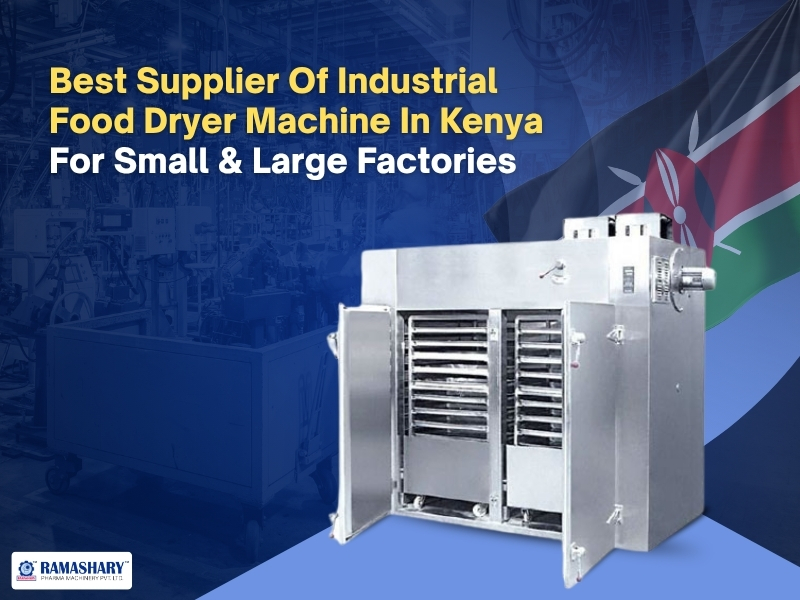
2.Tray Dryer
A Tray Dryer in Visp or across any other region can be used to remove moisture from pharmaceutical powders, granules, crystals and other suitable solid materials. The challenge is not simply removing water. The product must be dried without unnecessarily damaging heat-sensitive ingredients or changing the physical properties of the material.
The material is placed in trays and arranged inside the drying chamber. Heated air is circulated through the chamber. The air transfers heat to the product. As the product temperature rises, moisture moves from the material into the surrounding air. The moist air is then removed from the chamber while fresh air continues circulating.
For pharma manufacturers looking for a customised Tray Dryer in Visp, Basel, Zurich or across any city in Switzerland, we provide machines with accurate temperature and airflow control. Thus, desired results can be obtained without batch rejections.
Applications
- Active ingredients and intermediates
- Herbal pharmaceutical preparations
- Dry pharmaceutical powders
- Tablet granules
- Crystalline pharmaceutical materials
3. Ribbon Blender
A Ribbon Blender is used to mix powders, granules and other dry materials where the formulation needs thorough redistribution of ingredients throughout the batch. A Powder Blender Machine in Bern, Visp, Zurich or across any industrial hub is required when the manufacturer needs the active ingredient to be distributed consistently through the carrier material.
A Ribbon Blender has a horizontal trough containing a shaft fitted with ribbon-shaped mixing elements. When the shaft rotates, the ribbons move the product through the mixing chamber. The ribbon arrangement creates movement in different directions. Material is pushed, folded and redistributed as the mixer operates.
This repeated movement allows particles from different parts of the batch to come into contact with each other. The mixing time depends on the formulation and the required level of uniformity.
For manufacturers looking for a Powder Blender machine in Bern, Zurich or any city, we supply customised blending machines with accurate speed controls.
Very fragile granules may require a different mixing approach from heavier or more robust powders. Overmixing can also be undesirable for certain products. For this reason, the correct question is not simply whether a Ribbon Blender can mix the product. It is whether its mixing action suits that particular formulation.
Applications
- Nutraceutical powder blends
- Oral powder products
- Powder formulations
- Effervescent tablet formulations
- Capsule ingredient blending
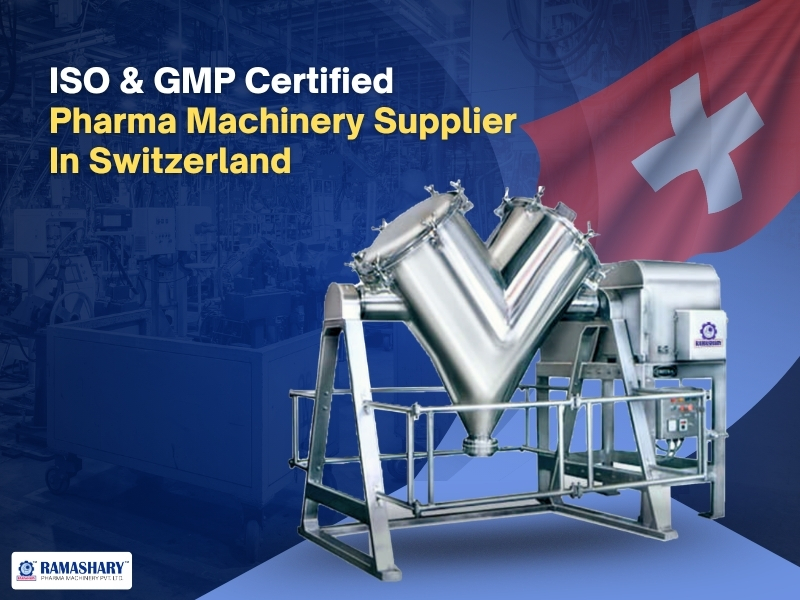
4. V Blender
A V Blender is used for gentle and uniform mixing of dry powders and granules. It is particularly useful when the formulation contains materials that need blending without unnecessarily aggressive mechanical action. The design is based on a V-shaped vessel that creates repeated movement and redistribution of the product during rotation, which makes it an ideal Powder Blender machine in Bern, Zurich, Basel and all other cities.
The V-shaped vessel rotates around its axis. As the vessel rotates, the material moves upward and then falls under gravity. The geometry of the vessel causes the material to divide and recombine continuously. This creates repeated cycles of particle movement.
Unlike a high-intensity mixer, the V Blender relies primarily on tumbling and particle redistribution. It is suitable for manufacturers looking for Powder Blender machine in Bern and across any city where gentle mixing is preferred.
Applications
- Pharmaceutical powders
- Dry granules
- Excipients and APIs
- Tablet premixes
- Nutraceutical powders
5. Liquid Manufacturing Plant
A Liquid Manufacturing Plant is used to manufacture pharmaceutical liquid formulations in a controlled and repeatable manner. A bottle of syrup may appear to be nothing more than a liquid inside a container. Manufacturing it consistently is a different matter.
The formulation may involve several ingredients that need controlled addition, dissolution, dispersion and mixing. That’s where we stand apart as the pharma machinery supplier in Switzerland by providing customised machines according to the requirements.
The manufacturing vessel is charged with the required liquid base. Ingredients are then added according to the formulation procedure. Soluble components can be added and mixed until they dissolve. Agitation keeps the contents moving and helps distribute the ingredients throughout the batch.
The sequence is important. Adding ingredients in the wrong order can create problems such as undissolved solids, localised concentration or inconsistent viscosity. This is why the manufacturing plant is designed around the process rather than simply around vessel capacity.
Applications
- Cough syrups
- Oral pharmaceutical solutions
- Oral suspensions
- Antacid liquids
- Paediatric liquid medicines
6. Vibro Shifter
A Vibro Shifter is used for screening, sieving and separating pharmaceutical powders and granules according to particle size. This is an important step because raw materials and processed powders do not always have a uniform particle size.
Oversized particles can affect downstream processing. Lumps can interfere with blending. Particles that are too large may affect flow and compression behaviour. A Vibro Shifter is an ideal pharmaceutical equipment in Basel, Zurich, Bern and across any industrial city to control this material condition.
The machine uses vibration to move material across a screen. The product is introduced onto the sieve surface. Vibration causes the material to move across the screen. Particles smaller than the selected mesh opening pass through. Larger particles remain on the screen and are discharged separately.
The screening action depends on factors such as mesh size, material characteristics, vibration intensity, feed rate, product moisture and particle shape.
Applications
- Screening pharmaceutical powders
- Sizing granules
- De-lumping
- Sifting excipients
- Sifting nutraceutical premixes
7. Ramashary's Automatic Tablet Coating Machine
Ramashary’s Automatic Tablet Coating Machine is used to apply a controlled coating layer over compressed pharmaceutical tablets. In a conventional coating process, several operating parameters need to be managed carefully during the batch. Spray rate, pan movement, drying air conditions and coating solution application all have a direct effect on the final tablet surface.
Ramashary’s Automatic Tablet Coating Machine is designed to bring greater control to these operations. This makes it an ideal pharmaceutical machinery in Zurich, Basel, Visp and all across Switzerland.
The tablets are loaded into the coating chamber, where controlled movement keeps the tablet bed in continuous motion. The coating formulation is introduced through the spraying system while conditioned drying air is circulated through the coating zone.
The tablets repeatedly move through the spray area. A thin quantity of coating material is deposited on their surfaces. The drying air helps remove the liquid portion of the coating formulation. This spray and drying cycle continues until the required coating level is reached. As a pharma machinery supplier in Switzerland, we customise the machine with proper controls for the airflow, speed, timing and temperature through the control panel.
Applications
- Film-coated tablets
- Taste-masked tablets
- Protective-coated tablets
- Colour-coated tablets
- Nutraceutical tablets
Are Long Drying Cycles Increasing Your Production Costs?
FAQs
1) Are customisation options available for small-batch clinical trial manufacturing?
Yes, Ramashary Pharma Machinery Pvt. Ltd. supports small-batch clinical trial manufacturing teams with customised, pilot-scale and laboratory-scale processing equipment. We also have a track record of successful site installations, which makes us a leading pharma machinery supplier in Switzerland.
2) What if our production capacity increases after we install the machine?
At Ramashary Pharma Machinery Pvt. Ltd., we analyse the manufacturer’s production goals, current processes, available space, customisation requirements and more before manufacturing and supplying pharmaceutical machinery in Zurich or any city. Thus, the machines are designed according to the scalability requirements with a focus on the future.
3) Do your machines support manufacturing multiple products in the same facility?
Yes, our machines are designed, engineered and manufactured for multiproduct versatility and various formulations. Also, they can be used as standalone equipment or integrated into the existing production line. These considerations make us an ideal pharma machinery supplier in Switzerland.
4) We are upgrading an old production line. Do we need to replace all our existing machines?
Not necessarily. An experienced pharma machinery supplier in Switzerland can help you make the right decisions. At Ramashary Pharma Machinery Pvt. Ltd., we first analyse your process, scalability goals and more and provide a consultation on process improvement. It saves you from unnecessary expenditure.
5) Why should I consider a single supplier for multiple machines at our plant rather than having different suppliers?
Having a single pharma machinery supplier in Switzerland saves you time and effort rather than having multiple vendors. This is because that supplier knows the machine configurations and can easily provide compatible spare parts when required, just as we do at Ramashary Pharma Machinery Pvt. Ltd.
Conclusion
The Swiss manufacturing industry demands precision and complete compliance with strict quality standards. To face high utility costs, strict validation audits and global logistics disruptions, plant heads and technical directors require a dependable and experienced machinery partner. Sourcing high-quality machines from a trusted pharma machinery supplier in Switzerland allows factories to achieve batch consistency and save costs over time.
For pharmaceutical manufacturers looking for a machinery partner rather than a one-time supplier, Ramashary Pharma Machinery Pvt. Ltd. brings together manufacturing capability, engineering support, machine customisation and long-term solutions. The goal is straightforward. Build equipment around the manufacturing process and be a business growth partner for any pharma manufacturer across the globe, rather than just a supplier.
Let’s connect now and discuss the right manufacturing solution for your production floor.