

Find reliable food machinery in Norway with advanced solutions for food processing, fruit and juice production, and seafood industries. Our range includes food processing machinery in Oslo, juice processing equipment in Norway, sifter machine in Rjukan, and rapid mixer granulator in Notodden, making us a dependable food machinery supplier in Norway for modern processing needs.
More production needs more than just more machines.
Norway’s food and beverage manufacturing sector is facing a changing business environment due to evolving consumer preferences, rising operating costs and strict health and safety regulations. Norwegian food and beverage manufacturers must adapt to growing demand for sustainable foods, functional beverages and high-grade seafood while managing high domestic labour costs and strict environmental guidelines set by Mattilsynet.
To remain competitive and scale production output effectively, manufacturers require advanced beverage and food machinery in Norway for small-scale and large-scale manufacturing.
Overview Of The Food & Beverage Industry In Norway
Can Your Existing Machines Handle High Batch Volumes?
Market Trends In Norway’s Food & Beverage Industry
1. Prices Affect The Buying Decision
2. Health & Nutrition Influence Product Development
3. Prioritisation To Local & Norwegian Products
4. Convenience Is Creating More Demands On Processing
5. Sustainability Is Important In Production
6. Automation Is Becoming A Practical Response To Production Costs
7. Export Demand Is Encouraging More Value-Added Processing
Challenges In Norway’s Food & Beverage Industries
1. High Operational Labour Costs & Workforce Scarcity
2. Strict Food Hygiene & Equipment Requirements
3. High Energy Consumption
4. Need For More Processing Capacity
5. Material Recovery & Yield Efficiency
6. Cross-Contamination Risks During Product Changeovers
7. Spare Parts Availability
This is particularly important in Norway’s large seafood-processing ecosystem. The Norwegian government reports that the seafood sector employed approximately 21,300 people in 2024 and generated NOK 175 billion in seafood export value, underlining the economic importance of maintaining reliable production infrastructure.
Is Your Manufacturing Facility Facing High Energy Costs?
Best Beverage & Food Machinery Supplier In Norway
Ramashary Pharma Machinery Pvt. Ltd. (an ISO & GMP certified company) is a manufacturer, supplier and exporter of high-precision food machinery in Norway. With global export capabilities, 40+ years of experience and 700+ site installations, we have become a dependable machinery partner across 20+ industries. Thus, besides the food and beverage industry, these machines can be used across the chemical, pharmaceutical, cosmetic, fertiliser and other industries.
1. Reducing Manual Intervention Through Process-Focused Automation
2. Hygienic Equipment Around Food-Safety Requirements
3. Energy-Efficient Machines
4. Support For Scalability
5. Wastage Reduction
6. Easy Product Changeovers & Cleaning
7. Reduction In Downtime
Do Your Existing Machines Help You Solve Production Challenges?
Best Beverage & Food Processing Machines In Norway
1. Liquid Manufacturing Plant
The Liquid Manufacturing Plant contains a closed-circuit processing system for liquid preparation. The plant consists of an ingredient preparation vessel, a main manufacturing vessel, an inline homogeniser, a zero hold-up filter press, and a control panel. It is ideal for manufacturers looking for beverage or juice processing equipment in Norway.
Step-by-Step Operational Workflow
- Liquid bases and sweeteners enter the jacketed preparation vessel for heating and initial dissolving.
- The pre-mixed liquid transfers through sealed piping into the main manufacturing vessel.
- Flavourings, active nutrients or fruit concentrates load through dust-free ports.
- The bottom homogeniser and top anchor agitator work to form a stable liquid emulsion.
- Liquid recirculates through the inline homogeniser loop while sensors monitor batch temperature.
- Once homogenisation is complete, the product passes through the Zero Hold Up Filter Press to remove micro-particulates.
Applications
- Clarified fruit juices and berry juice blends
- Flavoured beverage syrups and liquid concentrates
- Liquid nutritional supplements and wellness tonics
- Bases for dairy and non-dairy beverages
2. Mass Mixer
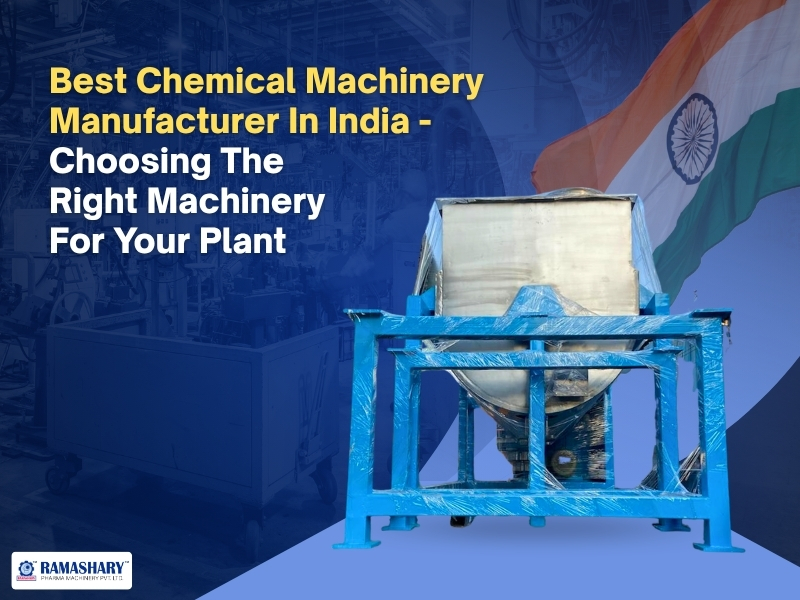
The Mass Mixer is a heavy-duty mixing machine designed to process dense, sticky or viscous wet and dry masses. The unit features a rigid horizontal U-shaped trough housing a single-paddle agitator blade driven by a heavy-duty gear motor.
Step-by-Step Operational Workflow
- Operators load dry powders and solid ingredients into the open trough and secure the safety cover.
- The drive system rotates the paddle blade at low speed to dry-blend base powders.
- Liquid binders, oils or fruit extracts are added later.
- The paddle folds and kneads the material until reaching a uniform, moist consistency.
Applications
- Processed pastes, fish cakes and seafood mixes
- Bakery dough bases and dense confectionery pastes
- Wet spice seasonings, sauce bases and marinades
- Moist cereal masses and energy bar formulations
3. Vibro Shifter
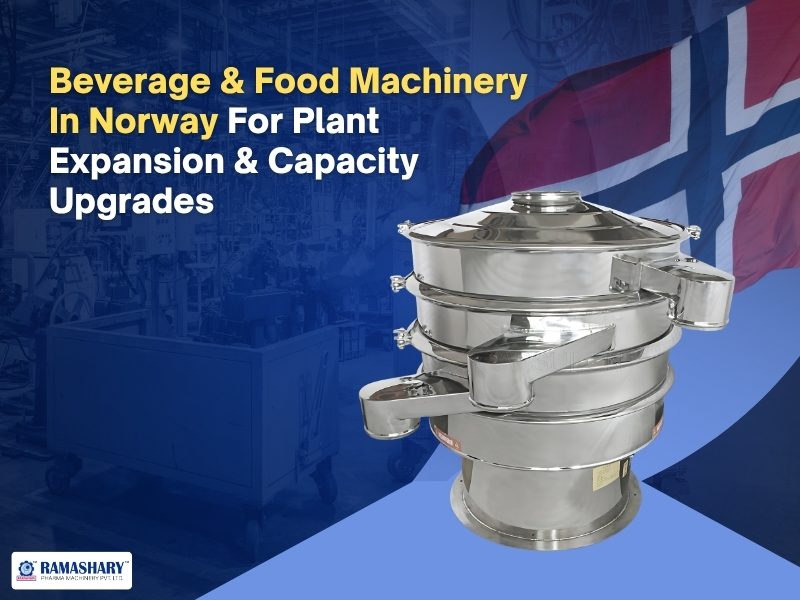
The Vibro Shifter is a high-precision sifting machine designed to classify, separate and de-lump fine powders. As a food machinery supplier in Norway, Ramashary Pharma Machinery Pvt. Ltd. provides Vibro Shifters built with high-grade SS 304/316L. It includes a screening deck, a vibration motor, tensioned wire mesh screens and springs mounted on a rigid base. Deploying a sifter machine in Rjukan, Oslo, Notodden or any facility on active processing lines ensures consistent particle size distribution.
Step-by-Step Operational Workflow
- Raw powders or liquids feed into the top inlet port.
- The vibratory motor drives multi-directional oscillation across the tensioned mesh screen.
- Required particles pass downward through screen openings into the main discharge chute.
- Agglomerates and oversized materials travel outward, exiting through the other discharge port.
Applications
- Sifted bakery flours, starches and baking agents
- Powdered milk, whey protein and infant formula bases
- Ground coffee, cocoa powder and fine spice mixes
- Strained fruit juices and liquid beverage bases
4. Rapid Mixer Granulator (RMG)
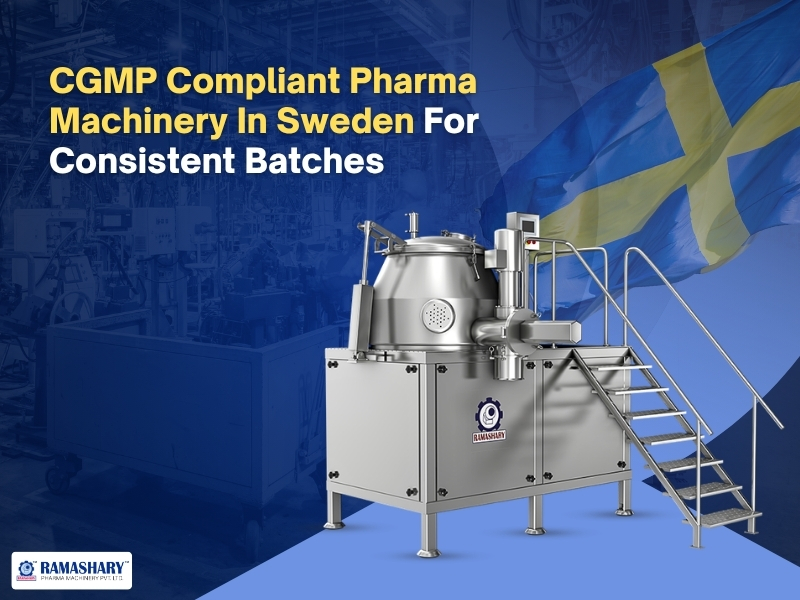
The Rapid Mixer Granulator (RMG) is a high shear wet granulation machine designed to convert light powders into dense granules. The machine features a dome-shaped stainless steel mixing bowl housing an impeller and a side-mounted high-speed chopper blade.
Step-by-Step Operational Workflow
- Dry powders enter the sealed bowl through controlled loading ports.
- The impeller rotates at a defined speed, uniformly blending powders before granulation.
- Binder solution is introduced into the moving powder bed at a controlled rate.
- The high-speed chopper breaks agglomerates and develops uniform wet granules.
- Once the granulation endpoint is achieved, the discharge valve transfers wet granules for drying.
Applications
- Granulated instant soups, stocks and bouillon bases
- Compressible sweetener tablets and flavour tablets
- Effervescent beverage powders and drink mixes
- Granulated plant-based protein extracts
5. Steam Heated Paste Kettle
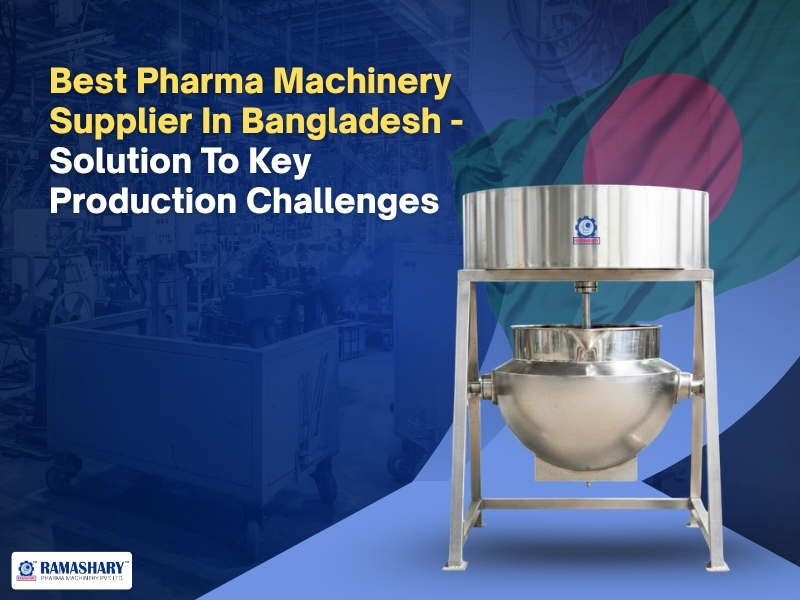
The Steam Heated Paste Kettle is a hemispherical processing vessel designed for thermal cooking, heating and blending viscous liquid bases. The vessel features an outer steam jacket, a motor-driven anchor agitator and a tilting discharge mechanism.
Step-by-Step Operational Workflow
- Liquid bases, starches or fruit purees are charged into the kettle bowl.
- Steam valves open, circulating saturated steam through the outer jacket.
- The anchor agitator sweeps material from the walls, ensuring uniform heat distribution.
- Temperature sensors monitor cooking conditions to achieve consistent starch gelatinisation.
- Steam shuts off, cooling water circulates through the jacket if required and the vessel tilts for product discharge.
Applications
- Cooked fruit jams, jellies and fruit fillings
- Thickening starch pastes for bakery and sauce lines
- Chocolate fillings, caramel bases and confectionery glazes
- Culinary sauces, gravies and soup bases
6. Fluid Bed Dryer (FBD)
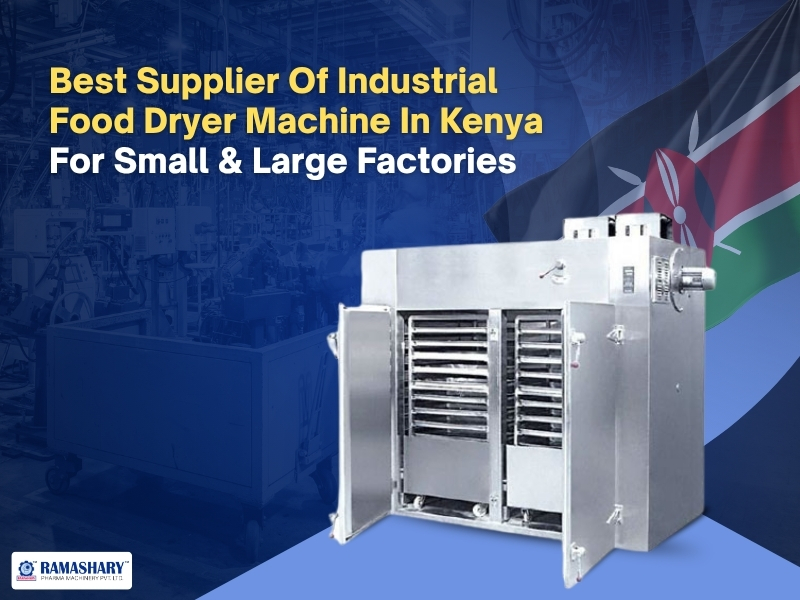
The Fluid Bed Dryer (FBD) helps reduce moisture content in granular materials and powders. The equipment consists of an air handling unit, steam heating coils, a perforated stainless steel product bowl, filter bags and an exhaust blower.
Step-by-Step Operational Workflow
- A trolley containing wet granules enters the FBD chamber and seals.
- The main blower engages, forcing heated filtered air through the product bed.
- Granules fluidise uniformly as moisture evaporates under controlled airflow and temperature.
- Moisture sensors indicate the endpoint; heating stops, ambient air cools the product and the trolley disengages.
Applications
- Dried food granules and instant soup powders
- Dehydrated herbs, spices and botanical extracts
- Dried dairy powders, whey proteins and malted extracts
- Granulated breading, starch flakes and seasoning mixes
7. Multi Mill
The Multi Mill is a size reduction machine designed for wet and dry milling, grinding and granulating. It is an ideal food processing machinery in Oslo, Notodden, Rjukan and all across Norway that consists of a central milling chamber, a rotor shaft fitted with swing hammer blades, a cylindrical screen and a variable-speed motor.
Step-by-Step Operational Workflow
- Operators select and install a cylindrical screen with the required perforation size.
- The motor direction is set to select knife or impact blade geometry.
- Raw materials feed into the top inlet hopper at a controlled rate.
- High-speed rotating blades shear or crush particles against the surrounding screen wall.
- Required particles pass through screen openings, discharging cleanly into holding bins.
Applications
- Ground spices, culinary herbs and seasonings
- Pulverised sugar crystals for confectionery coatings
- Granulated breadcrumbs and crushed bakery reclaim
- Milled marine proteins and dried seafood powders
Is Your Drying Process Providing The Desired Moisture Levels?
FAQs
1. What batch sizes can your food processing equipment handle?
2. Can your equipment reduce manual product transfer?
3. Can we use the same kettle for different food formulations?
4. Can you design the equipment for limited floor space?
5. Are these machines compatible with IoT?
Conclusion
Let’s connect now for a consultation.