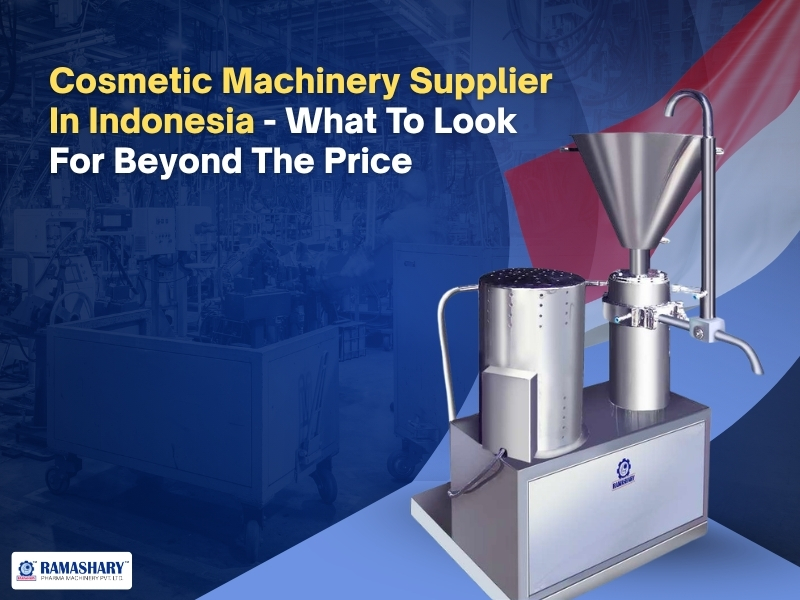
Cosmetic Machinery Supplier In Indonesia – What To Look For Beyond the Price
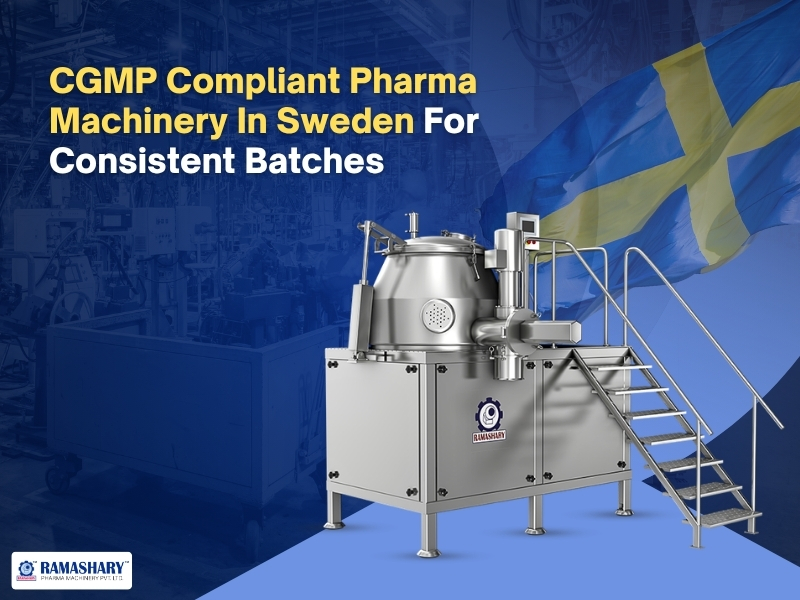
CGMP-Compliant Pharma Machinery in Sweden Looking for reliable pharma machinery in Sweden? We provide high-quality pharmaceutical solutions for manufacturers seeking a trusted pharma machinery supplier in Sweden, with equipment designed for efficient, consistent, and hygienic production. Our range of pharmaceutical equipment in Stockholm supports diverse manufacturing requirements, while businesses searching for a ribbon blender in Uppsala can benefit from advanced mixing solutions for uniform batch processing. As experienced pharmaceutical machinery suppliers in Sweden, we offer a range of equipment including rapid mixer granulator systems and solutions for manufacturers looking for a tablet manufacturing machine in Gothenburg, helping pharmaceutical companies improve productivity, process efficiency, and overall manufacturing performance. If you are a plant head in Ankleshwar or a procurement lead in Mumbai reading this because a batch failed again, you know the truth.The hardest problem in Indian chemical manufacturing today is not demand. It is repeatability. Demand is strong. Orders are coming. What breaks the month is a blender that leaves dead zones, a dryer that gives a moisture spread of 3% across the bed or a sifter that chokes on a sticky intermediate. That is exactly why the search for the right chemical machinery manufacturer in India has become a board-level conversation rather than a purchase-order formality. The machine you buy this quarter will define your yield, your audit readiness and your cost per kilogram for the next 5 years. India’s Chemical Industry – An Overview India’s chemical sector has grown into one of the largest in the world. However, a very large share of its installed base is still ageing, semi-manual and built for a time when nobody asked for batch traceability.Buyers used to ask one question: what is the price per unit capacity? Now they ask 5. What is the material of construction? Is it CGMP compliant? Can you validate it? Will you share the documentation set? Can you install it and train my operators? Those 5 questions are the reason a good chemical processing equipment manufacturer in India is no longer a vendor. That firm is a risk-management partner. A speciality chemical plant in Vapi exporting dye intermediates to Europe has to prove its process is controlled. An API intermediate unit in Hyderabad supplying a regulated market has to demonstrate cleanability and cross-contamination control. A fine chemicals unit in Vadodara handling a solvent-wet cake needs a closed drying route because open handling is both a safety hazard and a solvent loss.Off-the-shelf machines rarely fit these realities. This is why genuine chemical equipment manufacturers in India now design around the product rather than around a catalogue page. There is a second pressure that most buyers underestimate. Product mix is changing faster than plants can adapt. A unit that made 3 products in 2018 now makes eleven. Campaign lengths are shorter. Changeovers are more frequent. Equipment that cannot be stripped, cleaned and reassembled quickly quietly eats a huge percentage of your available capacity. Experienced chemical process equipment manufacturers in India design for changeover time as carefully as they design for throughput, because that is where hidden capacity lives. Building A New Chemical Processing Line? Talk To Our Process Engineering Team Statistics For India’s Chemical Industry Before you shortlist a single supplier, it helps to see the scale you are operating inside. The numbers explain why equipment quality has become a competitive asset rather than a cost line.India ranks as the world’s sixth-largest chemical producer and holds the third position in Asia. The sector contributes approximately 7% to the country’s GDP. Valued at nearly US$250 billion in 2024, India’s chemicals market is projected to grow to reach around US$1 trillion by 2040. That trajectory is not a gentle slope. It is a doubling and then a tripling inside a working career. The Indian chemical industry employs over two million people and accounts for roughly 2.8 to 3% of the global chemical industry. The sector is highly diversified, covering more than 80,000 commercial products across bulk chemicals, agrochemicals, speciality chemicals, polymers, petrochemicals and fertilisers. Eighty thousand products is the single most important statistic for anyone buying chemical machinery in India. It means no two processing lines are alike. It also means a generic machine will underperform on most of them. 1. Investment In The Chemical Sector India’s chemicals sector has received approximately US$23.21 billion in cumulative FDI equity inflows from FY2000-01 to FY2024-25. India contributes around 2.5% of global chemical sales and exports chemical products to over 175 countries. Export exposure changes everything about equipment specification. An overseas client will ask for documentation you cannot generate from an undocumented machine. That is the practical reason buyers now filter for chemical equipment manufacturers in India who provide end-to-end documentation rather than a single-page drawing. 2. Speciality Chemicals Are Growing Speciality chemicals represent approximately 20% of the global chemicals market, valued at around US$4 trillion. India’s speciality chemicals market has been projected to grow at a CAGR of about 12%. Its net exports could increase nearly tenfold, from approximately US$2 billion in 2021 to US$21 billion by 2040. Agrochemicals, dyes and pigments, cosmetics and personal care and food ingredient chemicals are expected to account for nearly 80% of speciality chemical exports. Speciality chemistry is low-volume, high-value and highly sensitive. Particle size matters. Residual moisture matters. Blend uniformity matters. These are precisely the parameters a well-designed blender, granulator, dryer or sifter controls. A competent chemical machinery manufacturer in India partner is therefore directly tied to your margin, not just your capex. India’s chemical manufacturing activity is largely concentrated in Maharashtra and Gujarat, while West Bengal and Tamil Nadu are also key production centres. The country ranks as the world’s fourth-largest agrochemical producer and manufacturer. Why This All Points Back To Machinery Put the numbers together and a clear picture emerges: A market heading towards US$ 1 trillion by 2040 cannot be served by manually controlled, undocumented equipment. More than 80,000 products means customisation is the default requirement, not a premium add-on. Export orientation to 175-plus countries makes compliance documentation non-negotiable. Speciality growth means