Canada’s food and beverage processing industry is the country’s largest manufacturing sector. Reportedly, in 2022 it recorded sales of goods manufactured worth $156.5 billion; it accounted for 18.2% of total manufacturing sales and for 1.7% of the national Gross Domestic Product (GDP).
Reportedly, it is also the largest manufacturing employer and provides employment for approximately 300,000 Canadians. That is the scale of the market you are competing in.
The sector is broad and deep. The industry was made up of nearly 15,000 establishments in 2024, contributed $35.2 billion to GDP in 2023 and directly employed over 315,000 people in 2024. Around 8,800 of these are processing businesses that employ at least one person, and the vast majority are small or medium-sized, with roughly 91% having fewer than 100 paid employees. In other words, most food processing equipment in Canada is bought by SMEs who cannot afford a machine that fails.
Exports matter too. Canadian processed food and beverage exports reached a record of nearly $60 billion in 2024 and account for a significant share of total national exports. Around 70% of all processed food and beverage products available in Canada are sourced domestically.
That domestic strength is exactly why demand for reliable food equipment in Canada keeps rising. If you make it here, you need machines that meet Canadian food safety expectations and export-market standards at the same time.
The mix of products is led by meat. Reportedly, Canada’s leading processing sectors in 2024 were meat products at roughly $30 billion (26%), followed by dairy, bakery and tortilla, and other food products at about $13 billion each (11%).
This is important context for anyone looking for meat processing equipment in Canada or blending and drying gear for protein products. Meat, dairy and bakery depend on precise mixing, cooking, coating and drying.
Here is the tension. While the market is large, growth is not being driven by consumption. The food and beverage manufacturing sales are reportedly expected to increase 0.8 per cent in 2026, driven by higher prices, while sales volumes are expected to decline by 0.7 per cent, marking a fourth consecutive year of falling volumes.
The gap between modest sales growth and declining volumes highlights the demand challenge facing food manufacturers. When you sell fewer units at higher cost, every point of yield, every avoided rejection and every hour of uptime matters more. That is the commercial case for high-quality food processing equipment in Canada in one sentence: when volumes are soft, efficiency is survival.
So the need is clear. Canadian manufacturers need customised, hygienic, GMP-aligned food equipment in Canada that raises yield, protects food safety and lowers cost per unit. Also, they need a food machinery manufacturer and supplier who will stand behind it.
The machines you buy today have to fit the market of tomorrow. Here are seven trends pushing food manufacturers toward better food equipment in Canada.
Canada’s food story is regional. Here is how the sector looks in some major hubs and why each one needs high-quality food processing equipment in Canada.
Some 25,000 jobs sit in food processing inside the city, about 12% of total industrial employment. The wider Toronto region’s food and beverage sector employs more than 64,000 workers with annual wages of about $3.2 billion.
Just west, Brampton was ranked Canada’s top food and beverage processing cluster by Business Facilities Magazine in its 2026 Global Rankings. Brampton’s food and beverage industry contributes more than $1.3 billion to Canada’s GDP, with about 8,500 people across 300 companies being employed.
Mississauga is described by its economic development office as one of Canada’s largest food and beverage clusters, hosting a dense network of manufacturers and distributors. For plants across the GTA, competition for shelf space and labour is fierce, so reliable food equipment in Canada is a baseline requirement.
For machinery suppliers, the size of this market matters because manufacturers across these categories require food processing equipment Canada for mixing, blending, processing, drying, handling and related production operations.
Reportedly, Quebec’s total manufacturing revenue reached $228.1 billion in 2024, an increase of 0.4%. Within the province’s manufacturing sector, food manufacturing was one of the major subsectors, although its revenue declined by approximately $0.6 billion during the year.
This creates an interesting situation for food manufacturers. The market is large, but manufacturers cannot simply rely on market expansion. Production efficiency, consistent output and better utilisation of food processing equipment in Canada become increasingly important when manufacturers are operating in a competitive environment.
By sales, food and beverage processing ranks as British Columbia’s second-largest manufacturing sector. In 2021, the industry generated more than C$12.6 billion in sales, contributed approximately C$3.6 billion to the province’s GDP and supported employment for over 40,000 people across B.C.
The Lower Mainland, which includes Metro Vancouver, represents the highest concentration of the sector in the province and is particularly known for its production of dairy products, seafood, functional foods, bakeries, and craft beverages.
A report identifies meat product manufacturing as British Columbia’s highest-grossing food-processing subsector in 2022, with sales of approximately C$2.2 billion. Dairy processing followed closely at C$2.1 billion while animal food manufacturing recorded around C$1.3 billion in sales. This diverse, quality-focused base is a strong market for hygienic food processing equipment in Canada.
Alberta is investing heavily in agri-food innovation and digital transformation, positioning the province as a technology-forward market for automated food equipment in Canada. Beef, grain milling and speciality foods anchor the local processing.
On the other hand, Winnipeg’s protein and plant-processing strength makes it a prime market for blending, drying and mixing equipment.
The cost of food processing equipment does not end with the purchase order. For a food manufacturer, the real cost is determined by how the food processing equipment Canada performs throughout its operating life. Energy consumption, labour requirements, processing time, product losses, maintenance and downtime can all influence the cost of every batch.
A machine with a lower purchase price may not always be the more economical option if it increases operating costs over time.
When a food machinery supplier in Canada is to be selected, the equipment should therefore be evaluated not only on its rated capacity but also on how its operating cycle fits into the overall production process.
The design of the food machinery in Canada should therefore be based on how materials move through the process and how effectively the product can be discharged after processing.
When comparing food machinery in Canada, manufacturers should consider the complete batch cycle rather than looking only at processing time.
These are the problems that keep plant managers up at night. Each one strengthens the case for the right food machinery manufacturer and supplier.
When skilled workers are difficult to find, manufacturers need to improve productivity through efficient processes, reliable food processing equipment Canada and better use of available operators.
Every product changeover is lost production time and every incomplete clean is a contamination risk. Food processing equipment in Canada that is hard to sanitise slows the whole plant and threatens food safety. Fast, hygienic cleaning and CIP/SIP ease is a competitive advantage.
The first thing to be noted is that manufacturers do not just need a machinery provider. They need a long-term food machinery supplier in Canada who provides end-to-end solutions and helps solve the factory-floor challenges.
With 40+ years of experience, 700+ site installations, 20+ industries served and a portfolio of 20+ dedicated machines, we are a food machinery manufacturer that supplies and exports worldwide. It includes key cities and provinces in Canada such as: Toronto, Montreal, Vancouver, Manitoba, British Columbia, Quebec, Ontario, etc.
For food and beverage plants, we provide equipment for mixing, blending, granulating, heating, coating, drying and liquid manufacturing and we customise each machine to the product and the scale of the business. We provide end-to-end solutions: customisation, site installation, assured spare parts, documentation, operator training and more. That is why the company positions itself as a growth partner rather than only the supplier of food processing equipment in Canada.
Here is how Ramashary Pharma Machinery Pvt. Ltd. helps with each of the challenges above.
After installing the FBD machine or a Ribbon Blender in Canada, handling it should be easy. Though we provide advanced and automated food processing equipment in Canada, we make sure that they remain easy to handle. For that, we provide commissioning, operator training and instruction and maintenance manuals. Also, the machines are designed with operator safety and ease of use at the core.
We use SS 304/316L and make sure that the machines perform closed-system processing and transfer to avoid human touch and contamination. All these factors help the food manufacturers maintain compliance and quality, which positions us as a leading food machinery supplier in Canada across Montreal, Toronto, Ontario, Vancouver, Winnipeg, etc.
But what makes our approach different is that we don’t just provide food processing equipment Canada. We provide solutions to your challenges. Thus, the machines are designed while considering the regional challenges across Toronto, Quebec, Montreal, Vancouver, Ontario, British Columbia, etc.
All these factors help achieve batch-to-batch consistency over time. To install a machine, the whole production line doesn’t need to be changed, as these machines can be used as standalone equipment or integrated into the existing production lines. Overall, it helps with controlling the costs, which positions us as a leading food machinery supplier in Canada.
That’s where Ramashary Pharma Machinery Pvt. Ltd. turns out to be an ideal food machinery supplier in Canada that provides long-term support for food manufacturers across Montreal, Winnipeg, Toronto, Vancouver, Manitoba, British Columbia, Ontario, Quebec, etc.
Such food equipment in Canada helps avoid the chances of contamination, which means that the output product follows the required standards.
Food manufacturers need equipment that can keep up with demanding production schedules, varied ingredients and the need for consistent processing. The right food machinery in Canada can influence batch uniformity, processing time, material handling and overall plant efficiency.
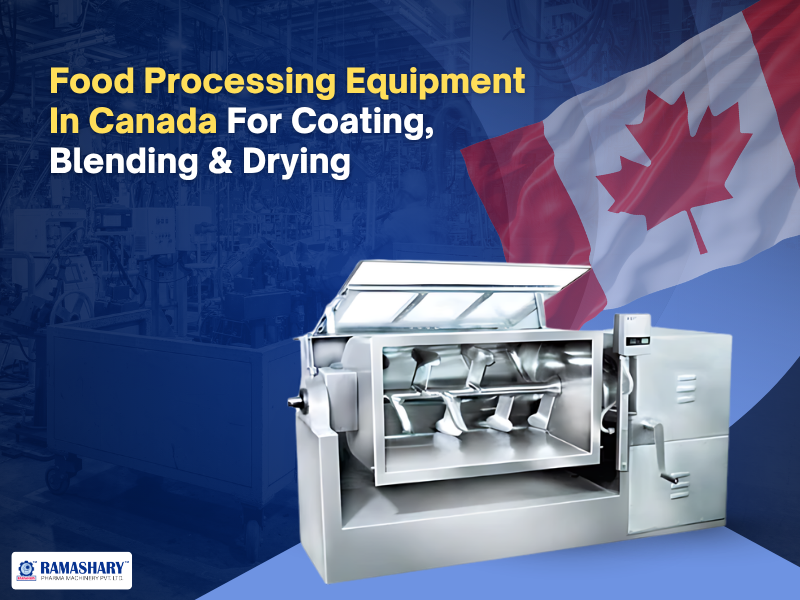
The ribbons are positioned to move material throughout the trough with no isolated zones, which gives a smooth, homogeneous end product and rapid discharge. We offer Ribbon Blender in Canada with capacities from 50 litres to 12,000 litres, so a small speciality processor and a large plant can both be served.
It handles dry powders and semi-solid materials. Real food products made with a Ribbon Blender in Canada include spice and seasoning blends, cake and bread mixes, flour blends, protein and drink premixes, dry soup mixes and dry seasoning for meat processing.
For anyone looking for a Ribbon Blender in Canada, this triple-action design is what provides batch-to-batch consistency.
It produces homogeneous mixtures of viscous and difficult substances. An interlocking mechanism prevents accidents, and easy unloading is achieved through the tilting device. In food plants, it is used for making juices, flour, creams and dough, spice blends and premixes and it supports meat processing lines by mixing seasonings and marinade bases uniformly.
Because it reduces manual handling, the Mass Mixer is a practical food processing equipment in Canada to handle challenges on the factory floor.
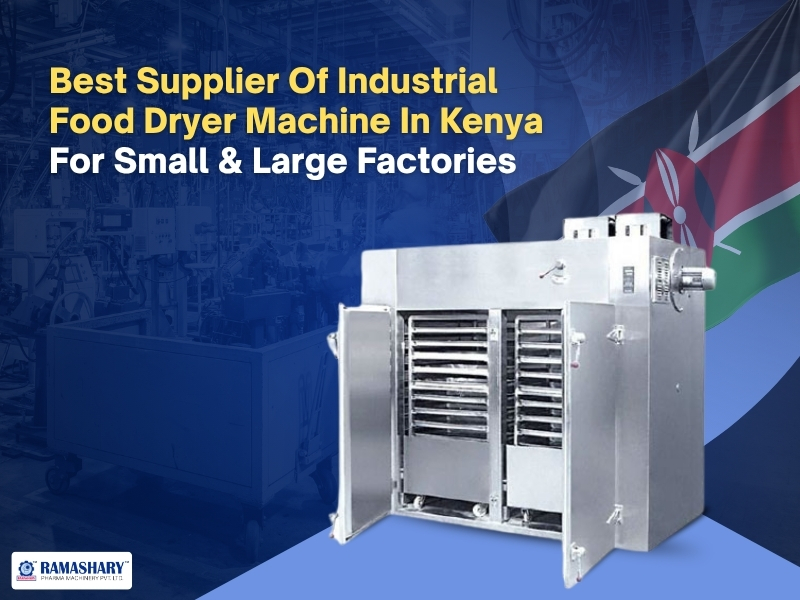
Heat-sensitive materials that can decompose or oxidise can be dried gently. The dryer handles herbs, granules and powders. It is easy to sanitise and clean to avoid cross-contamination between batches.
Real food products dried on a food dehydrator machine in Canada include dried fruits, dried vegetables, herbs, spices, tea leaves, nuts and dried or jerky-style meat products. For manufacturers looking for a food dehydrator machine in Canada, the easy-clean design is what protects food safety between runs.
It is well balanced even at higher capacities. This food equipment in Canada blends dry powders such as dairy powders, bakery premixes, drink powders and dry blends where gentle, uniform mixing matters. This gentle approach suits products that must hold quality without heavy processing.
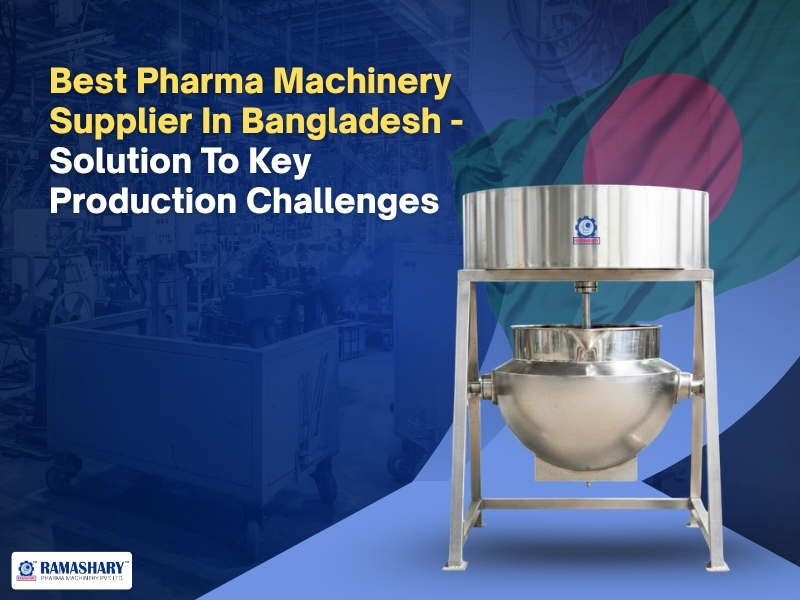
Ramashary Pharma Machinery Pvt. Ltd. offers capacities from 10 litres to 500 litres. The steam jacket provides uniform heating and operators control temperature to reach the perfect consistency. It handles semi-solid and sticky materials, so real food products include sauces, syrups, soups, tomato ketchup and confectionery, plus sauce and marinade bases used in meat processing.
When gentle, controlled heating protects flavour and nutrients, this food processing equipment in Canada earns its place on the line.
Its stainless steel construction ensures hygiene. In the confectionery and snacks industry, it coats products with sugar or chocolate, so real food products include coated nuts, candies, chocolates and coated snacks. For any food manufacturer making value-added coated products, this food equipment in Canada provides the uniformity that buyers expect.
During operation, the ingredients are loaded into the V-shaped vessel through the charging port. As the chamber rotates, the powders move along different paths and continuously mix through tumbling and gravitational movement.
Depending on the formulation and process requirements, mixing aids can be incorporated to improve blending performance for certain materials. Once the required uniformity is achieved, the blended material is discharged through the outlet.
Such food processing equipment Canada is widely used for pharmaceutical formulations, food ingredients, nutraceuticals, chemicals and other dry powder applications. At Ramashary Pharma Machinery Pvt. Ltd., their capacity ranges from 10 L to 5,000 L according to the requirements. Their enclosed design helps minimise material exposure during processing while supporting consistent batch-to-batch mixing.
Canada’s food and beverage industry is the largest manufacturing sector in the country. Yet the sector is under real pressure. Volumes are shrinking even as revenue rises, labour is scarce, capital investment slipped in 2025 and recalls remain a constant threat.
From the food clusters of Toronto, Mississauga, Quebec and Brampton to the processing hubs of Montreal, Vancouver, Calgary and Winnipeg, the message is the same. Food manufacturers who want to compete need efficient, hygienic and reliable food processing equipment in Canada and they need a partner who will help them get more from every batch.
That is where Ramashary Pharma Machinery Pvt. Ltd. fits. We design, engineer and manufacture customised and CGMP-compliant machines for 20+ industries, including the food industry. Backed by site installation, spare parts, documentation, operator training and global export experience, we work as a long-term business growth partner, more than just a food machinery supplier in Canada.