
Ramashary.com

Walk into any tablet or ointment manufacturing unit in the Philippines and you will notice something. The line supervisor is not talking about sales targets. He is talking about humidity readings, batch rejections and whether the new SKU can be scaled up before the next audit. That is the real, everyday pattern of pharmaceutical manufacturing in the country right now.

The Philippines pharmaceutical market reached a size of USD 3.36 billion in 2025 and is projected to grow to USD 3.91 billion by 2034 at a compound annual growth rate of 1.71%. It sounds good on paper but hides many challenges, which require high-quality and customised pharma machines in Philippines.
Healthcare expenditure reached PHP 1.20 trillion in 2022, with per capita spending around PHP 10,059.49. The demand is not slowing down even while the supply side struggles to keep up with quality, capacity and compliance. This is exactly the environment where the choice of pharma machines in Philippines becomes important. A tablet that cracks during coating, an ointment batch that separates in the tank, a dryer that cannot remove humidity are the reasons a company misses a hospital tender, fails a GMP audit or loses a contract manufacturing client.
That is why more plant heads, technical directors and procurement managers across the country are now actively searching for the best pharma machines in Philippines rather than settling for whatever is locally available or convenient.
Today, partnering with a dependable pharma machinery supplier in Philippines is less about brand preference and more about protecting batch consistency, audit outcomes and business relationships.

Overview Of The Pharmaceutical & Healthcare Industry In The Philippines

The Philippines is not a small market, though it is sometimes treated as one compared with Indonesia or Vietnam. As of August 2025, there were 278 registered drug manufacturers in the country. The supply side is currently a mix of multinational companies alongside strong domestic names. Multinational companies primarily market and distribute finished products along with raw and intermediate materials.
Local pharmaceutical firms often play more diverse manufacturing roles. That diversity of roles, from formulation to packing and full-scale production, is precisely why the demand for pharmaceutical processing machinery in Philippines has increased.

The Philippine Economic Zone Authority areas contain 14+ multinational pharmaceutical companies that have already established operations. PEZA has also gone a step further by issuing guidelines for dedicated Pharmazones. These zones are for companies involved in medical and drug manufacturing.

The Board of Investments has been targeting USD 2 billion in pharmaceutical revenue. However, the gap between rising demand and shrinking export competitiveness is a warning sign for local manufacturers. It means the pharmaceutical processing machinery in Philippines should meet export-grade GMP standards. This is the quiet reason why sourcing the best pharma machines in Philippines has become a boardroom topic and not just a plant floor one.

Trends In The Pharmaceutical & Healthcare Industry In The Philippines

A few clear patterns are showing how Filipino manufacturers plan their next three to five years.

1. Local Manufacturing Over Importing

Government healthcare reforms, encouragement of local pharmaceutical manufacturing and adoption of digital technologies are together encouraging companies to build or expand their own production lines. This directly increases demand for advanced pharma machinery in Manila and the surrounding industrial belt. This is because Manila remains the commercial and logistics anchor for most manufacturers.

2. Dedicated Pharma Economic Zones

Specialised pharmaceutical zones are increasing capacity for drug manufacturing and innovation. These zones improve collaboration between manufacturers and regulatory bodies. Thus, faster market entry and product quality improvement become easier.

3. Generics & Affordability Pressure

There is a surging demand for affordable generics, expanding over-the-counter and herbal remedies and a growing reliance on digital and online pharmacy services. Producing generics profitably means every failed batch eats directly into a thin margin. This is why manufacturers now think hard before choosing between a Ribbon Blender in Philippines or any other machine built for GMP compliance.

4. Out-of-Pocket Spending Keeps Demand High

The Philippines is among the countries in the Asia Pacific region with the highest out-of-pocket health expenditures. Household out-of-pocket payments represented 42.7% of all health spending in 2024. This keeps pressure on manufacturers to produce more units at lower unit cost without compromising on quality. It is a balance that only well-designed pharmaceutical processing machinery in Philippines can hold.

5. Import Dependency On APIs & Finished Goods

The Philippines heavily depends on imported pharmaceutical products and active ingredients. As local API processing grows, the country will need more granulation, blending and drying capacity domestically, not just formulation lines.

6. Rising Medical Inflation

Medical inflation in the country climbed to 19.3% during 2024, according to industry reports. It pushes both public and private buyers towards cost-efficient generics manufactured at scale, again raising the bar for throughput and reliability on the factory floor.

7. Digital & AI Adoption On The Shop Floor

AI-powered data analysis is being used to optimise research, manufacturing and supply chain operations within the pharmaceutical economic zones. It means that newer machines with PLC and HMI control are quickly becoming the baseline expectation rather than a premium feature.
Taken together, these seven trends point to one practical conclusion: the companies that treat pharma machinery in Manila or any city as a strategic decision are the ones best positioned to benefit from this growth. That strategic mindset is exactly what encourages the current search for the best pharma machines in Philippines.

Increase Your Domestic Manufacturing Capabilities With Complete Support

Need For The Best Pharma Machinery Supplier In Philippines

Most conversations about pharma machinery in Manila actually start somewhere else, because Manila is the commercial, banking and logistics anchor rather than the physical factory location for several manufacturers.
Laguna’s industrial parks host a dense cluster of pharmaceutical and consumer health manufacturers. These manufacturers need drying and granulation equipment that can remove moisture from the product in the province’s long humid season. This is exactly the gap a well-engineered Fluid Bed Dryer in Laguna is meant to close.
Batangas, with its port access and growing industrial zones, has become an attractive base for semi-solid and personal care manufacturing. Thus, a dependable Ointment Plant in Batangas is a practical necessity.
Cavite’s economic zones host a significant share of the country’s tablet and capsule manufacturers. So, an advanced Tablet Coating Machine in Cavite often stands between a batch and a passed export audit.
Working with one pharma machinery supplier in Philippines that understands this geography, rather than juggling multiple regional vendors, keeps documentation, spare parts and after-sales support consistent across every site. This is exactly the kind of coordinated support a company looks for when it decides to finally get the best pharma machines in Philippines.

Challenges In The Pharmaceutical Industry In The Philippines

Every one of the trends above eventually lands on the factory floor. Below are seven challenges that come up again and again in conversations with pharmaceutical manufacturers across the country. Also, here’s why each one quietly points back to the need for high-quality, customised pharmaceutical processing machinery in Philippines.

1. Tropical Humidity Disrupting Powder & Granule Stability

The Philippines runs hot and humid for most of the year and that moisture does not stop at the factory door. Powders absorb moisture during transfer, granules clump before compression and coated tablets stick in the pan. Manufacturers running older dryers often see batch-to-batch variation simply because the weather changed that week.
This is one of the strongest arguments for investing in a high-quality Fluid Bed Dryer in Laguna or any other humid manufacturing belt. Fluidisation-based drying is far less sensitive to ambient moisture swings than tray-based methods.

2. Inconsistent Blending Across Batch Sizes

A formula that blends perfectly in a 50-litre trial run does not always scale cleanly to a 5,000-litre commercial batch. Dead zones inside the blender, uneven ribbon or paddle speed and poor discharge design cause segregation. These things show up later as content uniformity failures during quality control testing.
This is a recurring headache for companies expanding from pilot to full production without upgrading their Fluid Bed Dryer or Ribbon Blender in Philippines to match the new volume.

3. Compliance Gaps

Older machines bought a decade ago were often not built with today’s documentation, validation and traceability expectations. Missing material certificates, non-standard surface finishes and more are common reasons a facility fails an inspection or a client audit, even when the product itself is fine.
Companies operating inside PEZA pharma zones feel this pressure especially hard, since these zones were built specifically for compliance and export-ready manufacturing.

4. Skilled Labour Shortages

Finding and retaining operators who understand both the mechanical side of pharmaceutical processing machinery in Philippines and the documentation is harder than it looks. Manual, labour-heavy processes multiply the risk of human error. Every additional touchpoint in a semi-solid or tablet process is another chance for contamination or inconsistency. However, automation through PLC- and HMI-controlled machinery reduces the dependency on large, highly trained teams for routine operation.

5. Rising Cost Pressure From Generic Competition

With generics and affordability continuing to shape the pharmaceutical landscape in the Philippines, margins are thin. Manufacturers cannot simply raise prices to cover inefficient, high-maintenance machinery. Energy consumption, cleaning downtime and spare part availability all directly affect the real cost per unit.
Thus, buyers increasingly compare total cost of ownership rather than just price when evaluating the best pharma machines in Philippines for their line.

6. Semi-Solid & Ointment Line Contamination Risks

Cream, ointment and gel manufacturing carries its own risk profile. These products are prone to phase separation, air entrapment and microbial contamination if the vessel design, homogenisation and vacuum transfer are not handled correctly. Any facility running or planning to have an Ointment Plant in Batangas or a similar industrial zone needs vessels that can hold a clean, closed process from wax melting to final filling.

7. Import Dependency & Long Lead Times On Spare Parts

The country depends heavily on imported pharmaceutical products and active ingredients. Thus, many plants have faced weeks of downtime waiting for a single imported material. This single point of failure is enough to derail a delivery schedule and damage a client relationship built over years.

Does Environmental Instability Affect Your Pharma Production?

Best Pharma Machinery Supplier In Philippines

Ramasharyâ„¢ Pharma Machinery Pvt. Ltd. is an ISO and GMP-certified company with 40+ years of experience in providing machines and solutions for the pharmaceutical, food, cosmetic, chemical and allied industries. The company has completed 700+ site installations across 20+ industries and continues to supply manufacturers across Turkey, South Korea, Russia, Germany and increasingly Southeast Asia, including the Philippines.

What separates Ramasharyâ„¢ Pharma Machinery Pvt. Ltd. from a regular supplier is that every machine, from a small pilot-scale Rapid Mixer Granulator to a full Ointment Manufacturing Plant, is provided with documentation, validation support and after-sales service.

For a manufacturer in the Philippines trying to shortlist the best pharma machines in Philippines available from an international supplier, that combination of certification, client history and physical installation support matters more than a brochure.

Solutions To The Pharma Production Challenges In Philippines

From blending and granulation to drying, milling and final coating, the right pharmaceutical processing machinery in Philippines helps manufacturers maintain product quality, improve process efficiency and achieve consistent production. Here are some of the important pharma machines in Philippines that support today’s manufacturing facilities.

1. Solutions To Tropical Humidity

Humidity is a constant challenge for pharmaceutical manufacturers in the Philippines. At Ramasharyâ„¢ Pharma Machinery Pvt. Ltd., the solution begins with understanding how moisture affects your formulation, production process and plant environment. Instead of offering standard machinery, the team studies your product characteristics, batch size and process flow before recommending the right pharmaceutical processing solution.

For moisture-sensitive powders and granules, a Fluid Bed Dryer in Laguna or any industrial city plays an important role in achieving uniform drying and reducing batch-to-batch variation. However, the machine alone is not the solution. Its performance depends on how well it integrates with the entire manufacturing process.
That is why they combine consultation, customised machine design, engineering and plant layout analysis to build a production system that delivers consistent results under the Philippines’ hot and humid conditions. It positions them as a dependable supplier of Fluid Bed Dryer in Laguna, Manila, Cavite and all across the Philippines.

2. Machines For Consistent Blending Across Batches

Many pharmaceutical manufacturers discover that increasing batch size changes the behaviour of the formulation. Ingredients that mixed uniformly during development may begin to separate when production volumes increase. Instead of treating this as a machine problem, Ramasharyâ„¢ Pharma Machinery Pvt. Ltd. approaches it as a process engineering challenge.

The objective is to maintain the same blend quality whether a manufacturer is producing a small validation batch or a full commercial run. Accordingly, they provide V Blender, Conta Blender or Ribbon Blender in Philippines to achieve uniform ingredient distribution, efficient material movement and controlled discharge.

For manufacturers planning expansion, this approach helps production grow without sacrificing consistency. Better process integration, reliable equipment performance and long-term technical support enable pharmaceutical companies to increase output while maintaining content uniformity.

3. Simplified Compliance

Compliance is built long before an inspection takes place. It starts with the equipment that enters the production floor. Ramasharyâ„¢ Pharma Machinery Pvt. Ltd. manufactures pharmaceutical processing machinery with GMP requirements. It helps manufacturers build production lines that support cleaner operations, easier validation and documentation.

The machines are manufactured using SS 304/316L. They provide DQ, IQ, OQ and FAT reports and MOC certificates. Also, while manufacturing, they follow ISO 9001:2015, ASME BPE, CE, SCADA, 21 CFR, WHO-cGMP, GMP and Industry 4.0 standards. The focus is not only on meeting today’s requirements but also on preparing facilities for future expansion and export opportunities. It positions them as a leading pharma machinery supplier in Philippines.

4. Operator Training

Finding experienced pharmaceutical operators has become increasingly difficult. Training new employees takes time, while frequent staff changes can affect production consistency. Ramasharyâ„¢ Pharma Machinery Pvt. Ltd. addresses this challenge by providing detailed instruction and maintenance manuals and easy-to-use pharma machines in Philippines.

The machines are advanced but can be easily handled due to the operator training provided by their team. They provide site installation, commissioning, ongoing after-sales support and assured spare parts, which helps reduce downtime. It makes them a long-term pharma machinery supplier in Philippines.
Modern pharmaceutical machinery with PLC and HMI-based controls helps standardise routine processes, reducing the chances of operator-to-operator variation. This enables manufacturers to build confidence across their workforce while reducing the learning curve for new operators.

5. Long-Term Cost Efficiency

When margins are under pressure, every investment comes under closer scrutiny. The purchase price of pharma machines in Philippines is only one part of the equation. Over the years, factors such as energy consumption, cleaning time, maintenance requirements and equipment reliability have a much greater impact on the overall cost of production. That is why Ramasharyâ„¢ Pharma Machinery Pvt. Ltd. helps manufacturers look beyond the initial investment and evaluate the long-term value of every processing solution.

The machines come with CIP/SIP ease for saving water and reducing the cleaning time. Also, these machines are easy to clean, space-efficient, energy-efficient and help reduce contamination via closed-system processing. Thus, neither do the particles enter the outer environment nor does the inner product get contaminated.

6. Protection Of Product Integrity

Semi-solid products demand a controlled manufacturing environment from start to finish. Once contamination enters the process or air becomes trapped inside the formulation, correcting the problem later is often difficult.

That is why Ramasharyâ„¢ Pharma Machinery Pvt. Ltd. focuses on designing machines that maintain product integrity throughout every stage of production rather than treating mixing, homogenisation and transfer as separate operations.

Whether it is a Fluid Bed Dryer, Ointment Manufacturing Plant or a Ribbon Blender in Philippines, the machines come with easy inlet ports, closed processing systems, discharge ports and transfer systems. This helps manufacturers improve productivity without adding avoidable operating costs.

7. Minimisation Of Downtime

A production line is only as reliable as the support behind it. Even the most efficient pharma machines in Philippines can become a bottleneck if manufacturers have to wait weeks for a replacement component. Ramasharyâ„¢ Pharma Machinery Pvt. Ltd. understands that every hour of downtime affects production schedules, customer commitments and overall business performance. That is why the partnership extends well beyond the day a machine is commissioned.

From the beginning, the focus is on building equipment that is easy to maintain and supported throughout its operational life. They provide assured spare parts, responsive technical assistance and after-sales support to help manufacturers restore operations quickly whenever maintenance is required. Instead of leaving customers to source critical components from multiple suppliers, the company remains a single point of support for both machinery and technical guidance.
For pharmaceutical manufacturers in the Philippines, dependable after-sales support is just as valuable as dependable machinery. That is what businesses expect from a machinery partner committed to long-term manufacturing success.

Are You Facing More Downtime In Your Pharma Production Line?

Top Pharma Machines In Philippines

Ramasharyâ„¢ Pharma Machinery Pvt. Ltd.’s pharmaceutical machine range covers the full journey of a tablet or an ointment, from raw powder to finished, coated, market-ready product. Below are seven machines from that range, explained in terms of what they are used for, how they work, and what they actually produce for the end consumer.

1. Ribbon Blender

A Ribbon Blender in Philippines is typically the first heavy-duty mixing step after raw materials arrive. The Ribbon Blender consists of a U-shaped horizontal channel fitted with a double-layer ribbon agitator, a gearbox and a transmission unit, working on a triple action principle where a homogeniser provides faster speed, a propeller runs at medium speed and an anchor stirrer works at a slower, steadier pace.

This layered approach moves material without leaving isolated dead zones, so the ribbon design gives rapid, even discharge once mixing is complete. Such a Ribbon Blender in Philippines can serve a mid-size manufacturer as easily as a large-scale producer.
Applications
Real-world applications include dry powder blends for tablet formulations, pre-mix bases for capsules and high-viscosity cream and lotion bases where lump-free blending without aeration is important.

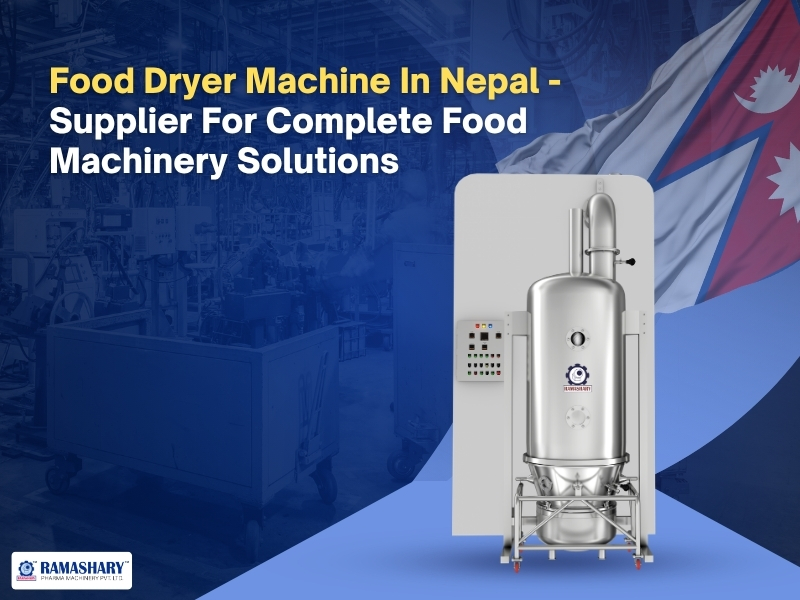
2. Fluid Bed Dryer

The Fluid Bed Dryer in Laguna or any high-humidity manufacturing region solves a very specific problem: getting consistent, uniform drying of granules and wet powder regardless of outside weather. The Fluid Bed Dryer is built using a stainless-steel chamber where hot air passes through a perforated bottom, causing the solids to behave almost like a fluid as they move through changing air velocity.

This fluidisation ensures uniform drying across the whole batch instead of the surface-only drying that tray dryers often produce. The air handling unit can be customised to the manufacturer’s requirements and a control panel governs temperature, flow rate and other key parameters.
Applications
It helps create granules for tablet compression to reach the exact moisture content needed for a stable, non-crumbling tablet and it is equally useful for drying herbal extracts, nutraceutical powders and food-grade materials.

3. Ointment / Cream Manufacturing Plant

For any manufacturer upgrading an Ointment Plant in Batangas or a similar industrial belt, consistency plays an important role. The Ointment Manufacturing Plant uses a wax-phase vessel with a slow-speed agitator to melt waxes, a water-phase vessel with a faster agitator and a storage vessel that collects the finished product via pump.

A bottom-entry homogeniser creates a genuinely homogeneous end product and inline filters ensure the expected level of filtration.
Applications
Real-world output from this Ointment Plant in Batangas or any other industrial hub includes medicated ointments, body lotions, cold creams and face washes, all manufactured on the same GMP-model platform.

4. Ramashary's Automatic Tablet Coating Machine

A tablet coating machine in Cavite or any tablet manufacturing hub is what turns a compressed, uncoated core into the market-ready tablet consumers actually swallow. Ramashary’s Automatic Tablet Coating Machine handles both sugar and film coating, using appropriate baffles to tumble tablets evenly inside the pan.

Drying happens inside a controlled environment. The machine includes a Wash-In-Place system and a fast automatic discharging device that minimises human contact with the product. For a manufacturer relying on a tablet coating machine in Cavite to hit export-grade finish standards, the closed-chamber design also matters for environmental compliance, since it processes materials in an enclosed system rather than releasing dust into the open factory air.
Applications
It is used for coating herbal, vitamin and calcium tablets, paracetamol, anti-diabetic medicines, etc.

5. Rapid Mixer Granulator

Granulation is where powders become uniform granules that compress cleanly into tablets and this is exactly what the Rapid Mixer Granulator is built for. It is automated with PLC and HMI controls, with a four-blade chopper covering a wide mixing area and a three-blade impeller rotating at controlled speeds to disperse fluid through the mix.

Whirling, tumbling and rising actions work together for effective granulation, while an air purging system keeps granules from mixing with mechanical components, and interlocked chopper and impeller motors provide sequential, predictable control.
Applications
Such pharmaceutical processing machinery in Philippines is widely used in the production of pharmaceutical tablets and capsules, including pain relief medicines, antibiotics, anti-diabetic drugs, vitamins, multivitamins, calcium and iron supplements, herbal formulations and nutraceutical products

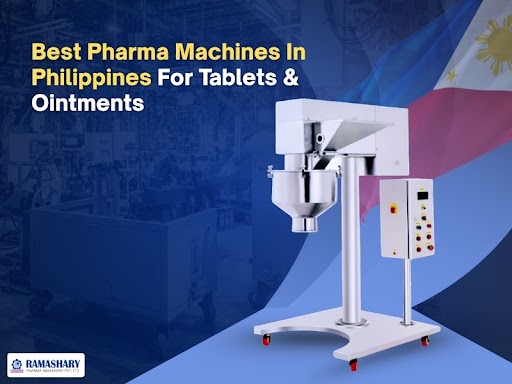
6. Multi Mill

After granulation or drying, particle size still needs to be brought into a tight, consistent range, and that is the job of the Multi Mill. Instead of relying purely on traditional shearing, grinding, compression and impact, it uses swing hammer blades with variable beater forces and material entering through the hopper inlet is broken down by knife and impact edges.

Applications
Multi Mill is widely used in pharmaceutical manufacturing to reduce particle size and produce uniform granules for tablets, capsules, dry syrups, herbal medicines and nutraceutical products.

7. Vibro Shifter

The Vibro Shifter, sometimes called a vibrating shifter, check screen or safety screener, handles the scaling, sorting and scoring operations that come after milling. It works on gyratory vibration to grade and separate material by size, with an enclosed screening design that also removes harmful dust and gases from the working environment, a meaningful safety benefit on any busy Philippine factory floor.

Compared with a mechanical shifter, it needs fewer moving parts, consumes less power and is faster to assemble, dismantle and clean. Mesh size, vibration speed and screen-deck configuration can all be customised to the specific formulation and industry.
Applications
The Vibro Shifter is widely used in pharmaceutical manufacturing to screen and separate powders and granules for tablets, capsules, dry syrups, herbal medicines and nutraceutical products.

Planning To Expand Your Pharma Production Capabilities?

FAQs

1. Can they customise machine capacity for a mid-size Philippine manufacturer?

Yes, Ramasharyâ„¢ Pharma Machinery Pvt. Ltd. builds across a wide capacity band. The Ribbon Blender alone spans from 50 litres to 12,000 litres, so a company can start with a pilot or mid-scale unit and later move up to a larger model built on the same design principles once volume grows, without having to re-validate an entirely different machine architecture.

2. Can one supplier provide the full line for both tablets and ointments?

A single supplier like Ramasharyâ„¢ Pharma Machinery Pvt. Ltd. can cover both. Their pharma and healthcare range includes granulation, drying, milling and coating equipment for tablets alongside a dedicated ointment and cream manufacturing plant for semi-solids. It positions them as a leading supplier of pharma machines in Philippines.

3. What industries besides pharmaceuticals can the same machinery be used in?

Most of the machines in this range, including the Ribbon Blender, Fluid Bed Dryer, Multi-Mill and Vibro Shifter, can be used across pharmaceutical, cosmetic, food and chemical manufacturing. The machines provided by Ramasharyâ„¢ Pharma Machinery Pvt. Ltd. are ideal for 20+ industries, which makes them a leading pharma machinery supplier in Philippines.

4. Can Ramashary help design a new pharmaceutical production line?

Yes, before recommending machinery, they analyse the manufacturing process, available space and production requirements. This enables the team to recommend suitable equipment layouts that support efficient material flow and future production expansion as a long-term pharma machinery supplier in Philippines.

5. Can Ramashary’s machines handle both generic and branded pharmaceutical products?

Yes, they provide pharmaceutical processing machinery in Philippines for manufacturing a wide range of formulations, generic medicines, branded products, nutraceuticals, herbal medicines and more.

Conclusion

The Philippines pharmaceutical industry is at a genuinely interesting point. Demand keeps climbing, government policy keeps pushing manufacturers toward local production and dedicated pharma economic zones are raising the compliance bar for anyone who wants to compete. None of that growth is available for free. It has to be earned on the factory floor, batch after batch.

This is where Ramasharyâ„¢ Pharma Machinery Pvt. Ltd. positions itself differently from just a supplier. It is an ISO and GMP-certified manufacturer with 40+ years of experience and 700+ successful site installations. For a manufacturer comparing options for the best pharma machines in Philippines, their combination of documentation, real installation history and genuine after-sales support, including spare parts availability, is what turns a machinery purchase into a long-term production partnership.

Connect with us to talk to our process engineering team.

Home
Industries
Blogs
Call us
Whatsapp

Let’s Talk

Contact Form New

I am looking to

My business belongs to

My name is

I represent

Where I hold the position of

My number is

My email is

I am planning to purchase the machine

I heard about Ramashary from

I would like a free consultation

Schedule a Call Now

Schedule a call

Fill the Form to Download Company Profile

Company Profile

Fill the Form to Download Brochure

Download Brochure