Sweden is a relatively small country, but its pharmaceutical industry has a much larger international presence and influence than you would expect from its size. Despite its modest population, the country is a genuine export powerhouse.
Sweden has a strong pharmaceutical industry with a significant presence in international markets. In 2024, the country exported pharmaceutical products worth approximately US$13.5 billion. Germany, the United States and China were among its biggest export markets.
Recent trade data underlines just how central this industry has become to the national economy. Reportedly, pharmaceutical exports reached SEK 152.5 billion, accounting for a total of 7.3% of Sweden’s total export value, an almost 10% increase since 2022. That scale of production is not possible without a large base of validated, CGMP-compliant pharmaceutical equipment in Stockholm, Gothenburg, Uppsala and all across the country, running around the clock.
Sweden’s research intensity is equally telling. As of 2024, Sweden’s R&D sector employed around 105,898 personnel and the intramural expenditure was 227,513 SEK million in the same year. In 2025, the expenditure of the country on R&D was SEK 233.7 billion.
Sweden’s strength in pharmaceutical research is increasingly extending into manufacturing. The government’s updated Life Science strategy gives greater recognition to pharmaceutical production as part of the country’s broader life science ecosystem. This reflects the growing importance of advanced manufacturing capabilities in maintaining Sweden’s long-term industrial competitiveness.
This is mainly because production of pharmaceuticals and advanced therapy medicinal products strengthens both export revenue and national self-sufficiency.
Sweden’s regional pharma market is also expanding at a healthy pace. Industry analysis expects pharmaceutical costs to climb from SEK 38.7 billion in 2024 to SEK 46.4 billion by 2028. Oncology drugs are increasing at a faster rate. Hospital pharmacies captured just over half of the market share in 2025. In the first quarter of 2024 alone, Swedish pharmaceutical exports reached SEK 39.5 billion against imports of just SEK 6.46 billion.
If you have ever sat through a deviation review meeting because a blender under-mixed a batch or a coating pan produced an uneven film, you already know why consistency is not optional. It is the difference between a clean audit and a costly recall.
This is also a moment where customisation matters more. Sweden’s pharma companies are not identical. A biologics fill-finish site in Uppsala may require specialised equipment such as a Ribbon Blender in Uppsala for specific formulation needs, while a tablet manufacturer near Gothenburg or a nutraceutical producer in Malmo may have entirely different equipment requirements.
Off-the-shelf pharma machinery in Sweden rarely fits every process, every room layout or every batch size. What Swedish manufacturers actually need is CGMP-compliant pharma machinery that can be configured around their existing production lines, their utilities and their specific product portfolio, while still complying fully with CGMP expectations.
There is also a quieter, more practical reason behind this growing demand. Many pharma plants are running a granulator or a tablet manufacturing machine in Gothenburg or across any city that is ten, fifteen or even twenty years old. It still works, but it is harder to validate, harder to clean and harder to integrate with modern PLC- and HMI-based control systems.
Replacing or upgrading this equipment with dependable pharma machinery in Sweden is becoming a priority for plant managers who want fewer unplanned stoppages and easier regulatory inspections.
Put all of this together and you get a clear picture. Manufacturers need pharmaceutical machinery suppliers in Sweden who understand both the regulatory weight of CGMP and the practical realities of a working pharma floor. Not every pharma machinery supplier in Sweden can offer that combination of engineering depth and hands-on installation support, which is exactly why choosing the right pharma machinery supplier in Sweden matters as much as choosing the right machine.
Sweden’s pharmaceutical industry is entering a period of change. For pharmaceutical manufacturers, these changes are influencing how products are formulated and manufactured, making the role of pharmaceutical machinery suppliers in Sweden increasingly important in supporting efficient, consistent and compliant production.
This stronger focus on evidence and regulatory compliance also highlights the importance of reliable manufacturing processes. For pharmaceutical manufacturers, CGMP-compliant pharma machinery in Sweden is therefore becoming an important part of maintaining consistent quality and meeting manufacturing expectations.
Sweden’s pharmaceutical industry is supported by a strong network of research institutions, manufacturing facilities, technology companies and life sciences clusters spread across several key cities.
For companies operating here, demand for dependable pharmaceutical equipment in Stockholm is closely tied to fill-finish, packaging and formulation lines supporting both large pharma and a growing base of speciality biotech firms. Procurement teams need pharmaceutical equipment in Stockholm that can be validated fast, since research-to-commercial handoffs happen quickly within this cluster.
Sourcing pharmaceutical equipment in Stockholm from a supplier who already understands GMP documentation saves considerable time during exactly these fast-moving handoffs.
Given this density of biologics and formulation work, procurement heads frequently search for a Ribbon Blender in Uppsala capable of handling both dry powder blending and semi-solid mixing for a wide product mix, since many facilities in the city run multiple product lines through shared equipment.
With this scale of tablet and solid dosage production nearby, demand for a reliable tablet manufacturing machine in Gothenburg has grown steadily, particularly among contract manufacturers supporting the wider cluster who need machinery that can flex between formulations without long changeover times.
A tablet manufacturing machine in Gothenburg also needs to fit within tighter cleanroom footprints than a decade ago, which is pushing buyers toward more compact, configurable pharma machinery in Sweden rather than oversized legacy lines.
Malmo is recognised as the largest life science city within Skane. Companies here range from established names to smaller CDMOs and many are actively seeking pharma machinery in Sweden that suits smaller-batch, high-mix production typical of this innovation-dense region.
Sweden’s pharmaceutical sector operates under strict quality, regulatory and production requirements, but maintaining consistent output on the factory floor can involve several practical challenges.
This mismatch means pharma plants often cannot find enough trained operators to run complex, manually intensive equipment, which puts pressure on machinery to be simpler and safer to operate.
This regulatory weight extends into equipment qualification, where all pharma machinery in Sweden must generate clean, traceable data for IQ, OQ and DQ documentation.
For pharmaceutical manufacturers, this makes the operating efficiency of production equipment increasingly relevant. Older, less energy-efficient blenders, dryers and coating systems may consume more energy per batch than modern, optimised machinery, making equipment efficiency an important consideration when controlling production costs.
Every one of these seven challenges ultimately points to one practical decision: choosing the right pharmaceutical machinery supplier in Sweden. Manufacturers that work with reliable and experienced pharmaceutical machinery suppliers in Sweden can address equipment, efficiency and production challenges more effectively, rather than continuing to invest time and resources in maintaining outdated machinery.
For companies searching for a dependable pharma machinery supplier in Sweden, Ramashary Pharma Machinery Pvt. Ltd. offers exactly the kind of end-to-end approach that reduces vendor complexity, from initial consultation and customisation through manufacturing, site installation and after-sales support.
Here is how we address each of the challenges outlined above.
We provide operator training and detailed instruction and maintenance manuals. All machines are customised with ease of use in mind. This directly answers Sweden’s structural labour shortage by providing pharma machinery in Sweden that is easier to run safely with a less specialised team.
Ramashary Pharma Machinery Pvt. Ltd. designs machines with straightforward cleaning and inspection processes, such as the Multi-Mill and Vibro Shifter. We also provide ongoing after-sales service and assured spare parts, which help reduce downtime. This can help reduce ongoing maintenance costs and ease the pressure of higher skilled-labour expenses faced by Swedish manufacturers.
We provide DQ, OQ, IQ and FAT reports and MOC certificates. Thus, traceability remains easier for pharma manufacturers in Sweden and globally.
This is precisely the kind of CGMP-compliant pharma machinery in Sweden that quality assurance heads need to eliminate deviation reports tied to equipment variability.
Across every one of these challenges, the underlying theme is the same. We do not just sell isolated machines. We function as a full-scope pharmaceutical machinery supplier in Sweden, handling consultation, customisation to GMP guidelines, manufacturing, global site installation and ongoing support, so that Swedish pharma companies get one accountable partner instead of a fragmented supply chain.
This end-to-end support, combined with 40+ years of manufacturing experience and a genuinely global installation footprint, is what makes Ramashary Pharma Machinery Pvt. Ltd. a trustworthy pharma machinery supplier in Sweden for teams that cannot afford inconsistent batches or delayed compliance.
Choosing the right equipment involves more than comparing specifications on a datasheet. It requires an understanding of how a machine performs within an actual production environment, the materials it is designed to handle and the finished products it can help manufacture.
The following seven machines from Ramashary Pharma Machinery Pvt. Ltd. are particularly relevant to pharma machinery in Sweden, covering key stages of the granulation, drying, blending and coating process used in solid dosage manufacturing.
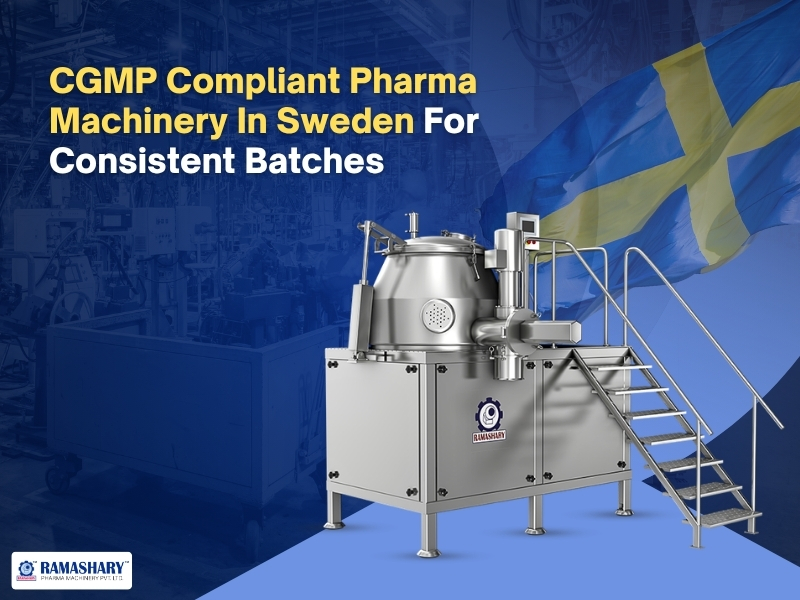
Our Rapid Mixer Granulator can be automated according to the requirements, with a chopper covering a wide mixing area and an impeller that disperses fluid at controlled speeds. The chopper and impeller motors are sequentially interlocked and an air purging system stops granules from mixing with mechanical components, which keeps the final product clean and uncontaminated.
Real-world products made using this exact process step include paracetamol tablets, metformin tablets, multivitamin granules and a wide range of ayurvedic and nutraceutical formulations, all of which rely on properly granulated powder before compression. For any manufacturer researching a Rapid Mixer Granulator for their Swedish facility, this machine is the backbone that determines how consistent every downstream step will be.
Its working principle follows a triple-action technique, where a homogeniser delivers faster mixing speed, a propeller offers medium-speed blending and an anchor stirrer works at a slower speed, all inside a U-shaped horizontal channel fitted with a double-helical ribbon agitator.
This design moves material through the entire channel without leaving isolated and unmixed pockets. The Ribbon Blender can handle large volumes of dry powders as well as high-viscosity semi-solid materials such as creams, lotions and hair gels, giving it versatility across both pharmaceutical and cosmetic production lines.
Capacity ranges from 50 litres to 12,000 litres, built according to your exact requirements. Real-world applications include blending excipient powders before granulation, mixing vitamin and mineral premixes and preparing semi-solid dermatological bases.
Given Uppsala’s dense concentration of biologics, formulation and fill-finish companies, sourcing a Ribbon Blender in Uppsala that can flexibly switch between dry powder batches and higher-viscosity semi-solids is increasingly common and Ramashary Pharma Machinery Pvt. Ltd. handles this regularly through its customisation process.
Manufacturers evaluating a Ribbon Blender in Uppsala specifically value this dual capability, since many facilities in the city run more than one product category through the same equipment footprint.
Its working principle is based on fluidisation, where hot air moves upward through a perforated bottom plate inside a stainless-steel chamber, causing the wet granules or powder to behave almost like a fluid as they are lifted and tumbled continuously.
This ensures every particle receives uniform exposure to hot air, avoiding the uneven drying that comes with older tray drying methods. Materials processed through this machine include granular materials, powders and crystalline substances, spanning pharmaceuticals, food products, chemicals and minerals. Capacity ranges from as small as 5 kg up to 500 kg, making it suitable for both pilot scale and full commercial runs.
Rather than relying on traditional shearing or compression alone, the Multi-Mill uses swing hammer blades combined with rotating impact edges along a knife assembly, giving it flexibility across a wide range of particle reduction tasks. Material enters through an inlet and the final particle size of the discharged product depends directly on the speed of the knife and impact edges, which are designed to run between 750 and 3,000 RPM depending on the required output.
The Multi-Mill’s blades can rotate, giving operators control over shear versus impact-based size reduction depending on the material’s characteristics. Materials handled include dried granules, crystalline powders and other materials. In real-world pharma manufacturing, this machine typically sits right after the Fluid Bed Dryer, preparing granules for either tablet compression or capsule filling.
Common finished products relying on this exact step include cough syrup powder mixes, dry syrup powders and standard tablet formulations.
Drying happens inside a controlled environment where air volume, bed temperature and negative pressure are all carefully maintained.
This machine is available across a wide range of pan sizes, from 30-inch dia up to 60-inch dia and it includes a WIP along with an automatic discharging device that avoids unnecessary human contact with the product.
In terms of real-world output, this is the exact machine responsible for the smooth, uniform coating seen on everyday tablets, from enteric-coated aspirin that must resist stomach acid to simple film-coated multivitamin tablets designed purely for easier swallowing and better shelf stability.
Any manufacturer sourcing a tablet manufacturing machine in Gothenburg for a growing solid dosage line will find that coating consistency, not just tablet compression, is often the deciding factor in final product quality, which is exactly why this machine is important within the full production line.
This machine is built with multiple check screening arrangements and its enclosed design actively avoids harmful dust and gases entering the environment during operation, which matters enormously for operator safety and cleanroom integrity. Available in sizes ranging from 8-inch dia up to 72-inch dia and with customisable mesh size, vibration speed and screen deck configuration, the Vibro Shifter adapts easily to different formulations and industries.
In pharmaceutical applications, this machine can screen granules before tablet compression to remove oversized lumps. It can also be used to inspect final packed capsules or granules for contamination before they leave the production floor.
The Octagonal Blender is designed for easy loading and unloading. Capacity ranges from 5 litres to a substantial 12,500 litres. This is a gentle and slow-speed blender, which matters greatly for sensitive granules that could fracture or generate excess fines under more aggressive mixing.
Together, these machines cover key stages of solid dosage manufacturing. Choosing the right equipment requires considering capacity, GMP requirements, automation and long-term support, making experienced pharmaceutical machinery suppliers in Sweden an important part of the process.
Sweden’s pharmaceutical industry is growing, backed by strong export statistics, deep research investment and a growing national push toward domestic manufacturing. But that growth is happening against a backdrop of real factory floor pressure, from a persistent skilled labour shortage to rising energy costs and tightening regulatory expectations.
For procurement heads, quality assurance teams and manufacturing directors across Stockholm, Uppsala, Gothenburg, Malmo and beyond, choosing the right pharmaceutical machinery suppliers in Sweden has become an increasingly important part of maintaining efficient production. It is central to whether a company can keep producing consistent, compliant batches while everything around it gets more demanding.
This is where Ramashary Pharma Machinery Pvt. Ltd. fits in. We aim to be a dependable pharma machinery supplier in Sweden for pharmaceutical companies, providing reliable equipment and solutions suited to their manufacturing requirements.