

Why Choose Our Food Dryer Machine in Nepal?
Our food dryer machine in Nepal dries products with controlled heat and airflow, so every batch reaches the same moisture target. Herbs, spices and fruits keep their colour, aroma and shelf life. You also avoid the contamination risks of open sun drying.
Looking for a reliable food dryer machine in Nepal? Ramashary Pharma Machinery Pvt. Ltd., an ISO and GMP-certified food machinery supplier in Nepal, builds customised Tray Dryers, Fluid Bed Dryers and Roto Cone Vacuum Dryers for ginger, turmeric, herbs, spices and fruits. Our food processing machines and food processing equipment also include a customised food dehydrator machine in Nepal, beverage processing machines in Nepal, and a liquid syrup manufacturing plant in Nepal from 50 to 10,000 litres. That plant provides the syrup stage behind every soft drink making machine in Nepal. We have 40+ years of experience and 700+ installations. We provide installation, operator training and assured spare parts across Kathmandu, Biratnagar, Birgunj, Hetauda and Bhairahawa. Talk to our process engineers today.
Choosing a food dryer machine is more than just comparing prices.

Nepal grows ginger, turmeric, apples, mushrooms, tea and milk in large volumes. A good share of it never reaches the shelf in good condition. The reason is simple. Drying, mixing and syrup making are still done by hand or on ageing equipment in many plants.
A reliable food dryer machine in Nepal is often the first upgrade that fixes this problem. The second is a dependable food machinery supplier in Nepal who understands both the product and the plant.
Industry Overview - Nepal's Food and Beverage Sector in Numbers
The market itself is not small. Reportedly, the packaged food segment is expected to grow to 13.40% in 2028. Urban shoppers want ready-to-eat meals, packed snacks and bottled drinks. Rural brands are spreading too. Demand is there. The pressure is on the factory floor.
That pressure is real. Manufacturing added only 5% of Nepal’s GDP in 2024, according to World Bank data. Many plants run below capacity. Power cuts interrupt batches. Farmers lose a large share of fruit and vegetables after harvest. Buyers and regulators now expect cleaner and more consistent products. A plant manager who relies on open sun drying or manual mixing will find this hard to sustain. Better food processing machines are no longer a luxury.
Thus, the food manufacturers to have to follow GMP and hygiene systems and to oversee the equipment they use. Stainless steel contact parts and easy cleaning are not optional extras. They decide whether a licence is granted and whether a batch is safe.
A research firm sizes the narrower food and beverage market at USD 584 million in 2025 and forecasts USD 1,057 million by 2032. Growth is steady and in the high single digits.
The prices of meat, fish, vegetables, oil, fruits, etc., grew in 2026, resulting in a 6.8% increase in inflation in Nepal’s food and beverage sector. Such persistently increasing inflation can affect household purchasing power and increase operational costs in various sectors.
The prices of meat, fish, vegetables, oil, fruits, etc., grew in 2026, resulting in a 6.8% increase in inflation in Nepal’s food and beverage sector. Such persistently increasing inflation can affect household purchasing power and increase operational costs in various sectors.
How Are Companies Classified In Nepal?
The Industrial Enterprises Act 2016 sets size bands by fixed assets. Small industries invest up to NPR 100 million. Medium industries invest between NPR 100 million and NPR 250 million. Large industries exceed NPR 250 million.
Cottage industries sit below these bands. They use traditional skills and local raw materials. Many start as home-based drying or pickling units. As they grow, they need simple and affordable food processing equipment. This matters when you choose a food machinery supplier in Nepal. A small spice unit and a large beverage plant need different capacities and different budgets from the same supplier.
What Do Importers Of Machinery Need To Know?
Manufacturing industries can claim preferential duty when they import plant and machinery used in direct production. Nepal is also landlocked and relies on Kolkata port for nearly all sea freight. Lead times and spare parts therefore matter as much as the machine price.
What Are The Biggest Gaps In The Supply Chain?
Post-harvest loss stands out. Reportedly, there were losses of 15% to 30% for vegetables and 20% to 35% for fruit in Nepal. A 1997 study put losses of fruit and vegetables at 12% to 35% of yield. A Paris Peace Forum project note says losses can reach 50% under adverse conditions for smallholders. Every unit of produce saved by drying or processing is income recovered.
Importance Of a Food Dryer Machine In Nepal
A food dryer machine removes moisture from food by using controlled heat and moving air. Less moisture means fewer microbes and slower spoilage. That is why dried ginger, herbs and fruit chips last for months. Some people call the same equipment a food dehydrator.
In practice, a food dehydrator machine in Nepal and a food dryer machine in Nepal do the same basic job. The difference lies in size and design. A cabinet-type unit handles batches of sliced fruit. A fluidised unit handles powders and granules. A larger industrial food dryer machine in Nepal serves plants that run several shifts and need written records for each batch.
What Does A Food Machinery Supplier In Nepal Actually Do?
A good food machinery supplier in Nepal does more than deliver a machine. It studies your product and recommends the right food processing machines. It customises the design and helps with installation. It trains your operators and supplies documents for audits. It also keeps spare parts available. Some suppliers manufacture inside Nepal.
Others manufacture in India and supply across the border. Both models can work if service is strong. When you compare offers, look at the whole package and not only at the price of the food processing equipment.
Which Beverage Processing Machines In Nepal Do Drink Makers Need?
Beverage processing machines in Nepal cover several stages. Water treatment comes first. Syrup preparation follows. Then come blending, heat treatment, filling and packing. Many new brands begin with a small liquid syrup manufacturing plant in Nepal because syrup quality drives taste.
Anyone searching for a soft drink making machine in Nepal should break the line into these stages. Each stage may come from a different maker. The syrup stage is where a closed and well-controlled vessel gives the most benefit. Beverage processing machines in Nepal also need easy cleaning because sugar leaves sticky residue.
What Do Large, Small & Medium Companies Need From Machinery?
Each size band buys differently. Small units want low entry cost and flexible machines. A customised food dehydrator machine in Nepal can start small and grow with the product range. A beverage start-up planning a soft drink making machine in Nepal can begin with the syrup stage. A liquid syrup manufacturing plant in Nepal can also start on a small scale.
Medium companies want repeatable quality and shorter batch times. They look at fluid bed drying, larger blenders and PLC controls. Large companies want integration, documentation and fast service. They compare food processing machines on uptime and audit readiness.
Across all three bands, a food dryer machine in Nepal is rarely a one-time purchase. A supplier that offers customised food processing equipment from small to large batch sizes keeps training and spare parts consistent as you grow. Procurement heads should ask each supplier for a growth path and not only for today’s quote. That question separates a partner from a trader.
Why Does The Right Supplier Matter?
The numbers above lead to one conclusion. Nepal has demand and raw material. It lacks consistent processing capacity. Plants that invest in good food processing machines close that gap faster. They need a partner who offers design help, installation, documentation, training and spare parts. A food dryer machine in Nepal that stops working in the peak ginger season costs more than its purchase price. The supplier you choose decides how often that happens.
Do You Lose Significant Raw Material During Production?
Trends In Nepal's Food & Beverage Industry
Nepal’s food processing industry is evolving as consumer preferences change. But capturing that opportunity takes more than increasing production. Understanding the key industry trends can help businesses make better investment decisions.
Trend 1: Packaged & Ready-to-Eat Foods Are Gaining Ground
Urban households in Kathmandu and other large towns now buy more packaged snacks and ready meals. Reports show that the packaged food market in Nepal was projected to grow by 7.56% in 2025 and to peak near 13.40% in 2028.
Another research report expects the ready-to-eat packed food market to rise from USD 790 million in 2025 to USD 1,161 million by 2030. Packed foods need consistent taste and texture in every batch. That puts pressure on mixing and blending. Plants need food processing machines that repeat the same recipe every day.
Trend 2: Health & Organic Products Are Moving From Niche To Mainstream
There is an increase in launches of health-oriented snacks and organic beverages. Buyers now read labels. They ask about colour and aroma and nutrient loss. Gentle and controlled drying protects these qualities. This is where a food dehydrator machine in Nepal earns its place. Heat that is too high or uneven drying can strip colour and essential oils from herbs and spices.
Trend 3: Packaged Juices & Ready-to-Drink Beverages Are Expanding
There is a growing preference for healthier drinks among Nepali consumers. It also points to rising demand for packaged ready-to-drink juices as people become more time-conscious. Nepal’s agriculture gives juice makers local fruit and distinct flavours. Syrups and concentrates sit at the start of this chain.
A good liquid syrup manufacturing plant in Nepal gives juice and beverage brands a clean and repeatable base. Many companies also search for beverage processing machines in Nepal for exactly this reason. Local soft drink makers also face rising competition from imported brands. A smaller brand cannot match their budget. It can match their consistency.
This is why the question related to the soft drink making machine in Nepal comes up so often in boardrooms. The answer starts with syrup quality and process control. Procurement teams should also compare beverage processing machines in Nepal on cleaning time, batch size and heating options.
Trend 4: Dehydration & Value Addition Are Becoming A Business Model
Raw produce sells cheaply. Dried and processed produce earns more. 365 metric tonnes of dried ginger and turmeric produced in Karnali Province were exported to Europe in the last fiscal year.
Khetipati Organics processes about 150 tons of perishables a year through cold storage and dehydration. It reports a 30% cut in post-harvest loss among its farmers. These examples show why interest in the food dryer machine in Nepal keeps growing. Every drying plant adds shelf life and export access.
Trend 5: Licensing Is Moving Online & Compliance Is Getting Stricter
Nepal’s DFTQC uses the online NeFFILS system for food industry licensing. The applicants must provide the company facility details, processes and the product scope. Other required documents are also to be uploaded and quality standards are to be maintained.
Trend 6: Power Policy Is Shifting Toward Surplus & Seasonal Tariffs
Reportedly, the government is preparing seasonal electricity tariffs and concessional rates for heavy users. The goal is to use surplus monsoon power and lower industrial costs. This may favour electrically heated equipment in the future. Plants still face outages today. That is why a food machinery supplier in Nepal should ask about your heating source and power backup before quoting any machine.
What Do These Trends Mean For Your Plant?
Taken together, the trends point in one direction. Buyers want packed, healthy and traceable food. Regulators want documented hygiene. Power is improving on paper but still unstable on the ground. Exporters want consistent moisture and clean surfaces. A plant that wants to benefit needs controlled drying, controlled mixing and controlled liquid preparation.
That means a dependable food dryer machine in Nepal for produce and herbs. It also means a liquid syrup manufacturing plant in Nepal for beverages and sweet products. Brands that plan a soft drink making machine in Nepal need that syrup stage first. A customised food dehydrator machine in Nepal suits plants that handle several raw materials. Choose equipment with these needs in mind and you will be ready for the next regulatory or buyer audit.
Does Your Product Quality Vary From Batch to Batch?
Food & Beverage Industry In 5 Key Nepali Cities
Nepal’s manufacturers cluster in the capital and along the Terai plains near the Indian border. The Investment Board Nepal profile names Kathmandu, Biratnagar, Birgunj, Bhairahawa and Hetauda among the major manufacturing cities. Each has a different personality. Each also raises a different need for food processing equipment.
1. Kathmandu Valley: The Largest Market & The Head Office Of The Industry
Kathmandu Valley is one of Nepal’s key commercial and economic centres. A Nepal Rastra Bank study estimated that the valley accounted for 23% of Nepal’s GDP under its reference scenario for 2010-11. The study also highlighted the valley’s substantial share of national consumption, reinforcing its importance as a consumer market.
Brands here compete on packaging, taste and food safety. Land is costly and some heavy processes are restricted inside Kathmandu Metropolitan City. These include sugar and molasses production and distilling.
Because big soft drink companies operate here, smaller local brands feel pressure to match product quality. Their owners often explore a soft drink making machine in Nepal or smaller beverage processing machines in Nepal to improve syrup consistency. Industrial districts offer ready sheds and utilities.
Because big soft drink companies operate here, smaller local brands feel pressure to match product quality. Their owners often explore a soft drink making machine in Nepal or smaller beverage processing machines in Nepal to improve syrup consistency. Industrial districts offer ready sheds and utilities.
2. Biratnagar: The Industrial Capital Of The East
Biratnagar is a major industrial and commercial centre in eastern Nepal, located in Morang District close to the Indian border. Reportedly, it is the country’s industrial capital.
A national census directory also lists local food and snack makers and a beverage maker in the city. A food dryer machine in Nepal installed here could serve ginger and cardamom collectors from the eastern hills. Industry bodies in Morang have also protested outages of more than 12 hours without notice. A plant here needs machines that restart cleanly after a power cut.
3. Birgunj: The Gateway City For Raw Material & Machinery
Birgunj is one of Nepal’s most important trade gateways, linked to the Indian border town of Raxaul. Reportedly, the corridor handles around two-thirds of Nepal’s total trade.
For food makers, this is a supply chain advantage. Packaging and raw materials, and imported machinery arrive here first. In April 2025, reportedly, units in the corridor were running at low capacity because of unannounced load shedding.
A reliable food machinery supplier in Nepal should therefore offer good lead times and spare part support for this corridor.
4. Hetauda: A Mature Industrial District With Food & Drink Names
Hetauda is 132 km from Kathmandu and hosts one of the largest industrial districts in Nepal. A December 2024 report counted 127 industries in the Hetauda corridor. They include a food industry, a brewery, a biscuit company and an edible oil plant. They also include a milk distribution project, a bottler and a tea leaf industry.
The same report says six older industries closed because of financial stress and lack of raw material. Twelve more were being set up. Hetauda shows both the promise and the risk. Plants here benefit from beverage processing machines in Nepal that are easy to maintain.
5. Bhairahawa: Trade, Tourism & A Special Economic Zone
The Bhairahawa Special Economic Zone (SEZ), Nepal’s first SEZ, had its administrative building inaugurated in November 2014. Historical reports describe incentives for eligible industries, including customs-duty exemptions. Businesses should verify the current terms under applicable SEZ legislation before relying on these incentives.
It is a strong location for dehydration and packed food units. An exporter here would look closely at a customised food dehydrator machine in Nepal and at hygienic food processing machines that satisfy foreign buyers.
7 Factory Floor Challenges in Nepal's Food and Beverage Industry
Talk to any plant manager in Nepal and the same problems come up. Some are national and some are local. Together they explain why the right food processing equipment and the right food machinery supplier in Nepal matter so much.
Challenge 1: Heavy Post-Harvest Loss & Too Little Drying Capacity
There is no full national assessment of post-harvest loss. Available estimates still show the scale. A review in the ISHS series puts losses at 20% to 30% for fruit. The losses can exceed 50% under adverse conditions.
Ask a manufacturer why and the answer is usually the same. Produce arrives in a short season and in large volumes. There is not enough drying or cold capacity nearby. Fruit that could have become dried slices or powder is sold at a low price or thrown away. Plants that add a food dryer machine in Nepal near the growing area turn a loss into stock they can sell all year.
Challenge 2: Open Sun Drying Damages Quality
Many ginger and turmeric farmers still dry in the open. This leads to poor quality and weak market prices. The same study tested a solar dryer. Ginger and turmeric moved from 88% to 10%-12% moisture in about 14 hours of sunshine.
Reportedly, dried ginger, known locally as sutho, is sensitive to moisture uptake in storage and transit. Picture a spice trader in the eastern hills who ships a lot of dried ginger. One damp lot can bring a rejection from a buyer in India. A controlled food dehydrator machine in Nepal gives the trader a fixed moisture target and a record of how it was reached.
Challenge 3: Unreliable Industrial Power & Costly Backup
Power is the challenge most plant managers raise first. In March 2025, reportedly, industrial areas faced cuts without notice. A batch of syrup or dried fruit that stops halfway can be lost. Equipment that offers flexible heating options and simple restart steps limits that damage. Ask any supplier of a food dryer machine in Nepal how the unit restarts after an outage and how the batch can be saved.
Challenge 4: Licensing & Audit Pressure Around GMP & HACCP
Food manufacturers in Nepal must follow the applicable registration, recommendation and licensing procedures administered through the Department of Food Technology and Quality Control (DFTQC).
An old mild steel mixer with rough welds is a hard sell in this setting. Plants that need to sell to supermarkets or export markets feel this pressure even more. Stainless steel food processing machines built to GMP principles make audit preparation far easier.
Challenge 5: Landlocked Logistics & Unavailable Spare Parts
Nepal depends on Kolkata for almost all sea freight. Reportedly, Birgunj is the only one linked by rail to a gateway port. Machinery that fails in Nepal may need a part from across a border.
Customs delays and freight can turn a small repair into a long stoppage. This is why plant managers value a food machinery supplier in Nepal who stocks parts and who gives clear lead times. A cheap machine with no spare parts plan is a poor bargain.
Challenge 6: Batch Inconsistency In Mixing & Syrup Preparation
No national statistic tracks this one. The pattern is common across small plants. A small beverage unit prepares sugar syrup in open vessels. Operators add ingredients by eye. One batch is thicker than the next. A bakery premix is blended by hand and some lots carry more spice than others. Customers notice. Quality teams reject batches.
Consistent results come from controlled stirring, controlled heating and closed handling. A liquid syrup manufacturing plant in Nepal built with a high-speed stirrer and a proper heating arrangement removes much of this guesswork. The same logic applies to dry blending. Soft drink and juice makers feel this most.
A syrup that varies in sugar level changes taste and shelf life. Brands that buy a soft drink making machine in Nepal without first fixing the syrup stage often find the same problem at the end of the line. Reliable beverage processing machines in Nepal start with a controlled syrup stage.
Challenge 7: Scaling Up Without Wasting Capital
The Industrial Enterprises Act places small industries at up to NPR 100 million in fixed assets and medium ones between NPR 100 million and NPR 250 million. Large ones go above that. Many food companies sit in the first two groups. They cannot afford to buy a machine that is too big or too small.
Demand can outrun capacity quickly. Companies need food processing machines that come in several batch sizes so they can start small and add capacity later.
Why Nepal Needs A Customised Industrial Food Dryer?
Dryers deserve special attention because they sit at the centre of challenges 1 and 2. Nepal’s produce is varied. Ginger needs one temperature profile. Herbs need another. Sliced apples and mushrooms need a third. Instant soup granules need a different dryer altogether. A single standard unit cannot serve all of them well.
This is why a customised food dehydrator machine in Nepal makes more sense than a generic one. A good design fixes tray size and air flow and temperature range and cleaning access around your actual product.
An industrial food dryer machine in Nepal also has to cope with local conditions. Monsoon humidity and seasonal harvest peaks and power interruptions all affect drying time. A food dryer machine in Nepal built for small farms will not handle a plant that runs two shifts.
A larger industrial food dryer machine in Nepal needs reliable hot air distribution and easy cleaning between batches. It also needs documentation for audits. Companies should ask every supplier how its dryer handles these points before they sign an order.
What Do These 7 Challenges Add Up To?
Read the seven challenges together and a pattern appears. Raw material is plentiful, but processing capacity is thin. Utilities are uncertain. Rules are tightening. Machines and parts cross a border. The answer is not a single machine. It is a partnership with a food machinery supplier in Nepal who can design, install and service a set of food processing machines around your product.
Planning Your Next Food Processing Upgrade?
Best Food Machinery Supplier In Nepal
Ramashary Pharma Machinery Pvt. Ltd. (an ISO and GMP-certified company) is an Indian food machinery manufacturer and supplier to Nepal. With 40+ years of experience and 700+ site installations across 20+ industries, we have analysed how different manufacturers across the world face unique challenges.
Whether it is food, cosmetic, chemical, pharmaceutical or allied industries, some challenges remain common. Here’s how our machines and end-to-end solutions help in the long run:
Solution 1: Solution To Post-Harvest Losses
Post-harvest losses occur due to inconsistent drying, blending, etc. We first understand your material to be dried, the drying conditions, batch size and more. Accordingly, we provide customised food dryer machine in Nepal with closed processing and appropriate temperature controls.
The Tray Dryer, Fluid Bed Dryer or Roto Cone Vacuum Dryer can be utilised according to the material sensitivity and other conditions.
Solution 2: Controlled Drying Conditions
Open sun drying may lead to contamination and inconsistent drying. This is where the controlled drying conditions provided by our food dryer machine in Nepal can help. A Fluid Bed Dryer is useful for drying free-flowing particles, while a Tray Dryer helps dry solid blended products.
These machines are user-friendly and come with accurate controls for precise drying. Overall, they reduce product damage and batch rejections.
Solution 3: Energy-Efficient Machines
The machines are designed for energy savings. Insulation is added wherever applicable. According to the working conditions, these machines can be customised and suitable controls can be added to determine whether a batch can resume processing or needs quality checks before restarting. PLC/HMI integration helps with accurate controls, while IoT-readiness helps gain real-time insights.
Solution 4: Simplified Compliance
Our machinery is developed with reference to applicable standards and frameworks, including ASME BPE, 21 CFR, SCADA, CE, WHO-cGMP, GMP and Industry 4.0, alongside relevant validation practices. As an experienced food machinery supplier in Nepal, we support equipment handover with technical documentation such as DQ, IQ, OQ, FAT reports and MOC certificates, as applicable.
Manufactured using SS 304 and SS 316L, our equipment is designed to support quality assurance, traceability and regulatory requirements across domestic and international markets.
Solution 5: Assured Spare Parts
Our post-fabrication solutions include site installation, commissioning, operator training, documentation, provision of assured spare parts and ongoing after-sales service. Thus, the compatibility between the machinery and the spare parts is not compromised.
It makes us more than just a food machinery supplier in Nepal; it makes us your long-term partner for high-quality customised equipment.
Solution 6: Increase In Batch Consistency
As a dependable food machinery supplier in Nepal, we help by replacing manual estimation with measurable, repeatable processing parameters. The focus is on how the equipment controls ingredient quantities, mixing, temperature and batch transfer, rather than simply recommending a high-speed machine.
The machines are customised according to your requirements, with energy and space efficiency. Also, the machines are made for multi-product versatility and handling different materials, which reduces material wastage and import dependency.
Solution 7: Scalability
From lab models to large-scale machines, we offer equipment with different capacities. These machines can support scalability and help in the long run. Also, they can be used as standalone equipment or integrated into the existing processing line.
That’s why our discussion begins with understanding your current process and future scalability goals. This makes us your long-term partner, rather than just a one-time supplier of food processing or food dryer machine in Nepal.
Best Food Machinery Supplier In Nepal
Choosing food processing equipment is easier when you know what each machine really does. The seven machines below cover drying, syrup making, mixing and blending, cooking and coating.
1. Fluid Bed Dryer
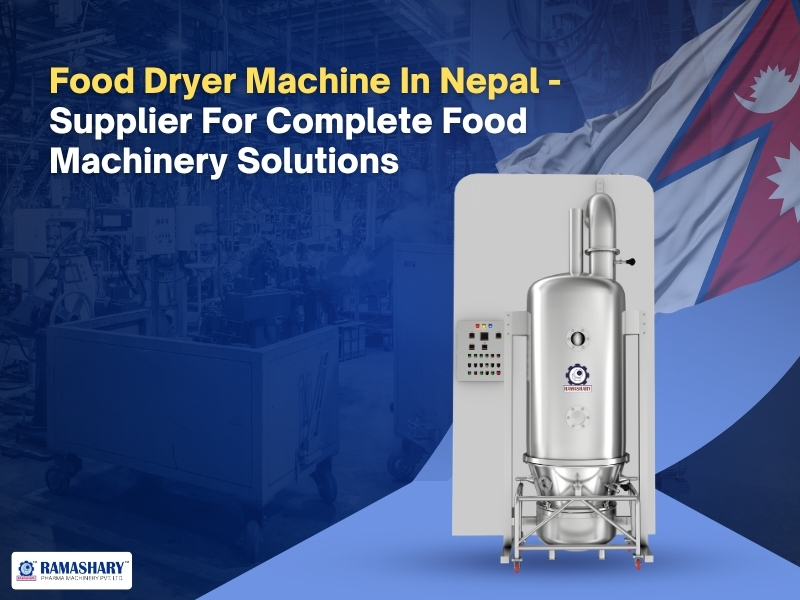
Working principle. A Fluid Bed Dryer uses fluidisation. Hot air blows upward through a perforated base at enough speed to lift the particles. They float and move like a boiling liquid. That is why the machine is called a fluid bed.
Materials it can handle. Fluid Bed Dryers are suitable for selected granular and powdered food ingredients, including agglomerated products and particles that can be effectively fluidised.
Depending on the machine configuration and product characteristics, applications may include instant beverage ingredients, soup mixes, spice blends, cereal products and certain dairy-based ingredients.
However, suitability depends on particle size, moisture content, density, stickiness and heat sensitivity. Very wet, cohesive or sticky materials may not fluidise properly in a conventional system and may require a different dryer design or pretreatment.
Exact working in detail. The process begins by loading the prepared wet granules or other suitable particulate material into the drying chamber. Heated air enters through the air distribution plate at the bottom and moves upward through the product bed. At the correct airflow, the particles become suspended and move continuously, exposing more of their surface to the drying air.
Heat transfers from the air to the product, causing moisture to evaporate. The moisture-laden exhaust air is then removed through the exhaust system, with suitable filtration or particle-recovery arrangements used where required. Operators can adjust parameters such as air temperature and airflow to suit the product and target moisture content. Once the required drying endpoint is achieved, the batch is discharged for the next processing stage
Real-world food products. Such a food dryer machine in Nepal can be used for drying instant soup mixes, other dry food preparation, making spice and seasoning blends, cereal-based particles, etc.
2. Tray Dryer
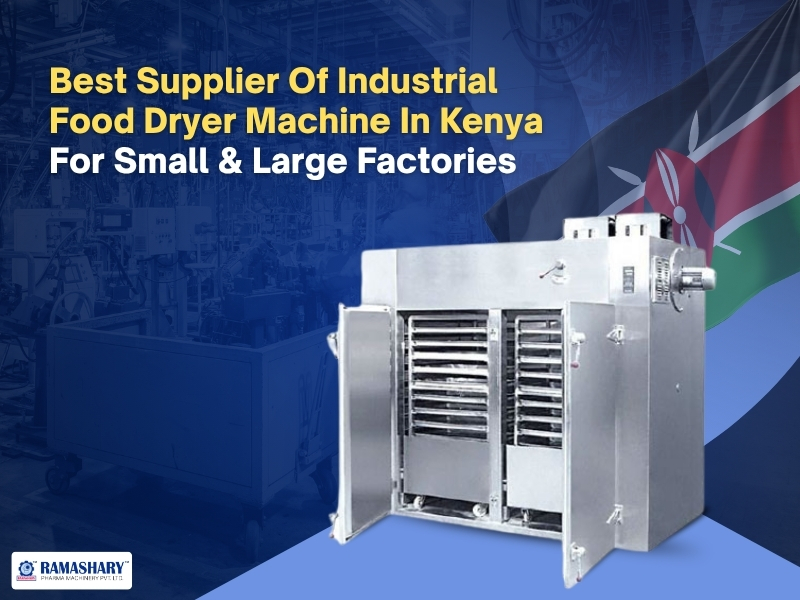
Working principle. A Tray Dryer removes moisture from a product by controlled heating. Warm air circulates through a closed cabinet and passes over trays that hold the material. Moisture moves from the product into the air and the humid air leaves the cabinet.
Materials it can handle. Tray dryers can process a variety of food materials, provided the product can be spread appropriately on trays and tolerate the selected drying conditions. Common examples include sliced fruits, vegetables, culinary herbs, spices and selected food ingredients. Product thickness, moisture content, heat sensitivity and loading depth influence drying time and the quality of the finished material.
Exact working in detail. The operator spreads the prepared food material across trays and loads them into the drying chamber. Once the chamber is closed, a fan circulates air through a heating system and distributes it around the trays. As the warm air contacts the product, moisture evaporates and is carried out through the exhaust.
Real-world food products. Such a food dehydrator machine in Nepal is used by food processors to dehydrate sliced fruits such as apples and bananas, vegetables such as onions and leafy produce and herbs such as mint, parsley and basil.
3. Roto Cone Vacuum Dryer (RCVD)
Working principle. A Roto Cone Vacuum Dryer removes moisture from wet solids by combining indirect heating, slow vessel rotation and vacuum. The machine features a sealed, jacketed vessel with a double-cone shape.
Heat supplied through the outer jacket warms the material, while reduced pressure inside the vessel allows moisture to evaporate at a lower temperature than it would under normal atmospheric conditions.
Materials it can handle. A Roto Cone Vacuum Dryer can process suitable wet powders, crystals, granules and filter cakes from which moisture or certain solvents need to be removed. In food processing, potential applications include selected food ingredients, crystalline products, powdered ingredients and other materials that require low-temperature drying.
The material must be compatible with vacuum operation, the heating conditions and the machine’s contact surfaces. Products that are sticky or tend to form lumps may require specific equipment features or process adjustments to achieve the required result.
Exact working in detail. The process begins by loading the wet material into the drying vessel and sealing the chamber. A heating medium, such as hot water, steam or thermal oil, circulates through the outer jacket to transfer heat indirectly to the product. At the same time, a vacuum system reduces the pressure inside the vessel, helping moisture or suitable volatile solvents evaporate at lower temperatures.
As the vessel rotates slowly, the material tumbles from one section to another, allowing different portions of the batch to contact the heated internal surface. The vapour produced during drying is drawn through the vacuum line. Once the material reaches the specified drying endpoint, the system is returned to a safe discharge condition and the dried product is removed through the outlet valve.
Which Dryer Should You Choose?
- Choose a Tray Dryer if your business processes sliced fruits, vegetables, herbs or similar materials that can be spread on trays. It can be a practical option for small and medium-sized food-processing units, pilot batches and businesses handling different products in separate runs.
- Choose a Fluid Bed Dryer if you process free-flowing granules or particles that can be suspended by an upward flow of heated air. It provides effective contact between air and the material, making it worth evaluating for suitable granulated food ingredients, seasoning components and instant food mixes.
- Choose a Roto Cone Vacuum Dryer if your product requires drying under reduced pressure, particularly when exposure to higher temperatures needs to be limited. It may suit specialised ingredients, crystals and suitable wet solids, although its cost and operating requirements should be assessed against the actual production need.
Other Food & Beverage Processing Machines In Nepal
1. Liquid / Sugar Syrup Manufacturing Plant
Working principle. The Liquid / Sugar Syrup Manufacturing Plant prepares syrup in a closed and controlled system. Sugar is melted and mixed with other liquids and then moved to storage. A high-speed stirrer and a heating arrangement control temperature and viscosity.
Materials it can handle. This plant can process granulated sugar, water and other formulation ingredients used in food and beverage production. Depending on the product and system design, it can prepare syrup bases for soft drinks, fruit beverages, flavoured drinks, confectionery and other food applications. Ingredients such as colours, flavours or acidity regulators may be added at the appropriate processing stage, according to the product recipe.
Exact working in detail. The process begins by charging the required quantity of water and sugar into the preparation vessel. An agitator circulates the mixture to help dissolve the sugar, while heating may be applied when the concentration or formulation requires it. Temperature, mixing speed and processing time are set according to the product specifications.
Once the sugar has dissolved, the syrup can be checked for its required concentration and transferred through a suitable filtration system to remove unwanted suspended particles. Additional ingredients can be incorporated at the designated stage before the syrup is sent for further processing, such as beverage mixing or filling. The exact sequence depends on the product formulation and plant configuration.
Real-world food products. The liquid syrup manufacturing plant in Nepal can be used for making the base for squashes, flavoured drinks and soft drink concentrates. A liquid syrup manufacturing plant in Nepal can also support juice blends and sweet syrups used in dessert shops and bakeries. This is how a beverage brand gets a clean start. The plant covers the syrup stage that sits behind every soft drink-making machine in Nepal. It is also one of the beverage processing machines in Nepal that small brands ask about first.
2. Mass Mixer
Working principle. A Mass Mixer blends wet and dry ingredients by slow and heavy stirring inside a trough or bowl. Paddles or agitators move material until the whole batch is uniform.
Materials it can handle. Depending on its design and mixing mechanism, a Mass Mixer can handle dry food powders, granulated ingredients and selected moist or semi-solid mixtures. These may include spice blends, seasoning ingredients, bakery premixes, confectionery mixtures and dough-like materials.
The suitable configuration depends on factors such as particle size, moisture content, stickiness and the resistance the material offers during mixing. Food processing equipment made for dry blending may not be appropriate for a dense paste or a heavy, wet mixture.
Exact working in detail. The ingredients are loaded into the mixing vessel according to the batch formulation. Once the machine starts, the motor drives the mixing paddles, which move and redistribute the material within the chamber. For recipes requiring liquid addition, measured quantities of water, oil or other suitable liquids can be introduced during the process, provided the machine is designed to handle wet mixing.
The operator selects an appropriate mixing duration and operating speed based on the ingredients and desired result. Once the batch reaches the required consistency, the material is discharged for the next processing stage, such as shaping, cooking, drying or packaging. Some models include a tilting vessel to simplify unloading and cleaning. Proper loading, mixing time and equipment selection are important for achieving consistent results across batches.
Real-world food products. In snack manufacturing, it can mix selected seasoning blends and ingredients for products such as namkeen and other savoury snacks. In bakeries, suitable models can prepare dough and combine ingredients for selected bakery premixes. They may also be used for mixing confectionery masses, spice mixtures and other food formulations that require controlled mechanical blending.
3. Double Cone Blender
Working principle. A Double Cone Blender is designed to blend dry powders and free-flowing granules into a uniform mixture. Its mixing vessel consists of two cone-shaped sections joined at the centre. As the vessel rotates, gravity causes the ingredients to tumble and cascade between different sections, repeatedly redistributing the particles throughout the batch.
This gentle mixing action makes the machine suitable for materials that need blending without intensive mechanical agitation. The final uniformity depends on the ingredients, loading level, rotation speed and mixing time
Materials it can handle. A Double Cone Blender is suitable for many dry food ingredients, including flour-based ingredients, starch, spices, seasoning powders, coffee, cocoa, powdered milk and granulated food components.
Exact working in detail. The required quantities of dry ingredients are loaded into the vessel through its charging opening. The blender is filled to a suitable working level, leaving enough space for the materials to move during rotation. Once the machine starts, the vessel rotates around its axis, causing the ingredients to move from one section to another through tumbling and cascading.
As the cycle continues, the particles repeatedly redistribute within the vessel, helping combine the ingredients into a consistent blend. The operator selects the mixing duration and rotational speed according to the formulation and required result. After mixing, the finished batch is discharged through a suitable outlet, commonly fitted with a butterfly valve.
Real-world food products. Double Cone Blenders are used in food-processing facilities to combine dry ingredients before further production or packaging. Applications include blending spice powders and seasonings for savoury snacks, preparing dry beverage mixes, combining powdered ingredients for instant soups and premixes, and mixing cocoa, coffee or powdered milk with other compatible ingredients.
Struggling With Inconsistent Drying Results?
FAQs
1) Can you customise a food dehydrator machine in Nepal for our own product and batch size?
Yes, we provide customised machines according to the processing needs of each industry. Tell us the product and its starting moisture and your target moisture. Share your batch size and your available utilities. A customised food dehydrator machine in Nepal usually gives steadier quality than a generic unit.
2) What capacity does your liquid syrup manufacturing plant in Nepal cover?
Our syrup manufacturing plants range from 50 litres to 10,000 litres. A new brand can start small. A larger brand can choose a bigger liquid syrup manufacturing plant in Nepal from day one. That range makes the plant one of the more ideal beverage processing machines in Nepal for both small and large brands.
3) How should we plan for power cuts?
Discuss about the existing process conditions with our team. We can figure out steam or electric heating where the machine allows it. We can also discuss PLC control and monitoring options.
4) Can a small company start with one machine and expand later?
Yes, our machines serve small-scale and large-scale production. A small spice or snack unit can begin with a Tray Dryer and a Mass Mixer. As orders grow, you can add a Fluid Bed Dryer or a blender or a larger syrup plant.
5) Will drying affect the product’s colour, flavour, texture or nutritional value?
Drying can affect the product’s colour, flavour, texture or nutritional value. That’s why it is important to choose the right food dryer machine in Nepal or anywhere in the world. A Tray Dryer, Fluid Bed Dryer or a Roto Cone Vacuum Dryer can be selected according to the materials, end product, etc.
Conclusion
Demand for packaged food, juices and dried and organic products is rising in Nepal. Exports of dried ginger and turmeric are reaching Europe. At the same time, plants face heavy post-harvest losses, unstable power and tighter licensing and slow spare parts. A dependable food dryer machine in Nepal and the right food processing equipment can lift quality, cut waste and help get new buyers. Choosing a food machinery supplier in Nepal who offers customisation and support is as important as choosing the machine itself.
Ramashary Pharma Machinery Pvt. Ltd. offers machines that are customised and built to GMP principles. The company backs them with installation, training, documentation, after-sales support and spare parts. Whether you run a small spice unit or a large beverage plant, Ramashary Pharma Machinery Pvt. Ltd. can help you grow as your business partner.
Connect with our process engineering team now for a consultation.