Ramashary.com

Pharma Machinery Supplier in Bangladesh | Pharmaceutical Equipment

Looking for a reliable pharma machinery supplier in Bangladesh? We provide quality pharmaceutical equipment designed to support efficient and consistent production processes. As a trusted source for pharmaceutical machinery in Bangladesh, we cater to pharmaceutical companies seeking dependable solutions for their manufacturing requirements. Our range includes tablet coating machines, rapid mixer granulators, and tablet manufacturing equipment. If you are searching for a tablet coating machine in Bangladesh, we offer solutions to support tablet finishing and coating processes. Our rapid mixer granulator in Bangladesh solutions are suitable for pharmaceutical powder mixing and granulation applications. As a pharma machinery manufacturer, we focus on equipment quality, performance, and practical manufacturing needs. Businesses looking for pharmaceutical machinery suppliers in Bangladesh can explore suitable equipment for their production facilities. Whether you need a tablet making machine in Bangladesh or other pharmaceutical processing equipment, choosing the right machinery is essential for maintaining production efficiency. Connect with an experienced pharma machinery supplier in Bangladesh to find equipment that meets your operational requirements and supports your pharmaceutical manufacturing goals.

Walk into any pharma plant in Gazipur or Savar and you will notice one thing quickly. The medicine is only as good as the machine that makes it. Bangladesh now meets about 98% of its own medicine demand and ships to more than 130 countries. That success puts real pressure on every production floor.
Plant heads keep asking the same question: Which pharma machinery supplier in Bangladesh can give us GMP-ready equipment that fits our process and our budget? The answer decides how easy your next five years of production will be. It also decides how well pharmaceutical machinery in Bangladesh performs when audit season arrives.

Bangladesh Pharma Industry Overview

Bangladesh is one of the few least developed countries with a full pharmaceutical industry. Local companies now supply almost all medicines sold at home. In the years after independence, the picture was very different.
Multinational firms controlled nearly 95% of the market and most drugs were imported. The national drug policy of 1982 changed that. Today the sector is a major employer and an export earner. For anyone buying pharmaceutical machinery in Bangladesh, these numbers explain why demand for reliable equipment keeps growing.
The table below pulls together the figures that matter most for machinery buyers.
Indicator Latest figure Why it matters on the plant floor
Domestic demand met locally
About 98%
Plants run at high load and need machines that stay available
Local market size
More than Tk 300 billion (Tk 90 billion in 2010)
A tripled market means more batches and more capacity upgrades
Pharma exports FY2025-26
$238.5 million (about 12% above $213.2 million)
Export buyers audit equipment records and cleaning proof
Export reach
More than 130 countries
Documentation must satisfy regulators outside Bangladesh
Active pharma companies
213
Competition pushes plants to cut batch failures and downtime
API import dependence
More than 85% (about $1.3 billion a year)
Costly inputs make yield loss expensive
Three points stand out from this data. First, the home market is large and still growing. The population is over 178 million and local firms meet 98% of demand, with a market size reported above Tk 300 billion in the latest report. A plant that cannot keep pace loses shelf space to rivals quickly.
Second, Export-focused firms are investing in better lines. Third, the cost of raw materials is high. When more than 85% of APIs are imported, every kilogram lost in a bad batch hurts.
What does this mean for buyers of a tablet-making machine or a tablet coating machine in Bangladesh? It means the machine must protect yield first. It must also keep records that satisfy auditors. A Rapid Mixer Granulator in Bangladesh that gives uneven granules can ruin a whole lot of tablets before anyone notices.
The right pharma machinery manufacturer will therefore talk about repeatability, cleaning and documentation before talking about price. A trusted pharma machinery supplier in Bangladesh will also support you after installation because the real test begins when production starts.
The industry is also changing fast. Bangladesh is set to leave the least developed country (LDC) group on 24 November 2026. That move begins the end of the patent waiver that helped local companies make generics at low cost.
Active pharmaceutical ingredients (APIs) are still mostly imported. Gas and power supply remain uneven in industrial areas. Every wasted batch now costs more. An advanced tablet making machine in Bangladesh is therefore not about having a single equipment. It is a full line that covers binder preparation, coating, granulation, etc. Each step must be consistent and clean and documented.
This is where customised and GMP-certified equipment becomes a business need. Off-the-shelf machines rarely match your batch size or your product mix. A well-built tablet coating machine in Bangladesh must handle humid weather and tight audit rules. A Rapid Mixer Granulator in Bangladesh must give consistent granules batch after batch.

Want To Reduce Dependence On Imported Raw Materials?

7 Trends Shaping the Pharma Industry in Bangladesh

Trends tell you where equipment demand is heading. Here are seven that plant leaders should watch.

1. Exports Are Growing & Spreading To New Markets

Exports have more than doubled in seven years and reached $238.5 million in FY2025-26. Sri Lanka and Myanmar lead the list of buyers. Cambodia grew the fastest at nearly 30%. New markets bring new inspection checklists. Plants that sell abroad need equipment records that stand up to foreign auditors. Many pharmaceutical machinery suppliers in Bangladesh and overseas now compete on documentation as much as on machine specifications.

2. The API Park Is Pushing Backward Integration

The 200-acre API industrial park in Gazaria Munshiganj was announced in 2008. Around 27 companies hold plots there. Experts still say gas supply and effluent treatment need to be fixed. Once the park runs fully, local firms will make more raw materials at home. That means more demand for blenders, dryers, mills and sifting equipment. A good Rapid Mixer Granulator in Bangladesh is only the start of that equipment list.

3. Complex Formulations Are On The Rise

Bangladeshi firms are moving into insulin, hormones and anti-cancer drugs and inhalers and lyophilised injectables. Imports of medicines to treat specific issues are on the rise. This shift raises the bar for hygiene and containment in solid dose areas too. Plants want closed processing and easy cleaning. They look for pharmaceutical machinery in Bangladesh that supports clean changeovers between products.

4. Biosimilars & Higher Margin Products Are In Focus

Analysts say local firms must move beyond basic generics into biosimilars and oncology and biologics to capture better margins. Not every plant will make that jump. But many will upgrade their oral solid lines. A reliable pharma machinery manufacturer can help by providing lines that run efficiently and need less rework.

5. Companies Are Preparing For Life After LDC Graduation

The waiver on patent royalties is tied to LDC status. Graduation on 24 November 2026 starts the phase-out and some experts expect pressure on costs. Firms are trying to launch generics of patented molecules early and tighten costs. For a procurement head, this is the moment to pick a pharma machinery supplier in Bangladesh who offers fair pricing and lasting support.

6. Regulated-Market Standards Are Becoming Normal

Bangladeshi products now reach the United States and several European countries. Some plants hold WHO prequalification and other international approvals. Regulators there inspect cleaning and calibration and data records closely. A tablet coating machine in Bangladesh with wash-in-place connections and closed chambers makes that inspection easier. A tablet making machine in Bangladesh built with smooth finishes and clear documentation helps too.

7. Strong Home Demand Keeps Capacity Expansion Going

The local market has tripled since 2010. Each expansion needs granulation, drying and blending equipment that fits the new layout. Buyers who plan early get better delivery slots from a pharma machinery supplier in Bangladesh or an overseas partner.

Pharma Manufacturing in 5 Key Bangladesh Cities

Pharma production in Bangladesh is concentrated around Dhaka. Each city or district has its own character. Knowing the local picture helps you plan logistics and service visits when you choose a pharma machinery supplier in Bangladesh.

1) Dhaka

Dhaka is the nerve centre. Most large companies keep their head offices here. The Directorate General of Drug Administration (DGDA) sits in Mohakhali and issues the GMP certificates that plants need. Procurement teams and regulatory teams work in the city while factories sit in nearby districts.
For machinery buyers, Dhaka is where decisions are made. Many pharmaceutical machinery suppliers in Bangladesh therefore can keep sales contacts here even when the plants are elsewhere.

2) Gazipur

Gazipur is a major factory belt north of Dhaka. Listings show plants in Tongi, Kaliakoir, Sreepur and Rajendrapur. Gazipur plants face heavy energy demand because many industries share the same grid. A dependable tablet making machine in Bangladesh needs efficient dryers and stable controls. A rapid mixer granulator in Bangladesh used in this belt should handle long shifts without drift in batch quality.

3) Narayanganj

Narayanganj has old and respected pharma sites. River access and nearness to Dhaka make logistics easy. Many plants here run older lines that need upgrades. Replacing worn pharmaceutical machinery in Bangladesh with newer GMP-friendly units can cut cleaning time. An advanced tablet coating machine in Bangladesh can also bring smoother finishes to products that were once coated by hand.

4) Savar

Savar and nearby Dhamrai and Jirabo host some of the best-known plants. The area also has many garment factories that compete for gas and power. Reports say power and gas shortages cut output by 15% to 20% in the Savar, Ashulia and Dhamrai belt.
Plants here value any pharma machinery manufacturer who can customise machines for tight utilities and steady output. They also look for a pharma machinery supplier in Bangladesh who can respond quickly when a line stops.

5) Munshiganj

Munshiganj matters because of the API park at Gazaria. The park covers 200 acres and 27 firms have taken plots. When it is fully operational, it can cut the country’s heavy reliance on imported raw materials. Factories listed at Gazaria already make formulations too.
API production needs reactors, filters, dryers, blenders and sifters. Firms setting up here will need pharmaceutical machinery suppliers in Bangladesh who can design equipment around chemical and API requirements. Early planning with a skilled pharma machinery manufacturer saves months during commissioning.

Planning To Expand Your Pharma Production Line?

7 Factory-Floor Challenges in Bangladesh Pharma Plants

Every plant has its own headaches. These 7 show up again and again on production floors across Bangladesh. Each one points back to the machine and to the partner who supplies it. Think of this list as a quick audit of your own line.

1. Gas & Power Supply Gaps

Bangladesh’s daily gas demand is approximately 3.8 billion cubic feet, while local production and imported LNG supply is around 2.7 billion cubic feet. In the Savar, Ashulia and Dhamrai belt, generators have cut output by 15% to 20% on average. The pharma sector feels it too.
A gas crisis recently cut paracetamol API output because the boilers run on natural gas. Paracetamol is the fourth highest-selling medicine category in the country. Dryers and coating pans use a lot of heat and power.
A pharma machinery supplier in Bangladesh who understands this will design for efficient cycles and stable control. A good pharma machinery manufacturer will also let you set temperature and airflow precisely so no energy is wasted.

2. Costly Imported APIs & Yield Loss

Bangladesh imports APIs costing approximately $1.3 billion. Whatever the exact figure, the message is the same. Raw material is expensive and a failed batch burns cash. Uneven mixing in a rapid mixer granulator in Bangladesh or poor drying can push a whole lot out of specification. Buyers of pharmaceutical machinery in Bangladesh should treat yield protection as a first buying criteria.

3. Margin Pressure After LDC Graduation

Graduation on 24 November 2026 starts the phase-out of the patent waiver. Experts warn that licensing fees and input costs will rise and squeeze the sector from both ends. A pharma machinery supplier in Bangladesh cannot change those rules. But the right equipment can lift efficiency and cut rework so margins hold. A tablet making machine in Bangladesh that runs with fewer stops pays back faster in this new environment.

4. Tougher GMP & Audit Expectations

Bangladesh has hundreds of licensed manufacturers. One estimate counts 267 and notes that quality standards vary between them. At the same time, exports reach regulated markets where inspectors review cleaning, calibration and batch records closely.
Cross-contamination between products is a common finding. A tablet coating machine in Bangladesh that opens easily and washes in place helps your team stay audit-ready. So does any equipment that comes with design and quality documents.

5. Humidity & Inconsistent Drying Or Coating

Bangladesh has a hot and humid climate with a long monsoon season. Moist air makes powders sticky and slows drying. It also causes coating defects such as roughness and sticking. Plants that depend on open or poorly controlled equipment see more rejects in the rainy months. Machines with controlled inlet air and measured bed temperature give steadier results all year round.

6. Operator Skills & Training Gaps

A SANEM assessment of the national API policy flagged a severe human capital gap in the sector. Plants feel a similar pinch at operator level. Advanced machines run on PLC and HMI controls. If operators do not know the settings, they run the machine below its ability or make costly mistakes. Training should come with the machine and not as an afterthought.

7. Slow Service & Spare Part Delays

When a machine stops, the whole schedule slips. Waiting weeks for an engineer or a part is painful for plants with tight export dates. Machines bought from distant sources often carry this risk. The best pharma machinery supplier in Bangladesh or abroad is the one that stays reachable after the sale and keeps spares ready.

Best Pharma Machinery Supplier In Bangladesh

Ramashary Pharma Machinery Pvt. Ltd. is an ISO and GMP-certified company based in India. We work with global manufacturers to identify machinery that meets their production requirements, quality standards and expansion plans.

  • 40+ years of experience
  • 700+ site installations
  • 20+ industries
  • 20+ dedicated machines
With significant experience, we understand that not all manufacturers face the same challenge. Somewhere, the problem is in the machine, while somewhere the issue lies in the process itself. Since one stage depends on the previous, we begin by understanding your unique challenges. Here’s how we help solve the above challenges as an experienced pharma machinery supplier in Bangladesh.

1. Energy-Efficient Machines

To be honest, a pharma machinery supplier in Bangladesh cannot eliminate gas shortages or power interruptions, but it can help manufacturers reduce energy consumption and manage available utilities more efficiently. Our machines are designed for energy savings, with precise process controls that can help minimise avoidable energy losses.
For dryers and coating equipment, controlled temperature, airflow and heating cycles reduce unnecessary energy use while maintaining the required process conditions. Suppliers can also assess utility requirements before installation and recommend compatible configurations.

2. Saving Material Loss

When APIs are expensive, preventing avoidable material loss becomes particularly important. A pharma machinery manufacturer can help improve process consistency through suitable mixing, granulation, drying and material-handling equipment.
Our dedicated machines are customised according to the requirements, which reduces dead spots and raw material wastage. Batch consistency can be easily maintained through precise temperature, airflow, timing and speed controls that help reduce batch rejection and material wastage.
Multi-product versatility and support for diverse formulations help use different materials efficiently. Thus, even during global supply chain disruptions, the pharma manufacturer won’t have to depend much on raw materials, as the existing material is being used efficiently.

3. Cost Efficiency

Energy efficiency, machine compatibility, multi-product versatility, precise controls and space efficiency altogether help save raw materials and reduce production costs over time. As a pharma machinery manufacturer, we focus on scalability and your business goals, which means these machines will be useful in the long run.
These machines can be integrated into the existing production lines or installed as standalone equipment. All these factors eliminate the need to change your machines as your factory expands.

4. Support For Compliance

We follow ASME BPE, 21 CFR, SCADA, CE, WHO-cGMP, GMP, Industry 4.0 and international validation protocols. Also, we provide end-to-end documentation, including the OQ, IQ, DQ and FAT reports and MOC certificates. The machines are made with high-quality SS 304/216L. All these factors help the manufacturers ensure compliance, even in the export markets. This positions us as a leading pharma machinery supplier in Bangladesh.

5. Humidity & Inconsistent Drying Or Coating

High humidity can affect powder handling, drying times and coating performance. As a leading supplier of pharmaceutical machinery in Bangladesh, we make sure that our machines help manage these variables through controlled process conditions and equipment suited to the product and production environment.
Fluid bed dryers and tray dryers can be configured to support appropriate temperature and airflow control. Coating equipment with controlled spray rates, inlet-air conditions and product-bed temperature can help reduce defects such as sticking, rough surfaces and uneven coating. The right configuration depends on the formulation, moisture sensitivity and local environmental conditions.

6. Operator Skills & Training Gaps

Advanced pharmaceutical machinery in Bangladesh can deliver its intended performance only when operators understand how to run it correctly. We reduce the learning curve by providing operator training alongside installation and commissioning.
The machines are made with operator safety and ease of use at the core. Clear operating and instruction manuals help teams follow consistent practices across shifts.

7. Ongoing After-Sales Service & Assured Spare Parts

Unplanned downtime can disrupt production schedules, delay dispatches and increase operating costs. As one of the top pharma machinery suppliers in Bangladesh, we provide ongoing after-sales service and assured spare parts. This positions us as more than just a pharma machinery manufacturer or supplier; it makes us a long-term global machinery partner.

Reduce Production Costs With Energy-Efficient Machines

Top 7 Pharma Manufacturing Machines In Bangladesh

A tablet line is a chain. If one link is weak, the whole chain suffers. That is why plant teams searching for a pharma machinery supplier in Bangladesh should look at the full chain and not just one machine. The following machines follow the order of an oral solid dose line: binder preparation, granulation, drying, sizing, screening, blending and coating. They cover the stages before and after compression.
Whether you are upgrading pharmaceutical machinery in Bangladesh or planning a new tablet-making line, these seven are the machines to understand first.

1. Starch Paste Kettle

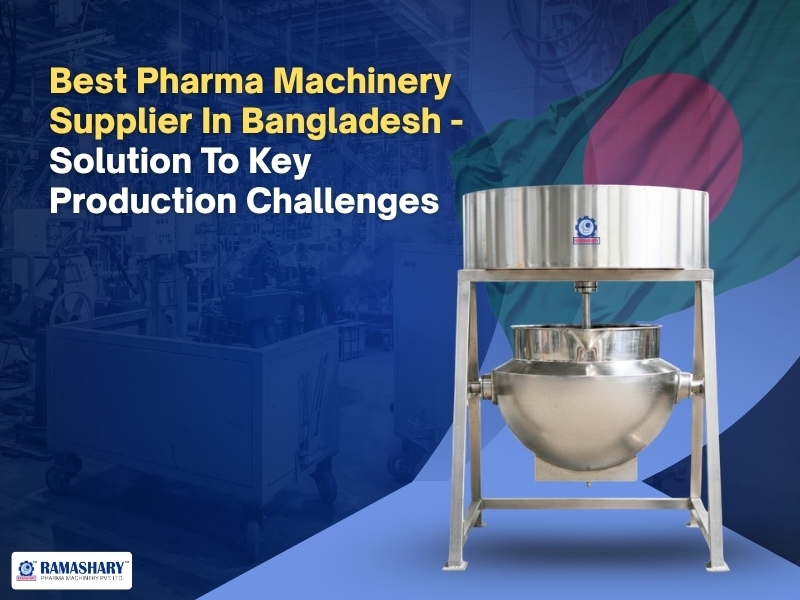
Binders hold powder particles together during granulation. Starch paste is one of the oldest and most trusted binders. The Starch Paste Kettle prepares it with steady heat and mixing. A good paste sets the tone for the whole granulation step. As a pharma machinery manufacturer, we provide it with a tilting facility as per the requirements.

Materials it handles: Starch-based materials and other semi-solid and sticky materials used in tablet granulation. The same kettle is also useful in food, chemical and cosmetic work.

Applications: Starch paste is widely used as a binder in common tablets such as paracetamol and multivitamin tablets.

Capacity Range: 10 L to 500 L

2. Rapid Mixer Granulator

A Rapid Mixer Granulator (RMG) is a machine that mixes dry powders and then binds them into granules using a liquid binder in a single bowl. Many production heads call it the heart of the granulation room. If you search for a rapid mixer granulator in Bangladesh look for controllable speeds, clean design and proper interlocks.

Materials it handles: Powders and powder blends used in pharmaceutical, nutraceutical, herbal and Ayurvedic work.

Applications: Granules for paracetamol tablets, antibiotic tablets, multivitamin tablets and herbal tablets are typically made this way.

Capacity Range: 05 L to 1,500 L

3. Fluid Bed Dryer

A Fluid Bed Dryer (FBD) removes moisture from wet granules or powders by blowing hot air through them so they behave like a fluid. After the RMG, the granules are wet. They must reach the right moisture level before compression. Plants that run a tablet manufacturing line often judge a supplier by how well the dryer performs in humid months. Plants using a rapid mixer granulator in Bangladesh get the best results when the machine is customised according to the requirements.

Materials it handles: Granular materials, powders, agglomerates and crystalline materials. It is used with pharmaceuticals, chemicals, food products, minerals, dyestuffs and catalysts.

Applications: Dried granules for analgesic, antacid and vitamin tablets.

Capacity Range: 05 kg to 500 kg

4. Multi Mill

After drying, the granules can form lumps and uneven sizes. The Multi Mill reduces them to a controlled size. The GMP Model helps if your audit expectations are high. As an experienced pharma machinery manufacturer, we also advise on screen size. This is a good example of how pharmaceutical machinery in Bangladesh can be customised to get the required product.

Materials it handles: Dry solids that need size control. It can also be used in fertiliser, plastic, ceramics and resin industries.

Applications: Sizing of dried granules before blending in tablet lines for common medicines such as antacid and pain relief tablets.

5. Vibro Shifter

A Vibro Shifter is a sieving machine that uses gyratory vibrations to grade and separate powders and granules. It is also called a vibrating shifter, check screen, vibro sieve or safety screener. As an experienced pharma machinery supplier in Bangladesh, we explain its mesh options clearly.

We offer multiple check arrangements according to the requirements. For plants that care about pharmaceutical machinery in Bangladesh as an investment, a good sifter is a better way to protect tablet quality.
The machine revolves and vibrates in a gyratory motion. This lets it perform scaling, sorting and scoring operations at high efficiency. It is suited to grading, separating and scalping.

Materials it handles: Powders and granules that must be separated by size. Enclosed screening removes harmful dust and dangerous gases.

Applications: Sifting of granules and blends before compression for tablets such as paracetamol and vitamin tablets.

Capacity Range: 08” Dia to 72” Dia

6. Octagonal Blender

An Octagonal Blender is a slow tumbling blender used to mix dry powders and to lubricate granules before compression. The octagonal shape and the baffles inside help the powder flow in a good pattern. We build it for gentle blending of sensitive materials.

Plants that depend on a tablet making machine in Bangladesh often face content uniformity issues here. That is why blender choice matters. Among pharmaceutical machinery suppliers in Bangladesh, this blender is a frequent request from plants that want gentle handling.

Materials it handles: Dry powders where the bulk is much larger than the active ingredient. It also handles the lubrication of granules of various shapes and sizes.

Applications: Lubricated blends for tablets and powder blends for nutraceutical supplements.

Capacity Range: 05 L to 12,500 L

7. Ramashary's Automatic Tablet Coating Machine

Tablet coating is the process of applying a thin layer of sugar or film over a tablet. Coating improves appearance, masks taste and protects the tablet. The coating stage is where many plants lose time and tablets. Ramashary’s Automatic Tablet Coating Machine is ideal for both sugar and film coating.

We provide a tablet coating machine in Bangladesh that withstands the weather conditions and is easy to clean. That’s why our process begins with understanding your requirements. Processing happens in a closed chamber so hazardous material stays inside. A Wash In Place system comes with the required connections. A faster automatic discharge avoids human touch.

Materials it handles: Tablets for sugar and film coating. Optional uses include sugar coating candies and giving seeds an insect-protection film.

Application: Film-coated tablets, sugar-coated tablets and enteric-coated tablets for common medicines such as pain relief and antibiotic tablets.

Size Range: 30” Dia Pan to 60” Dia Pan

Reduce Coating Defects & Tablet Rejection

FAQs

1. Can you provide multiple machines as a part of a single production line?

Yes, we can provide multiple machines as a part of a single production line. These machines include, the blenders, sifter, granulator, tablet coating machines, assured spare parts and more. It makes us more than just a pharma machinery supplier in Bangladesh; it makes us a long-term business growth partner.

2. How do we choose the right capacity for a Rapid Mixer Granulator?

Start with your batch size. Then consider impeller and chopper needs, binder addition rate and cleaning time. While looking for a Rapid Mixer Granulator in Bangladesh, plan for future growth too. Our team can help you select a model between the small lab size and the larger production sizes according to your requirements.

3. What other industries do you provide machines for?

We provide dedicated machines for 20+ industries such as chemical, fertiliser, cosmetic, paints and coating, food and beverage, confectionery, etc. We understand that every industry brings different challenges, which is why we provide customised machines after understanding your unique challenges.

4. Can the machines accommodate in my small factory?

Yes, we provide machines in varying capacities that can be accommodated in a small factory. For that, we first conduct a space and a process analysis. We also consider your scalability goals to make sure that these machines can help you in the long run.

5. What spare parts do you provide?

We provide sifter sieves, scoops, FBD finger bags and more. We provide assured spare parts as a part of of post-fabrication support, which positions us as a long-term business growth partner rather than just a one-time pharma machinery supplier in Bangladesh.

Conclusion

The pharma industry in Bangladesh has come a long way. Local firms meet about 98% of domestic demand and export to more than 130 countries. The market has tripled since 2010. Yet the road ahead is not easy.
LDC graduation on 24 November 2026 will phase out the patent waiver. APIs are still largely imported. Gas and power remain tight. In this situation, every batch counts. The choice of pharma machinery supplier in Bangladesh now shapes yield and audit results and long-term margins.
Ramashary Pharma Machinery Pvt. Ltd. is that partner. We provide customised machines, end-to-end documentation, site installation, operator training and ongoing after-sales support. Our range of 20+ dedicated machines lets you build a full production line from one source. This single-source approach saves time and coordination effort, positioning us as a business growth partner than just a supplier.

Let’s connect now to discuss your unique production challenges.

Home
Industries
Blogs
Call Us
WhatsApp

Let’s Talk

Contact Form New

I am looking to

My business belongs to

My name is

I represent

Where I hold the position of

My number is

My email is

I am planning to purchase the machine

I heard about Ramashary from

I would like a free consultation

Schedule a Call Now

Schedule a call

Fill the Form to Download Company Profile

Company Profile

Fill the Form to Download Brochure

Download Brochure