
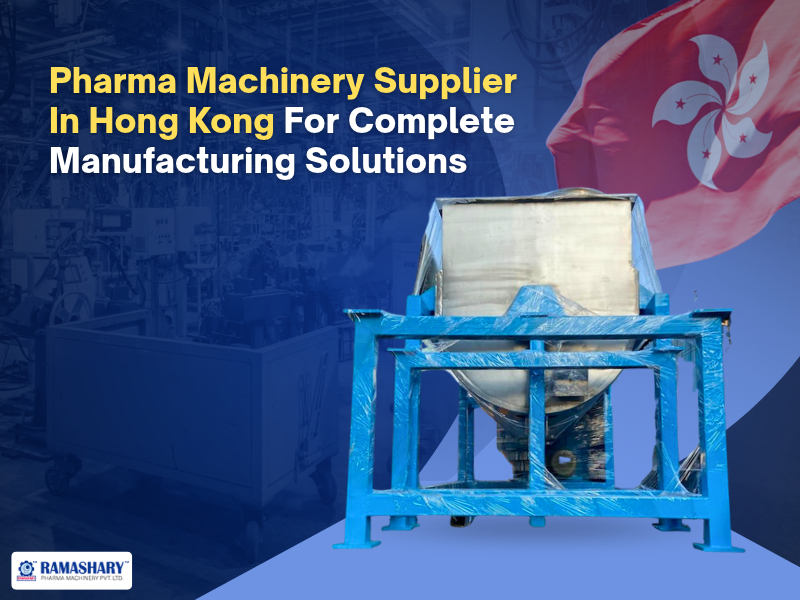
If you run a pharmaceutical plant in Hong Kong today, you are working in one of the most demanding manufacturing units in Asia. Space is scarce. Skilled hands are hard to find. Regulators expect discipline on every batch. In this setting, the choice of a pharma machinery supplier in Hong Kong is not a routine purchase. It shapes your yield, your audit results and your ability to grow for the next ten to fifteen years.
Hong Kong’s pharma sector is small in headcount but sharp in focus. It also has a compact group of licensed Western drug manufacturers who supply hospitals, clinics and export markets. Most of these plants are not giant greenfield sites. They are tight, multi-storey facilities in places like Tai Po, Yuen Long, Tseung Kwan O, Kwai Chung and Tsuen Wan. Every square metre has to earn its keep.
The regulatory picture is also changing fast. Hong Kong started the “1+” new drug approval mechanism in November 2023. It began phased “primary evaluation” of new drugs in March 2026. A new Centre for Medical Products Regulation (CMPR) is being set up this year.
For manufacturers, this means one thing: more scrutiny, more data and less room for process drift. Older mixers that leak, granulators that give uneven granules and dryers with poor airflow control become real compliance risks.
This is why plant managers and procurement heads now look for customised and GMP-certified pharma machinery in Hong Kong rather than generic equipment off a catalogue. A machine has to fit your floor plan. It has to clean quickly between products. It must give you the same result on batch 1 and batch 500. It should come from a partner who understands documentation, installation and spare parts for the long run.
Hong Kong Pharma Industry Overview - Why Machinery Quality Matters Now
Hong Kong’s pharmaceutical manufacturing base has two main parts.
- Western drug manufacturers: It has a small number of licensed manufacturers of Western medicines. A report recorded 25 licensed manufacturers of Western drugs. GMP has been adopted for Western drug manufacturing since 2002. This tells you the base is small but already GMP-minded.
- Proprietary Chinese medicine (pCm) manufacturers: This is the larger group by number. The same Legislative Council reply recorded 293 licensed pCm manufacturers. A more recent report lists about 264 local pCm manufacturers. Around 2,000 companies take part in the wider pCm and herbal medicine trade.
How Big Is The Export Opportunity?
The pCm segment has a strong export story. Reportedly:
- Hong Kong’s pCm exports reached HK$2.88 billion in 2024.
- About 93% of those exports were produced locally.
- Mainland China took over 70% of exports. Macao took 20%. ASEAN took 6%.
- The mainland pCm market itself is valued at around RMB450 billion.
- About 345 Hong Kong enterprises have registered a total of 8,244 pCms.
These numbers matter for machinery buyers. Export growth to the ASEAN means larger batches, tighter specifications and more frequent customer audits. A plant that wants to grow its share needs pharmaceutical machinery in Hong Kong that can scale without losing consistency.
What This Means For Your Machinery Decisions
Put together, these facts tell a clear story. Hong Kong pharma plants are small, export-led and under rising regulatory pressure. The government wants more high-value manufacturing on limited land. That combination rewards plants that invest in compact, cleanable and well-documented pharma machinery in Hong Kong.
For R&D managers, the message is similar. A formula that works in a 25 L bowl must behave the same way in a 750 L bowl. Choosing pharma machinery in Hong Kong that comes in a wide range of sizes from one design family makes scale-up far more predictable.
It also means your choice of a pharma machinery supplier in Hong Kong should be judged on more than price. Ask whether the supplier can customise to your floor, support GMP paperwork, install on site and keep spares moving for years.
7 Factory-Floor Challenges In Hong Kong’s Pharma Industry
Every plant manager in Hong Kong has a list of daily challenges. Some are global. Many are sharper here because of land, labour and regulation. Below are seven challenges we hear most often from production, engineering and QA teams.
Challenge 1: Very Limited Floor Space & Height
What it looks like on the floor: A pCm maker in Kwai Chung wants to add a second granulation line. The building is a flat factory with a fixed column grid. The only free bay is 6 metres wide. A standard granulation suite with a mixer, a dryer, a mill and a blender simply does not fit in a straight line. The team ends up moving materials by hand across a corridor. That adds time and contamination risk.
Why it is a problem: Land is the tightest resource. A report noted that the main difficulty in commercialising local innovation is the absence of local advanced manufacturing because of land shortage and weak support. HKSTP has responded by building multi-storey industrial buildings for rent to several users at once. That helps supply. It also means many plants work on upper floors with load limits and lift size limits.
What it demands from machinery: Equipment must be made according to the space and process analysis. It must fit irregular rooms. It should allow vertical or L-shaped layouts. A ribbon blender supplier in Hong Kong who only sells one standard length is not much help here.
Challenge 2: Shortage Of Skilled Operators & Maintenance Technicians
What it looks like on the floor: A plant in Tsuen Wan has one senior fitter who understands its old granulator. He is close to retirement. When the impeller seal fails on a Saturday night shift, nobody else knows how to fix it. Production stops until Monday.
Why it is a problem: A report projected a manpower shortage of 180,000 workers by 2028 in its 2023 projection. Skilled technical workers would make up over one-third of that shortage. A September 2026 update narrowed the shortfall to about 130,000.
It still flagged workforce ageing and difficulty attracting young entrants. The local labour force (excluding foreign domestic helpers) slipped from 3.5 million in 2023 to 3.47 million in 2025.
What it demands from machinery: Machines must be simple to run and maintain. PLC and HMI controls reduce reliance on operator judgement. Fewer moving parts mean fewer breakdowns. Clear manuals and spare parts lists help new staff learn faster.
Challenge 3: Rising GMP Expectations On Every Batch
What it looks like on the floor: During a Drug Office inspection, an inspector asks for evidence that the blender cleaning procedure removes residue from hidden corners. The QA manager has a procedure. She does not have proof that the blender design allows full drainage and inspection. The plant receives an observation.
Why it is a Hong Kong problem: Hong Kong licensed manufacturers follow the PIC/S GMP Guide. The Drug Office continues to brief the trade on the latest version and on common deficiencies found in inspections. The Pharmacy and Poisons Board also sets strict qualification and experience rules for Authorised Persons who release batches. pCm manufacturers who want a GMP certificate must meet the guidelines. With primary evaluation now starting, reviewers will look more closely at manufacturing data.
What it demands from machinery: Machines must support cleaning validation. They need smooth contact surfaces, few dead zones and easy dismantling. Suppliers must provide documentation that QA teams can use for qualification.
Challenge 4: Batch-To-Batch Inconsistency In Mixing & Granulation
What it looks like on the floor: A generic tablet line in Tai Po sees hardness and dissolution swings from batch to batch. The cause is traced to granules. Some batches have too many fines. Others have hard lumps. The wet mixing step is done in an old mixer with no speed control. The binder is added by hand.
Why it is a Hong Kong problem: Plants here make many products in small batches. Short runs mean more changeovers and more chances for variation. Exports to the mainland and ASEAN add customer specifications on top of local rules.
What it demands from machinery: Precise speed control on impellers and choppers. Repeatable mixing times. Even drying. Uniform milling and sizing. This is the core reason teams look for a reliable rapid mixer granulator in Hong Kong.
A quick way to check: Pull the granule size data from your last 20 batches. If the spread is wide, the problem is usually in mixing, drying or milling, not in the tablet press. The same check applies to blend uniformity. If a mass mixer in Hong Kong still relies on hand-timed mixing, variation may occur.
Challenge 5: Cross-Contamination Risk In Multi-Product Plants
What it looks like on the floor: A contract manufacturer in Kwun Tong runs a herbal granule product in the morning and a vitamin blend in the afternoon on the same line. A customer audit finds herbal colour traces in a vitamin sample. The customer suspends orders.
Why it is a Hong Kong problem: Small plants cannot afford dedicated lines for every product. Many pCm makers handle dozens of formulas. Herbal extracts are often sticky, coloured and strongly scented. They cling to surfaces and gaskets. Dust from sifting and milling also spreads easily in tight rooms.
What it demands from machinery: Closed or enclosed designs. Easy-clean contact parts. Dust containment during sifting and milling. Equipment that can be stripped and checked quickly between products.
For blending in particular, procurement teams often ask a ribbon blender supplier in Hong Kong two direct questions: how fast can the trough be cleaned and can every corner be inspected? The answer decides how many products one blender can safely handle in a day.
Challenge 6: Long Lead Times & Slow Spare Parts Supply
What it looks like on the floor: A plant orders a fluid bed dryer from a European maker. The quoted lead time is ten months. Six months into the wait, a key export customer increases its order. The plant has to turn it down.
Why it is a Hong Kong problem: Hong Kong has very little local heavy machinery fabrication. Most process equipment is imported. That means long shipping legs, customs work and dependence on overseas service teams. When a part fails, waiting weeks for a gasket or sieve can cost more than the part.
What it demands from machinery: Shorter build times. Spare parts that can be ordered easily. Standard components where possible.
The cheapest machine is not always the lowest cost if spares take weeks to arrive. A good pharma machinery supplier in Hong Kong would help even after the installation.
Challenge 7: High Operating Cost & Pressure To Modernise
What it looks like on the floor: Energy, rent and wages keep rising. Why is the plant still running three separate machines and three operators for a step that could be done in one?
Why it is a Hong Kong problem: Hong Kong is among the most expensive places in the world to run a factory. At the same time, the government’s “new industrialisation” push and InnoPark repositioning favour high value-added processes with advanced technology.
What it demands from machinery: Equipment that combines steps. Machines that cut processing time and energy. Automation that lets one operator manage more output. A pharma machinery supplier in Hong Kong that buyers can trust must help them lower cost per batch.
In short: each of these seven challenges points to the same need. Hong Kong plants need compact, controlled, cleanable and well-supported pharmaceutical machinery in Hong Kong from a partner who thinks about the whole line.
Make Every Production Cycle More Efficient
Leading Pharma Machinery Supplier In Hong Kong
Ramashary Pharma Machinery Pvt. Ltd. (an ISO & GMP certified company) is an industrial machinery manufacturer based in India. The company designs and builds process equipment for pharmaceutical, food and beverage, cosmetic, chemical and allied industries.
- 40+ years of experience and 700+ site installations
- 20+ industries served and 20+ machines
- Customisation as per the requirements and GMP guidelines
- Equipment suited to both small-scale and large-scale production
- Export to the UAE, the USA, the Philippines, Russia and worldwide
The product range covers the full oral solid dose and semi-solid chain. This matters for Hong Kong buyers. When one partner can supply the mixer, the dryer, the mill, the sifter and the blender, the line works as one system. You deal with one set of drawings and one service contact.
As a pharma machinery supplier in Hong Kong, Ramashary Pharma Machinery Pvt. Ltd. brings a complete granulation and blending line under one roof.
Here’s How We Work:
For a Hong Kong buyer the process is simple and practical.
- Enquiry: we understand your requirements during the initial discussion rather than beginning with showing a catalogue.
- Requirement review: We conduct space and process analysis to understand the factory-floor challenges. Best options are suggested accordingly.
- Fabrication stage: We design, engineer and manufacture machines in-house according to your exact requirements. Operator safety and ease of use are at the core.
- Post-Fabrication stage: We are a long-term partner rather than just a pharma machinery supplier in Hong Kong. In this stage, we provide site installation, operator training, commissioning, documentation, ongoing after-sales support and assured spare parts.
This flow suits both a first-time buyer of pharmaceutical machinery in Hong Kong and a large group adding a second line.
1. Solutions For Limited Floor Space
Space problems are best solved at the design stage. Ramashary Pharma Machinery Pvt. Ltd. builds customised machinery to customer requirements. That means the team can discuss your room size, door width, lift limits and floor loading before fabrication starts.
How this helps in practice:
- Wide capacity choice. The ribbon blender runs from 50 L to 12,000 L. The octagonal blender runs from 05 L to 12,500 L. A small plant in Kwai Chung does not have to buy an oversized machine just because it is the only model on offer.
- Fewer machines for the same job. A rapid mixer granulator does dry mixing and wet granulation in one bowl. That can remove a separate mixing step from your layout.
- Combined line planning. Since one supplier builds the whole granulation train, the transfer points between machines can be planned to suit an L-shaped or stacked room.
For buyers looking for pharmaceutical machinery in Hong Kong that fits flatted factories in Tsuen Wan or upper floors in Kwun Tong, this flexibility is often the deciding factor.
It also helps with growth. A plant can start with a 300 L granulator and a mid-size blender. When export orders rise, it can add larger models from the same family without retraining staff on a new design. That is a practical advantage of working with one ribbon blender supplier in Hong Kong buyers can also use for granulators, dryers and mills.
2. Solutions For Skilled Labour Shortage
When skilled hands are scarce, the machine has to carry more of the knowledge. Ramashary Pharma Machinery Pvt. Ltd. addresses this in three ways.
- Automation. The rapid mixer granulator can be fully automated with PLC and HMI controls. Impeller and chopper motors are interlocked for sequential control.
- Simple machines where they fit. The mass mixer uses slow-speed paddles, a gearbox and a tilting device. Such a mass mixer in Hong Kong is easy to operate and maintain for small teams.
- Simple mechanics. The vibro sifter has fewer moving parts than a mechanical sifter. It is easier to assemble, dismantle and clean. The multi-mill is easier to dismantle, clean and inspect.
- Installation and after-sales support. The company provides site installation, after-sales support and assured spare parts as a pharma machinery supplier in Hong Kong. That reduces dependence on one senior fitter who knows the old machine.
A Tsuen Wan plant that loses its veteran technician can still keep running when its rapid mixer granulator in Hong Kong is controlled through an HMI with interlocks.
3. Maintaining Compliance
GMP compliance starts with machine design. Ramashary Pharma Machinery Pvt. Ltd. is ISO and GMP certified. We follow ASME BPE, 21 CFR, SCADA, CE, WHO-cGMP, GMP and Industry 4.0 standards and international validation protocols. DQ, IQ, OQ, FAT reports and MOC certificates are provided to make compliance easy for pharma manufacturers.
For a QA head choosing a pharma machinery supplier in Hong Kong, design-led GMP support saves weeks of remediation later.
4. Maintaining Batch Consistency
Consistency comes from control at each step of the process. Ramashary Pharma Machinery Pvt. Ltd. offers machines that control each critical variable.
- Granulation: The rapid mixer granulator uses a 3-blade impeller and a 4-blade chopper at controlled speeds. The impeller spreads the binder. The chopper speed can be adjusted to produce the target particle size. Wet and dry mixing happen in the same tub. The company says this prevents powder segregation.
- Drying: The fluid bed dryer suspends particles in hot air so each one dries evenly. The control panel regulates temperature and flow rate.
- Sizing: Final particle size depends on knife and impact-edge speed. Blades can run clockwise or anticlockwise. The company says it can run for long periods without loss of output or uniformity.
- Screening: The vibro sifter separates fines from oversize particles with double or triple deck options.
- Blending: The octagonal blender uses baffles to reduce dead zones and give more consistent blends. The ribbon blender moves material so that no area stays isolated.
5. Avoiding Cross-Contamination
Multi-product plants need machines that clean fast and contain dust. Ramashary Pharma Machinery Pvt. Ltd. designs with this in mind.
- Easy cleaning: The multi-mill is easy to clean so residue and cross-batch contamination are reduced. The vibro sifter is easy to dismantle and clean.
- Dust control: The vibro sifter uses enclosed screening. The mass mixer drum helps prevent dusting.
- Closed transfer options: The octagonal blender can take optional vacuum charging for loading and unloading. We also provide a vacuum transfer system.
6. Assured Spare Parts
- A single source for spares across the granulation line.
- Machines with simple mechanics that use standard parts such as motors, gearboxes and sieves.
This matters most for high-use items. A busy ribbon blender supplier in Hong Kong clients rely on should be able to send seals, bearings and valve parts without long delays. The same applies to impeller seals on a rapid mixer granulator in Hong Kong plants run on double shifts.
7. Controlling The Operating Costs
Cost per batch drops when machines combine steps and cut cycle times. The machines are designed for energy savings and space savings.
- The rapid mixer granulator combines dry mixing and wet granulation in one bowl. The company says it offers lower operating costs.
- The mass mixer can process multiple batches in less time.
- The ribbon blender needs less time and space for large dry batches.
- The vibro sifter uses less power than older designs.
- The fluid bed dryer cuts drying time compared with static tray drying because hot air passes through every particle.
This is also why many owners now see Ramashary Pharma Machinery Pvt. Ltd. as a long-term pharma machinery supplier in Hong Kong rather than a one-time vendor.
Planning To Increase Production Capacity?
7 Machines For Hong Kong's Pharma Industry
Most Hong Kong plants make tablets, capsules, granules, powders or pills. All of these depend on a good granulation and blending train. The seven machines below form a complete line: mix, granulate, dry, size, screen and blend. Each one solves at least one of the challenges above.
The table below gives a quick view before we go into detail.
| Machine | Main process step | Capacity range listed by Ramashary Pharma Machinery Pvt. Ltd. |
|---|---|---|
|
Rapid Mixer Granulator
|
Dry mixing and wet granulation
|
05 L to 1,500 L
|
|
Mass Mixer
|
Wet massing of powders with binder
|
Based on batch volume
|
|
Ribbon Blender
|
Large-volume dry and semi-solid blending
|
50 L to 12,000 L |
|
Fluid Bed Dryer
|
Drying of wet granules
|
5 kg to 500 kg
|
|
Multi-Mill
|
Size reduction of dried granules
|
Standard Type and GMP Model
|
|
Vibro Sifter
|
Screening and grading
|
8 inch to 72 inch diameter
|
|
Octagonal Blender
|
Final lubrication blending
|
5 L to 12,500 L
|
1. Rapid Mixer Granulator
Introduction: The rapid mixer granulator (RMG) is significant for a wet granulation line. It turns fine, poorly flowing powders into dense granules that compress well into tablets. For any plant searching for a rapid mixer granulator in Hong Kong, this is the machine that most affects tablet quality.
Working principle: High-shear wet granulation. A bottom-mounted impeller rotates at speed and throws the powder bed into a tumbling, rising motion. A binder solution is added. The impeller spreads the liquid through the powder so particles stick together. A side-mounted chopper cuts large wet lumps into smaller granules. The balance of impeller speed, chopper speed and time decides the final granule size and density.
Materials that can be handled:
- Active pharmaceutical ingredients
- Herbal powders and extracts used in pCm granules
- Nutraceutical powders such as vitamin and mineral blends
- Chemical, food, cosmetic and detergent powders that need agglomeration
Real-world pharma products made using this machine:
- Paracetamol tablets
- High-dose tablets that need good compressibility
- Antacid and calcium tablets
- pCm granules and pressed herbal tablets
- Vitamin C effervescent granules (with suitable process controls)
Available capacities: 05 L to 1,500 L
A plant manager in Tai Po who swaps an old planetary mixer for a modern rapid mixer granulator in Hong Kong usually sees tighter granule size distribution within the first few batches. That alone can cut tablet rejects.
2. Mass Mixer
Introduction: The mass mixer is a sturdy, slower-speed mixer for wet massing. It is a common choice for smaller plants and for products where gentle kneading is better than high shear. Many pCm and nutraceutical makers search for a mass mixer in Hong Kong when they need a simple, robust wet mixing step.
Working principle: Low-speed paddle mixing. Paddle agitators turn inside a drum at a slower speed than an RMG. They fold and knead the powder with binder until a uniform wet mass forms. A tilting mechanism then tips the drum to unload.
Materials that can be handled:
- Dry powders with liquid binders for tablet granulation
- Viscous and difficult materials that need thorough kneading
- Herbal and nutraceutical powders
- Chemical and veterinary formulations
- Food materials such as flour-based mixes and creams
Real-world pharma products made using this machine:
- Wet mass for conventional tablet granulation through an oscillating granulator or multi-mill
- Herbal pill masses for pCm products
- Veterinary boluses and premixes
- Nutraceutical tablet granules
3. Ribbon Blender
Introduction: The ribbon blender is important for large-volume dry blending. It is used for premixes, direct-compression blends, powders for sachets and semi-solid products. Many buyers search for a ribbon blender supplier in Hong Kong when they need high-volume blending in limited space.
Working principle: Convective mixing. A horizontal U-shaped trough holds the material. A shaft carries a double helical ribbon agitator. The outer ribbon pushes material one way along the trough. The inner ribbon pushes it back the other way. This counter-current motion moves every part of the batch so no zone stays still.
Materials that can be handled:
- Dry pharmaceutical powders and premixes
- Nutraceutical and vitamin blends
- Food powders and spice mixes
- Chemical powders, fertilisers and animal feed
- High-viscosity semi-solids such as creams, lotions and gels (as described for cosmetic use)
Real-world pharma products made using this machine:
- Oral rehydration salt (ORS) powders
- Vitamin and mineral premixes
- Protein and nutraceutical powders
- Direct compression blends for large-volume tablets
- Herbal powder blends for capsules and sachets
- Topical creams and gels
Available capacities: 50 L to 12,000
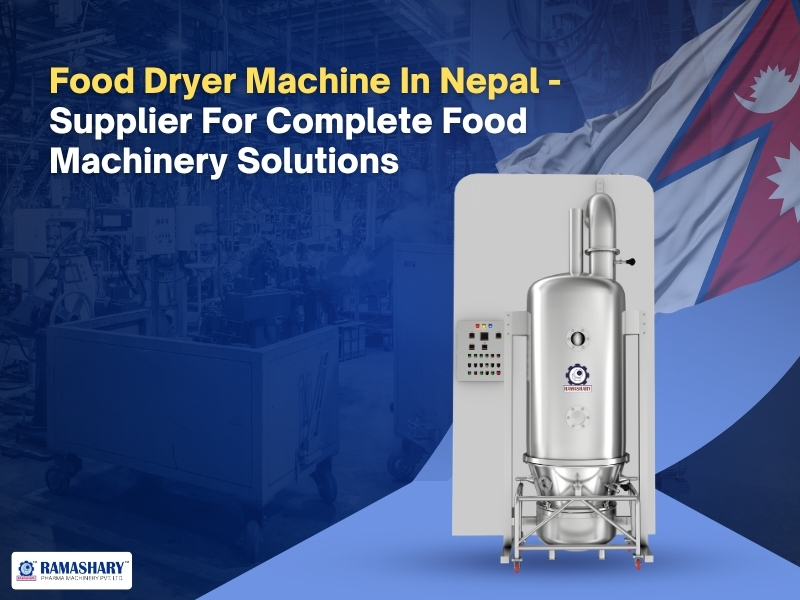
4. Fluid Bed Dryer
Introduction: After wet granulation, the granules must be dried to a precise moisture level. The fluid bed dryer (FBD) does this faster and more evenly than tray drying. It is a key link between the granulator and the mill.
Paired with a mass mixer in Hong Kong or a high-shear granulator, it completes the core of any line with modern pharma machinery in Hong Kong. Ask your pharma machinery supplier in Hong Kong to size the dryer bowl to your granulator output so that both steps run in rhythm. That simple match is one of the most overlooked points when plants buy pharmaceutical machinery in Hong Kong.
Working principle: Fluidisation. Heated air is blown up through a perforated bottom plate. At the right velocity, the air lifts the wet granules so they float and move like a boiling liquid. Every particle is surrounded by hot air. Heat and moisture transfer happen quickly and evenly. A suitable pressure drop keeps the bed stable.
Materials that can be handled:
- Wet pharmaceutical granules
- Powders and agglomerates
- Crystalline materials
- Food products
- Chemicals, minerals, dyestuffs and catalysts
Real-world pharma products made using this machine:
- Dried granules for almost every wet-granulated tablet
- Herbal granules for pCm instant granule products
- Dried API intermediates in chemical plants
- Nutraceutical granules
Available capacities: 5 kg to 500 kg
5. Multi Mill
Introduction: Dried granules are often uneven. Some lumps are too big for the tablet press. The multi mill reduces these to a uniform size. It is a simple machine with a big impact on flow and compression.
Working principle: Size reduction by swing hammer blades. A high-speed rotor carries knives or impact edges. Material enters the milling chamber and is struck repeatedly. Particles that become small enough pass through the sieve below. The final size depends on blade type, blade direction, rotor speed and sieve size.
Materials that can be handled:
- Dried pharmaceutical granules
- Wet masses for wet milling
- Herbal and botanical materials
- Chemicals, resins, plastics, ceramics and fertilisers
Real-world pharma products made using this machine:
- Sized granules for tablet compression
- Milled herbal material for powders and capsules
- Wet-milled masses before drying
6. Vibro Shifter
Introduction: The vibro shifter screens powders and granules by size. It removes oversize lumps and foreign particles. It also separates fines. It is one of the simplest ways to protect product quality before blending and compression.
Working principle: Gyratory vibration. A motor with eccentric weights makes the screen deck vibrate in a circular pattern. Material on the mesh moves outward in a spiral. Particles smaller than the mesh pass through. Larger particles move to the outlet. Multiple decks can split one feed into several size fractions at once.
Materials that can be handled:
- Pharmaceutical powders and granules
- API and chemical powders
- Herbal powders
- Food powders and other dry bulk materials
Real-world pharma products made using this machine:
- Sifting raw materials before dispensing
- Grading dried granules before lubrication
- Removing fines from capsule fill powders
- Safety screening of finished powder products
Available capacities: Diameters from 8 inches to 72 inches
7. Octagonal Blender
Introduction: The final blend before compression is where lubricants and glidants are added. It must be gentle. Too much shear breaks granules. Too little mixing gives poor uniformity. The octagonal blender is designed for this exact step.
Working principle: Tumble blending. An eight-sided bin rotates slowly around its own axis. Material falls and splits repeatedly as the bin turns. Baffles inside the bin break up flow patterns and push material across the bin.
Materials that can be handled:
- Dried granules with lubricants such as magnesium stearate
- Dry powders where the bulk excipient is much larger than the active
- Granules of various shapes and sizes
- Nutraceutical, food, chemical and cosmetic powders
Real-world pharma products made using this machine:
- Lubricated blends for almost every tablet product
- Capsule fill blends
- Low-dose active blends where uniformity is critical
- Nutraceutical tablet blends
Available capacities: 5 L to 12,500 L.
Octagonal Blender Or Ribbon Blender?
Use the octagonal blender for gentle final blending of fragile granules with lubricants. Use the ribbon blender for large-volume dry premixes and semi-solids. Some plants that work with a ribbon blender supplier in Hong Kong end up using both machines on the same line.
Putting The Line Together
- Raw materials are screened in the vibro sifter.
- Powders are wet granulated in the rapid mixer granulator or mass mixer.
- Wet granules are dried in the fluid bed dryer.
- Dried granules are sized in the multi-mill.
- Sized granules are screened again in the vibro sifter.
- Lubricants are added in the octagonal blender.
- For large premixes or direct compression products, the ribbon blender handles bulk blending.
With every machine from one pharma machinery supplier in Hong Kong, the interfaces match. For a maintenance head, this single-source approach to pharma machinery in Hong Kong also means one spares list and one service contact. The drawings fit together. The service contact is the same. That is the real value of choosing pharmaceutical machinery in Hong Kong as a line rather than as single pieces.
These are the factors to be considered while selecting juice manufacturing machinery supplier in Argentina.
This movement creates circulation within the mixing chamber and helps distribute the ingredients throughout the batch. After the required mixing cycle, the material is discharged through the outlet.
Struggling With Batch-To-Batch Variations?
FAQs
1. Can you customise a rapid mixer granulator for a small factory?
Yes. Our rapid mixer granulator range covers many gross capacities. We understand your requirements and conduct space and process analysis to suggest the best solutions and customise machinery accordingly. That’s what makes us more than just a pharma machinery supplier in Hong Kong; it makes us a long-term machinery partner.
3. How do we get a quote or consultation?
Visit our contact page and send an enquiry. Our team will review your needs. We are happy to set up a consultation call with your engineering and QA teams. Our goal is to be the trustworthy pharma machinery supplier in Hong Kong you call first for every project.
3. Do you offer SS304 and SS316L machinery construction?
Yes, we offer SS 304/316L machinery construction. Based on the materials to be processed, the output product and other manufacturing conditions, the suitable material can be utilised for engineering and supplying food processing machinery in Argentina.
4. Can these machines be used for the food and beverage industry?
Yes, these machines can be customised and used for the food and beverage industry. However, we will need to conduct a discussion and a space and process analysis to understand your materials, products, etc.
5. Are the machines fully automated?
Automation can be added according to your requirements. However, we make sure that operator training, commissioning and detailed instruction and maintenance manuals are provided. The machines are also designed with a focus on ease of use and operator safety. All these factors help in productivity and a better output.
Conclusion
Hong Kong’s pharma industry is small in footprint but big in ambition. Western drug makers work under PIC/S GMP. New rules like the “1+” mechanism, primary evaluation and the CMPR are raising the bar on data and quality. At the same time, plants in Tai Po, Yuen Long, Tseung Kwan O, Kwai Chung and Tsuen Wan face tight space, an ageing workforce and high running costs.
In this setting, the right pharma machinery in Hong Kong is not just about a purchase. Choosing the right pharma machinery supplier in Hong Kong is one of the most important decisions a plant leader will make. It is the base for compliance, consistency and growth.
Ramashary Pharma Machinery Pvt. Ltd. helps Hong Kong manufacturers meet these demands with customised machines. From the rapid mixer granulator and mass mixer to the ribbon blender, fluid bed dryer, multi-mill, vibro sifter and octagonal blender, we supply a complete line backed by installation, spare parts and 40+ years of experience.
If you are looking for a reliable pharma machinery supplier in Hong Kong or worldwide, connect with our process engineering team now and let’s discuss your requirements.