
Ramashary.com

Food Machinery Supplier in Kenya for Processing and Drying Solutions

Looking for a reliable food machinery supplier in Kenya? We offer advanced solutions for food processing, drying, dehydration, and beverage production to meet the needs of food manufacturers and processing businesses. Our range of food processing machines in Kenya includes efficient equipment for different production requirements, including a food dryer machine in Kenya and a food dehydrator machine in Kenya for removing moisture and extending the shelf life of food products. We also provide solutions for businesses looking for a food drying machine in Kenya, a complete beverage processing plant in Kenya, or reliable animal feed processing machines in Kenya. Whether you are setting up a new processing facility or upgrading existing production operations, our food processing equipment is designed to support productivity, consistent product quality, and efficient manufacturing.

If you are searching for the best food dryer machine in Kenya, you are probably already facing one of two problems. Either your current drying or processing equipment cannot meet GMP standards, or you are setting up a new food processing line and do not want to repeat the mistakes of suppliers who oversell and underdeliver.
Kenya’s food industry is growing fast, but growth without the right machinery creates more waste than profit. A food dryer machine in Kenya is no longer a nice-to-have. It is becoming a basic requirement for any processor who wants to protect product quality, meet export standards, and reduce the huge post-harvest losses that the country has struggled with for years.
Kenya’s food sector sits at an interesting crossroads right now. On one hand, the country has one of the strongest agricultural bases in East Africa, with tea, coffee, dairy, horticulture and grains driving rural livelihoods. On the other hand, a large share of that produce still moves through informal channels with almost no mechanised processing.
This gap between raw production and finished, packaged, shelf-stable food is exactly where a food machinery supplier in Kenya can make the biggest difference. Manufacturing directors and plant managers who understand this gap are the ones investing early in reliable drying, blending, granulating and liquid processing equipment.

Food Processing Industry In Kenya - An Overview

Kenya Bureau of Standards (KEBS) and export markets in the EU, Middle East and COMESA region are pushing local manufacturers toward GMP-certified processes. Food processing machines in Kenya that cannot demonstrate consistent temperature control, contamination-free material handling and repeatable batch quality will struggle to pass audits.

This is why quality control and quality assurance teams are now part of every serious machinery buying decision, not an afterthought. For company procurement heads and business owners, the real question is not just which machine works. It is which food machinery supplier in Kenya can be trusted for the long term.
Machines break down. Spare parts run out. Technical support disappears after the sale. These are the real pain points that decide whether a factory floor runs smoothly or grinds to a halt during peak season.
Kenya’s Food Industry – The Numbers Behind The Opportunity
  • Growth within food processing itself has been uneven. Beverage production grew strongly at 15.6% in 2024, milk processing grew to 11.8% and grain mill products and bakery products also expanded. At the same time, sugar manufacturing and fruit and vegetable processing recorded sharp declines in other years, showing how exposed the sector is to inconsistent raw material supply and outdated processing capacity.
  • Post-harvest losses remain one of the biggest structural problems. Studies estimate that horticultural losses in Kenya can reach as high as 50%, mainly due to poor storage, poor handling and insufficient drying and preservation infrastructure. A separate research estimate put the annual monetary value of food lost after harvest at around Sh72 billion.
  • Sales of processed packaged food in Kenya grew by more than 16% in 2023, reflecting a growing consumer base that expects packaged, processed and shelf-stable food products rather than only raw produce.
  • Agriculture contributed 25% to the GDP and employed 70% of the workforce as of 2024. However, Kenya still depends on imports for specific yields, mainly because domestic production cannot meet the overall demand. Some of these yields include wheat, maize, rice and more.
What do these numbers tell a plant manager or a business owner? They tell you that demand for processed food is rising faster than local processing capacity. They also tell you that the businesses currently losing the most money are the ones without proper drying, blending and liquid processing infrastructure.
This is exactly why investment in a dependable food dryer machine in Kenya, alongside supporting equipment like blenders, granulators and sifters, is becoming a competitive necessity rather than an optional upgrade. Any business serious about reducing waste and meeting the standards and export quality requirements needs to partner with an experienced food machinery supplier in Kenya rather than buying disconnected, unsupported equipment.

Struggling With Inconsistent Batches Or Limited Capacity?

7 Trends In Kenya's Food Industry

The shift in Kenya’s food-processing sector is not being driven by one factor. It is happening where agricultural production meets changing consumer habits, tighter production expectations and the commercial need to get more value from every kilogram of raw material.

1. Value Addition Is Becoming A National Priority

The Kenyan government has repeatedly pushed for more value addition instead of exporting raw agricultural produce. Processed tea, coffee and horticultural products earn far more per kilogram than raw exports. This pressure is pushing manufacturers to invest in better processing lines.

2. Rising Demand For Packaged & Preserved Food

Urbanisation and a growing middle class mean more Kenyans are buying packaged snacks, dried fruits, powdered products and bottled beverages instead of only fresh produce from open markets.

3. Stricter Compliance Expectations

Both local regulation and export market requirements are pushing food companies toward GMP-aligned production, proper documentation and food processing machines in Kenya that support consistent, auditable batches.

4. Growth In Dairy & Beverage Processing

Recent data shows strong growth in milk processing and beverage production compared to other subsectors, which is increasing demand for reliable mixing, blending and liquid handling equipment. As of 2024, the beverage sector grew by 1.3%. The next year, the production of beverages and tobacco products grew by 1.1%.

5. A Shift Toward Mechanisation Among Mid-Sized Manufacturers

Many mid-sized Kenyan food businesses that previously relied on manual or semi-manual processes are now investing in automated food processing and food dryer machine in Kenya to scale production without proportionally scaling labour costs.

6. Growing Awareness Of Post-Harvest Loss

Post-harvest losses reportedly account for 30% to 40% of total crop production. This results in annual losses of approximately KES 150 billion. Manufacturers are starting to treat drying, sieving and blending capacity as a direct lever for reducing waste and protecting margins, rather than viewing it purely as a farm-level issue.

7. Interest In Imported Machinery From Experienced Suppliers

Because local fabrication cannot always guarantee GMP compliance or long-term parts availability, more procurement heads are looking at an established international food machinery supplier in Kenya.

Food Industry In Kenya's Top 5 Manufacturing Cities

Kenya’s food-processing activity is not concentrated in one location. Different manufacturing centres have developed around industrial infrastructure, agricultural production, logistics, ports and access to raw materials. Understanding it therefore helps identify where specific processing challenges and machinery requirements are likely to be most relevant.

1. Nairobi

Nairobi City County accounted for 36.9% of Kenya’s manufacturing activity on average between 2018 and 2022, making it by far the largest contributor among the counties covered in its analysis. Industrial zones such as Embakasi and the Nairobi Industrial Area carry a dense cluster of food processing machines in Kenya operations.
Competition here is intense, which means manufacturers in Nairobi are often the first to adopt new food processing or food dryer machine in Kenya to stay ahead. But they are also the first to feel the pain of unreliable machinery because downtime directly costs market share.

2. Mombasa

Mombasa’s importance to Kenya’s food-processing industry is closely tied to its position as the country’s main maritime gateway. The Port of Mombasa handled 45.45 million metric tonnes of cargo in 2025, up from 40.99 million tonnes in 2024.
The operating environment also has a physical consideration that machinery buyers cannot ignore. Mombasa has an annual mean temperature of about 27.9°C and average noon humidity of around 65%, with long rains averaging about 1,040 mm between April and June.
For manufacturers handling grains, powders, dried ingredients or other moisture-sensitive products, maintaining the required moisture level therefore becomes a process-control issue rather than simply a storage concern. Drying efficiency, moisture uniformity and controlled handling can directly affect product stability and the usable life of processed material.

3. Nakuru

Nakuru has a substantial agricultural production base that feeds several food-processing value chains. The county government reports 466,173 hectares of arable land, with 69,150 hectares under fodder, while its main agricultural outputs include potatoes, maize, wheat, avocado and other crops. Its 2026-27 Annual Development Plan records annual production of 48,513 tonnes of potatoes, 32,006 tonnes of avocado and 325,636,939 litres of milk.

4. Eldoret

Eldoret sits within Uasin Gishu County, where maize, wheat and milk are produced on a large scale. KNBS describes agriculture and agro-processing as major economic activities in the county and notes that its large-scale production of wheat, maize and milk has earned Uasin Gishu the description of Kenya’s ‘bread basket.’ That’s where a food dehydrator machine in Kenya becomes necessary.

5. Thika

Thika has developed into one of Kenya’s established industrial centres, with around 50 major factories and approximately 100 small-scale industries. The municipality describes agricultural processing as a major part of the local economy, with activities including horticulture and pineapple processing, cooking-oil production, animal-feed processing and wheat-related industries.
Pineapples produced in the surrounding area are also exported, particularly to European markets and to meet this demand, a customised fruit drying machine Kenya becomes important.

Are You Losing Too Much Raw Material During Processing?

7 Factory Floor Challenges Facing Kenya's Food Industry

Kenya’s food-processing industry is expanding across dairy, grain milling, meat products, animal feeds, beverages and other agro-based manufacturing segments. The following 7 challenges highlight where these pressures appear most clearly on the factory floor and why equipment selection, process control and dependable food processing machines in Kenya matter.

1. Severe Post-Harvest Losses

Horticultural losses in Kenya can reach as high as 50%. A large share of this loss happens because produce is not dried, dehydrated or stabilised quickly enough after harvest. Without a dependable food dryer machine in Kenya operating at the point of processing, factories lose raw material value before it even reaches packaging.

2. Inconsistent Raw Material Moisture Content

Kenyan grains, spices and horticultural produce often arrive at the factory with variable moisture levels depending on season and region. Manufacturers without controlled drying and moisture stabilisation struggle to maintain consistent product quality batch after batch, which creates rejection risk during quality control checks. That’s where the right food dryer machine in Kenya makes the difference.

3. Difficulty Meeting GMP & KEBS Compliance

Export buyers and even local supermarket chains increasingly demand documented, GMP-aligned production. Older or locally fabricated equipment frequently lacks the validation, material of construction standards, and process control needed to pass these audits, putting entire export contracts at risk.

4. Frequent Equipment Downtime & Poor After-Sales Support

When a blender, dryer or granulator breaks down and no local support or spare parts are available, entire production lines stall, sometimes for weeks. That’s why manufacturers need more than just a food machinery supplier in Kenya; they need a dependable machinery partner.

5. High Energy & Utility Costs Affecting Drying Operations

Drying is one of the most energy-intensive steps in food processing. Poorly designed drying systems waste heat and electricity, pushing up the cost per kilogram of finished product and eroding already thin margins for small and mid-sized processors.

6. Powder & Granule Handling Inefficiencies

Many Kenyan food, spice, and nutraceutical-style manufacturers still rely on manual mixing and sieving for powders and blends. This might lead to uneven product quality, contamination risk and slower throughput compared to mechanised blending and sifting systems. It creates a need for a supplier that provides fruit or animal feed processing machines in Kenya with required automation and customisation.

7. Limited Access To Infrastructure For The Beverage Sector

With beverage production among the fastest-growing food processing subsectors in Kenya, many smaller beverage and juice concentrate producers still lack properly designed liquid manufacturing systems, leading to inconsistent syrup quality, contamination risk and difficulty scaling batch sizes. Thus, a beverage processing plant in Kenya, made with a focus on scalability can help with space utilisation.
These 7 challenges point to the same underlying issue. Kenya does not lack raw material or market demand. It lacks enough well-designed, GMP-aligned food processing machines in Kenya that can dry, blend, sieve, granulate and process materials consistently at scale.
This is precisely the gap where a specialised food machinery supplier in Kenya, offering dependable solutions alongside supporting processing equipment, becomes important to closing the loss and quality gap across the value chain.

Best Food Machinery Supplier In Kenya - Solutions For Kenya's Food Industry Challenges

Ramashary Pharma Machinery Pvt. Ltd. (an ISO and GMP-certified company) is an India-based manufacturer with 40+ years of experience across 700+ site installations and 20+ industries. With export capabilities and end-to-end solutions, we have positioned ourselves as more than just a food machinery supplier in Kenya; we have become a dependable machinery partner for several countries across the globe.

1. Solution To Post-Harvest Losses

Post-harvest losses mainly occur due to minimal or poor drying, sifting, granulation, blending, etc. Here, one process depends on the other. Thus, we understand your batch size, production volume and scalability requirements to provide a customised food processing or food dryer machine in Kenya accordingly.
PLC/HMI integration and control panels help the operators control every required aspect of the machine (such as the temperature, air flow, timing, speed, etc.) during the process for more accuracy. Also, the machines are IoT-ready that help get real-time insights.

2. Consistent Drying Across Batches

When we provide a food dehydrator machine in Kenya or any other processing machine, we make sure it supports multi-product versatility and different formulations. Controlled temperature and airflow management, especially in the Fluid Bed Dryer, help dry every particle uniformly. According to the material sensitivity, our Roto Cone Vacuum Dryer and Tray Dryer can be utilised. This helps when the raw material moisture content varies.

3. Ease In Meeting Compliance

We follow CE, WHO-cGMP, GMP, ISO 9001:2015, ASME BPE, SCADA, 21 CFR, Industry 4.0 standards and international validation protocols. IQ, OQ, DQ, FAT reports and MOC certificates are provided for traceability. All this, along with end-to-end documentation, helps beverage and food manufacturers meet compliance, even in export markets.
We supply all across Kenya, including Nairobi, Mombasa, Nakuru, Kisumu, Kilifi, Thika, Machakos, Nanyuki, Naivasha, Malindi, Nyeri, etc and globally.

4. Ongoing After-Sales Support

Ramashary Pharma Machinery Pvt. Ltd., we provide support to you throughout the pre-fabrication, fabrication and post-fabrication stages. It includes site installation, commissioning, operator training, provision of detailed instruction and maintenance manuals, ongoing after-sales support and provision of assured spare parts. It helps reduce downtime. This positions us as a leading supplier of food processing machines in Kenya.

5. Decrease In Energy Costs

Drying can be an energy-intensive operation if not performed using the right machine. Our food dehydrator machine in Kenya and any other processing machine comes with energy efficiency, made for cost savings. Over time, it helps reduce production costs.

6. Handling Powder & Granule Inefficiencies

We manufacture a full range of blending and granulating equipment, including the Rapid Mixer Granulator, Ribbon Blender, Octagonal Blender, V-Blender and Double Cone Blender, along with the Multi Mill for pulverising and the Vibro Sifter for sieving and grading.
Applied to food, spice and nutraceutical-style powders, this equipment mechanises what many Kenyan manufacturers still do manually, improving consistency and throughput, positioning us as a leading supplier of food and beverage processing plant in Kenya.

7. Solution To Limited Infrastructure

We begin by understanding your requirements, analysing available space and the current process and suggesting the best options accordingly. This specifically helps when you have limited infrastructure.
We also focus on scalability while providing food processing and a food dryer machine in Kenya, which means these machines can help you in the long run even if your business grows. That’s what makes us more than just a food machinery supplier in Kenya; it makes us an ideal business growth partner for manufacturers across the globe.

Is Variable Moisture Affecting Your Product Quality?

Top 7 Beverage & Food Processing Machines In Kenya

Kenya’s food and beverage processing industry covers a wide range of production requirements, from dairy and beverages to grain milling, meat products and animal feeds. This diversity means there is no single machine that fits every factory. These are 7 food processing machines in Kenya that address some of the most important production requirements faced by food and beverage manufacturers.

1. Fluid Bed Dryer

The Fluid Bed Dryer works on the principle of fluidisation. A solid material, usually in granule or particle form, is suspended and agitated in a stream of hot air moving upward through a perforated base. This suspension exposes every particle to the drying air evenly, unlike static tray drying where the top layer dries faster than the bottom.

The GMP-compliant design ensures uniform, efficient drying while meeting strict hygiene and regulatory standards. It can handle granulated food powders, spice granules, nutraceutical-grade granules, and similar particulate materials.
In food industry terms, this is the type of equipment used to dry powdered food ingredients, instant mix granules and similar particulate food products before final packaging, functioning as a genuine food dryer machine in Kenya for granulated and powdered materials.

Capacity Range: 05 kg to 500 kg

2. Tray Dryer

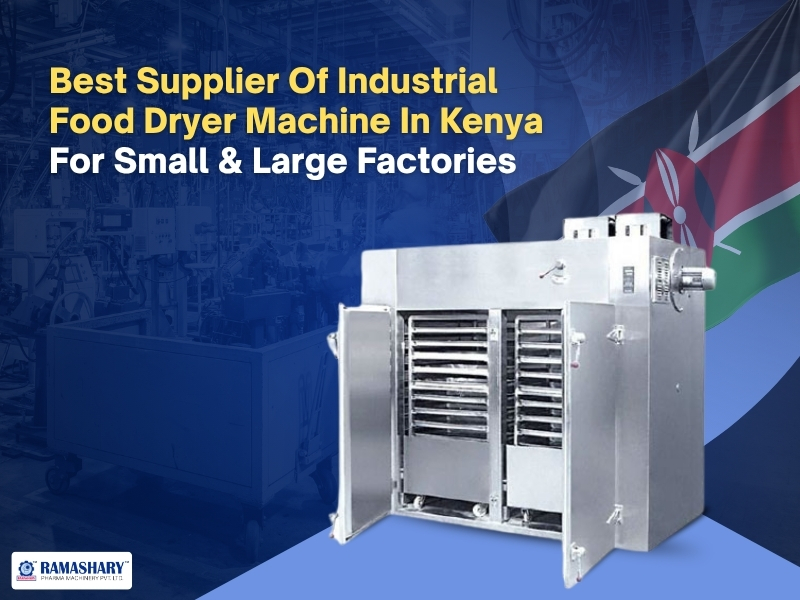
The Tray Dryer uses controlled hot-air circulation to remove moisture from food materials placed across perforated trays. Uniform air distribution helps achieve consistent drying across batches while allowing manufacturers to control drying temperature and time according to the material being processed.

In food processing, it is suitable for drying fruits, vegetables, herbs, spices and other moisture-sensitive materials where controlled dehydration is important for storage stability and further processing. This makes it a practical food dehydrator machine in Kenya for manufacturers looking to reduce moisture variation and improve drying consistency.

3. Ribbon Blender

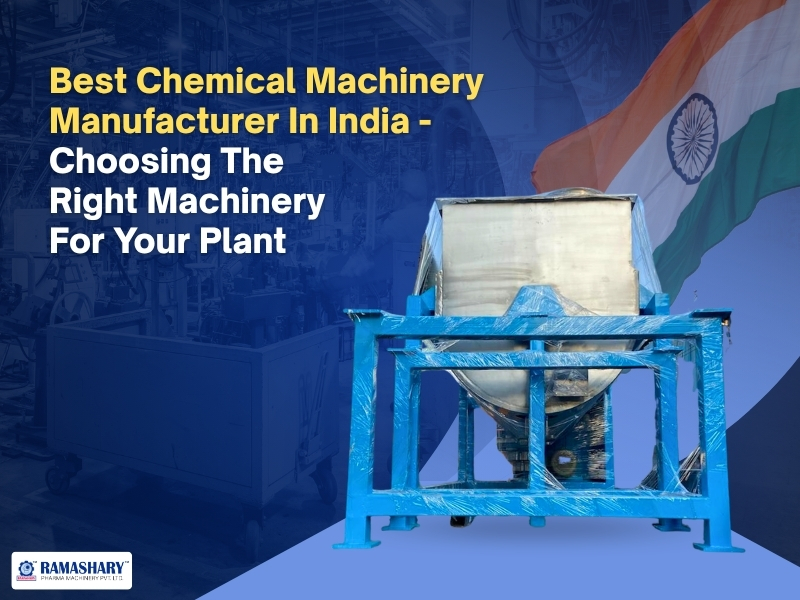
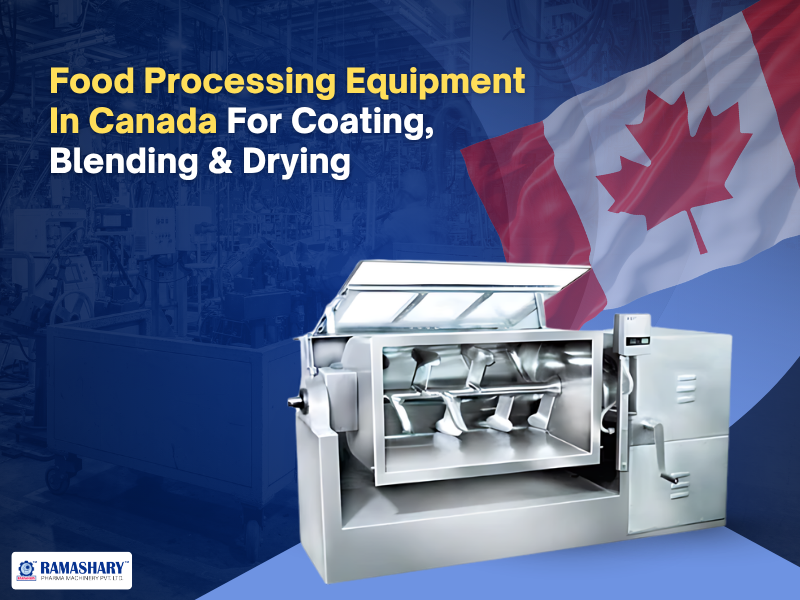
The Ribbon Blender uses a U-shaped horizontal trough fitted with a double helical ribbon agitator. As the ribbon rotates, it moves material simultaneously toward the centre and outward toward the ends, creating a triple mixing action that blends large volumes of dry powder efficiently and evenly.

This is well suited to blending dry food ingredients such as spice mixes, flour blends, dry beverage powders and dry animal feed-style formulations that require thorough, uniform mixing before packaging. Manufacturers looking for animal feed processing machines in Kenya also find it preferable.

Capacity Range: 50 L to 12,000 L

4. Roto Cone Vacuum Dryer

The Roto Cone Vacuum Dryer combines gentle tumbling with vacuum drying to remove moisture at lower temperatures. This makes it suitable for heat-sensitive food materials where maintaining product characteristics during drying is important.

In food processing, it can be used for drying powders, granules, crystals and other materials where controlled moisture removal, reduced oxidation and uniform drying are required. Vacuum operation can also support efficient moisture removal at lower temperatures, making it useful for specialised food processing applications in Kenya.

5. V Blender

The V Blender features a cylindrical body cut at a precise angle to form a V shape, constructed from SS 304/316L with a discharge valve at the bottom for easy feeding and cleaning.

As the vessel rotates, material inside splits and recombines repeatedly, producing a gentle but thorough blend. This makes it one of the best food processing machines in Kenya for blending dry food powders, spice formulations and nutraceutical-style food powders where hygienic construction and easy cleaning between batches are priorities for quality control teams.

6. Vibro Shifter

The Vibro Shifter, also called a sieving and grading machine, uses controlled vibration to pass material through a mesh screen, separating particles by size and removing oversized lumps or foreign material. At Ramashary Pharma Machinery Pvt. Ltd., we manufacture sifters according to specific sieving and grading requirements for powders that do not pass easily through standard screens.

In food processing, this is essential for grading flour, spice powders, sugar, and other granulated food ingredients to ensure a consistent, contaminant-free final product before packaging. It can be used before or after the food dryer machine in Kenya.

Before the dryer: raw-material preparation and screening

After the dryer: final sizing, de-lumping, grading and check-screening

Both: possible when the process requires screening at both stages

Capacity Range: 8” Dia to 72” Dia

7. Liquid / Sugar Syrup Manufacturing Plant

The Liquid / Sugar Syrup Manufacturing Plant is designed for hygienic manufacturing of liquid syrups, ranging from smaller batch sizes up to large-scale volumes, using a high-speed stirrer combined with a steam- or electrically powered heating facility.

It typically comprises a sugar syrup vessel, a manufacturing vessel and a storage vessel, all controlled from a centralised operating panel to minimise manual handling and contamination risk, making it an ideal beverage processing plant in Kenya.
For Kenya’s growing beverage processing plant segment, this equipment applies directly to producing beverage syrups, flavoured concentrates, and other sugar-based liquid formulations that require consistent viscosity, sweetness and hygiene standards batch after batch.

Capacity Range: 50 L to 10,000 L

Choosing A Machine On Capacity Alone Can Create Problems Later

FAQs

1. Do you provide a food dryer machine in Kenya for animal feed or agricultural products?

Yes, we provide food dryer machine in Kenya for animal feed and agricultural powders. We first understand the sensitivity of the materials, their moisture content, required output product, processing capacity, scalability goals and more before starting with machine design.

2. What machines do you provide for beverage processing?

Our Liquid Manufacturing Plant, Ointment Manufacturing Plant (for mayonnaise and ketchups) and Starch Paste Kettle can be used for beverage processing in liquid and semi-liquid forms. This makes us an ideal choice for those looking for a beverage processing plant in Kenya.

3. Can you provide the same machines for our pharma production plant?

Yes, the same machines can be provided for your pharma production plant, but after customisation. We first understand what materials will be processed, what output product is required, what is the processing capacity, etc. and proceed with the machine design accordingly.

4. Can one drying system handle different fruits, powders and granulated food products?

The key is that, selecting a food dryer machine in Kenya is based on the physical and thermal characteristics of the product, not simply whether something is a food product. Different products can require different drying temperatures, airflow, residence times, loading conditions and moisture endpoints. The final recommendation can be provided after considering your raw materials, operating conditions, required output, etc.

5. Can you install the Tray Dryer in my existing production line?

Yes. A Tray Dryer can be integrated into an existing production setup after evaluating your available space, batch capacity, material flow, utilities and the other equipment in the production line. The objective is not simply to fit the dryer into the factory but to make sure that material can move efficiently through the complete process without creating a new challenge.

Conclusion

Demand for processed, packaged and export-ready food products is rising steadily, yet the country continues to lose a significant share of its agricultural output to post-harvest losses, inconsistent processing quality and compliance gaps. Cities like Nairobi, Mombasa, Nakuru, Eldoret and Thika each show strong potential for food manufacturing growth. But that potential will only convert into real business value if processors invest in dependable, well-engineered equipment rather than patched-together, unsupported machinery.
This is where partnering with the right food machinery supplier in Kenya makes a measurable difference. Ramashary Pharma Machinery Pvt. Ltd. brings 40+ years of experience across 20+ industries across the globe, offering CGMP-compliant food processing machines in Kenya for blending, granulating, sieving and liquid processing equipment.
For procurement heads, plant managers and business owners who want to reduce waste, meet compliance requirements, and build a production line that will still be running reliably five years from now, Ramashary Pharma Machinery Pvt. Ltd. is worth a direct conversation.

Contact us now for a consultation and discuss which machinery fits your specific product, capacity and compliance goals.

Home
Industries
Blogs
Call Us
WhatsApp

Let’s Talk

Contact Form New

I am looking to

My business belongs to

My name is

I represent

Where I hold the position of

My number is

My email is

I am planning to purchase the machine

I heard about Ramashary from

I would like a free consultation

Schedule a Call Now

Schedule a call

Fill the Form to Download Company Profile

Company Profile

Fill the Form to Download Brochure

Download Brochure