Ramashary.com

Pharma Machinery in Austria | Pharmaceutical Equipment Supplier

Austria is an important market for pharmaceutical manufacturing, where precision, quality, and advanced production technology play a vital role in the pharmaceutical industry. Our range of pharmaceutical equipment is designed to support efficient and reliable manufacturing processes for pharmaceutical companies across Austria. As a trusted pharma machinery supplier in Austria, we offer advanced solutions for tablet production, powder processing, mixing, granulation, and coating applications. Our equipment includes high-performance tablet manufacturing machines in Austria, precision-engineered Ribbon Blenders in Austria, and efficient Rapid Mixer Granulators in Austria to meet diverse pharmaceutical production requirements. We also provide advanced tablet coating machines in Austria that help achieve uniform coating and improved product quality. As a pharmaceutical machinery manufacturer & exporter in Austria, we focus on delivering innovative, durable, and technologically advanced machinery suitable for modern pharmaceutical facilities. Our solutions cater to the requirements of pharmaceutical companies seeking reliable pharmaceutical machines manufacturers in Austria and experienced pharmaceutical machinery manufacturer & supplier to Austria. From formulation and blending to granulation, compression, and coating, our pharmaceutical machinery supports streamlined production, consistent performance, and operational efficiency. We are committed to providing quality pharmaceutical manufacturing equipment that meets industry expectations and helps pharmaceutical businesses in Austria enhance their production capabilities.

Pharma machinery in Austria carries more weight than most people outside the industry realise.
Behind every tablet and syrup that leaves an Austrian plant is a blender, a granulator, or a coating pan that has to work perfectly on every single batch. In 2024, the Austrian pharmaceutical industry employed about 25,000 people and produced goods worth €4,782 million. That is a serious industrial base for a country of this size.
The sector is also growing in visible ways. Sandoz has poured around €200 million into its Kundl site in Tyrol. Takeda has announced €100 million for Linz up to 2028. Boehringer Ingelheim started biopharmaceutical production in Vienna in 2021 after an investment of more than €700 million. These are not small bets. They show that global companies see Austria as a stable and skilled place to make medicines.
But success brings pressure. Several drugs are regularly unavailable. Production costs for off-patent medicines have climbed while prices have fallen. Energy is expensive and skilled people are hard to find. In this climate, every plant manager and every procurement head asks the same question. How do we make more good product with less waste and less risk?
The answer starts on the factory floor. You need customised and GMP-compliant pharma machinery in Austria that fits your formulation, your batch size and your cleaning routine. A generic machine bought on price alone often costs more over five years. A good pharma machinery supplier in Austria or one that exports to Austria, understands this. It designs for your process rather than asking you to bend your process around its catalogue.

Austria's Pharmaceutical Industry - An Overview

Let us look at the data first. Numbers show why the quality of pharma machinery in Austria is a business question and not only an engineering one.
Key figures for 2024
Indicator Value
Companies (manufacturers and importers)
120
Production value
€4,782 million
Imports
€11,753 million
Exports
€19,967 million
Share of pharmaceuticals in total health spending
13.3%
Biotechnology turnover (2023)
About €1,725 million
Exports are far larger than domestic production. This tells you that Austria works as a trade and logistics gateway as well as a production base. Plants in Kundl, Linz and Vienna ship to more than 100 countries. For a plant like that, a batch failure is not a local problem. It can delay a shipment to dozens of markets.
The quality of pharma machinery in Austria therefore shapes the reputation of the whole plant. Plants that source from a Pharmaceutical Machinery Manufacturer & Supplier to Austria should also check logistics early.

What This Means For Machinery Buyers

Three points stand out.

  • Output must be consistent. Export customers audit your batch records. Your machines must give the same result in batch 1 and batch 500.
  • Quality systems are tight. Austrian and EU inspectors expect clean design and clear documentation.
  • Cost pressure is real. Selling prices for generics are low. Efficient machines protect your margin.
That is how a good pharma machinery supplier in Austria, or one that ships to Austria, earns trust. It starts with questions and not with a price list.

Why The Right Supplier Matters

A machine is not just a purchase. It is a ten- or fifteen-year relationship. The best pharma machinery supplier in Austria or abroad will answer your technical questions in detail and will adapt capacity and finish to your needs. It will also support you after installation.
If you are comparing Pharmaceutical Machines Manufacturers in Austria and overseas, you should look at five things. Check the GMP design of the equipment. Check the grade of stainless steel. Check how the supplier handles customisation. Check the quality of the control panel and safety features. Check what support follows delivery. A Pharmaceutical Machinery Manufacturer & Exporter in Austria or abroad that scores well on all five is worth a place on your shortlist.
The right choice depends on how much customisation you need. If your product needs a special bowl size or finish, then direct contact with a maker matters more. Many buyers who search for pharma machinery in Austria end up combining two types. They buy core process machines from a maker and small spares from a local dealer.

Is Your Existing Machinery Costing You More?

7 Trends In The Pharma Industry In Austria

1. Biologics and biopharma keep growing

Austria is moving strongly into biologics. Novartis runs cell culture facilities for monoclonal antibodies in Kundl and Schaftenau. Boehringer Ingelheim produces about 40 biopharmaceutical products in Vienna that reach roughly 120 countries. Biologics need sterile and tightly controlled equipment. So solid-dose and liquid plants remain the backbone. Smart companies invest in both worlds.

2. Supply security and European production

The shortage of antibiotics has changed the political mood. Sandoz committed to keeping relevant penicillin active ingredient production in Europe for ten years after public funding. Kundl now holds a rare vertically integrated penicillin network in Europe. The message is clear. Governments want medicines made closer to patients. This lifts demand for reliable pharma machinery in Austria.

3. Digitalisation and AI on the shop floor

A report points to a clear shift towards digitalisation in life sciences. Plants are adding sensors, electronic batch records and data dashboards. Yet industry analysts note that few companies have taken digital projects to full manufacturing scale. Machines with clean control panels and room for data connection are easier to upgrade later.

4. Continuous and intensified manufacturing

Continuous and intensified manufacturing has benefits. But their adoption is limited by the inability to adapt to technology and regulatory uncertainty. Comparison across scales, process control and validation requirements are important here.

5. Cost of goods under the spotlight

Industry experts describe cost of goods reduction as the defining priority. Plants look for shorter cycle times, lower energy use and less rework. A rapid mixer granulator that combines mixing and granulation in one bowl is a simple example. It saves time and floor space.

6. Quality risk management moves to the centre

The revised EU GMP Annex 1 is now fully in force and it asks sterile manufacturers to write a contamination control strategy. Even outside sterile production, the situation has changed. Inspectors expect risk-based thinking about cross-contamination and cleaning and materials flow. Equipment with smooth surfaces and few crevices helps you answer those questions.

7. Public support for research and manufacturing

Austria backs the life science sector with research funding and tax incentives. The federal government announced €45 million for pharma research support for 2024 to 2026 and the Industry Strategy 2035 aims to strengthen the industrial base. This public support gives plants the confidence to invest in new lines and new machines.
That is why the conversation about pharma machinery in Austria has moved from price to total value. A plant that picks a reliable pharma machinery supplier in Austria or overseas gets more than a machine. It gets a partner who understands the change around it.
The same logic applies to every step of a solid dose line. A tablet manufacturing machine in Austria must keep pace with faster cycles and tighter documentation. A rapid mixer granulator must give repeatable endpoints. A tablet coating machine in Austria must deliver a uniform film batch after batch.

Pharma Manufacturing In 5 Austrian Hubs

Austria’s pharma activity is spread across the country. Five locations stand out for manufacturing and processing. Two of them are small towns, but they carry the weight of full cities. Each one creates its own demand for pharma machinery in Austria.

1. Vienna

Vienna is the commercial and scientific heart of the sector. Takeda runs a campus-style site in the 22nd district. Octapharma, Valneva and Vela Laboratories also operate in the city with plasma products and biologics and GMP contract services.
What does this mean for equipment buyers? Vienna companies work with high-value products and strict audits. They favour hygienic design and clear documentation. Space is tight in a big city, so compact machines with a small footprint are valued.
A buyer here will often compare a Pharmaceutical Machinery Manufacturer & Exporter in Austria against overseas options on engineering detail and not only on price. Vienna also has a strong contract and biotech scene. Small and fast projects are common there. A pharma machinery supplier in Austria or abroad that can deliver a compact and well-documented machine on a clear schedule has an edge in this city.

2. Linz

Linz in Upper Austria hosts a major Takeda production site. The site focuses on biologics for patients with chronic inflammatory bowel disease and is known in the Takeda network as a centre for prefilled syringes and self-administration medicines. Takeda announced it will invest €100 million in Linz up to 2028 and it supplies medicines to more than 75 countries from there.
Linz also sits next to Wels, where Richter Pharma is based. The region has a strong engineering culture. Plant teams here expect machines to be robust and easy to maintain. Maintenance heads in Upper Austria often ask for spare part availability before they ask for the price.
This is where a Pharmaceutical Machinery Manufacturer & Exporter in Austria or overseas shows its quality. Spare part lists and clear drawings reduce stoppages. A ribbon blender in Austria that uses standard motors and seals is easy to keep running.

3. Graz

Graz is the pharma and biotech centre of Styria. Business directories list several pharmaceutical manufacturers in Graz and nearby Kapfenberg with revenues in the tens of millions of dollars.
Graz is a university city and R&D managers play a big role in buying decisions. They want flexible equipment for pilot batches and scale-up. A rapid mixer granulator in Austria that offers a wide range of bowl sizes helps a team move from a three-litre trial to a full production batch without changing the principle. This is where Pharmaceutical Machines Manufacturers in Austria and abroad compete on range and not on volume alone.

4. Kundl

Kundl in Tyrol is small but globally important. Sandoz operates here and the site is a flagship for European antibiotics. A new facility opened in 2024 with a 3,000 m² manufacturing area. It allows one billion more penicillin tablets and doubles the output of powder oral suspension that is mainly used in paediatric medicines. Kundl now has a capacity of 240 million packages per year. That is more than double the 2021 level.
For solid dose plants like this, the tablet manufacturing machine in Austria is not one machine. It is a chain. Blending, granulation, drying, compression and coating all have to link up. A weak link in the chain slows the whole line. Maintenance and production managers in Tyrol know this well. They look for equipment that runs for long shifts with little downtime.

5. Orth an der Donau

Orth an der Donau in Lower Austria is the easternmost production site in the country. A site with this profile lives on precision. QC teams measure everything. They are also the people who notice when a machine causes variation. Buyers in Orth tend to ask detailed questions about surface finish, calibration, and traceability.

How Location Affects Buying

Where your plant sits changes what you ask for. Vienna teams worry about footprint. Linz teams worry about spares. Graz teams worry about scale-up range. Kundl teams worry about uptime. Orth teams worry about traceability. Yet one question is common to all five. Can the supplier support us after the machine arrives?
A Pharmaceutical Machinery Manufacturer & Supplier to Austria that ships from abroad must answer this clearly. Ask about packing, dispatch, spare parts and remote support. If you are comparing Pharmaceutical Machines Manufacturers in Austria and overseas for any of these hubs, these factors are worth considering.

Let's Make Your Production More Cost-Efficient

7 Factory-Floor Challenges in Austria's Pharma Industry

Reports and headlines describe the big picture. Plant teams feel it in smaller ways every shift. Here are seven challenges that shape equipment decisions across Austria. Each one affects how you choose pharma machinery in Austria. Good Pharmaceutical Machines Manufacturers in Austria and abroad design with these pressures in mind.

1. Medicine shortages and price pressure

Reportedly, hundreds of drugs are regularly unavailable and many people have almost grown used to it. A report counted 340 products that could not be delivered. A survey found that 84% of Austrian pharmacists had made missing medications themselves because of shortages.
A European study of the top ten off-patent antibiotics found that prices fell by 10% between 2020 and 2024. Over the same period, industrial prices rose by 31.6% and labour costs by 25.7%. Plants are squeezed from both sides. They cannot raise prices, so they must lower the cost per batch. The equipment decision becomes a margin decision. A machine that cuts cycle time or reduces rejected batches pays for itself.
Picture a 500 kg batch that fails because the granules were over-wetted. The loss is raw material and energy and a day of line time. A rapid mixer granulator in Austria with a controllable endpoint reduces this risk. So does a fluid bed dryer with stable airflow. Small fixes at machine level protect the output of the whole month.

2. High energy costs

Energy prices hit pharma plants hard. Sandoz said its Kundl investment would help to partly offset the impact of high energy prices by lowering unit costs. Blending, drying and coating all use power and heated air. An old dryer with poor airflow wastes energy every hour it runs.
Efficient machines with good insulation and well-sized motors reduce the bill. Maintenance heads should ask suppliers for power ratings and not only for capacity figures. This single question separates serious pharma machinery suppliers from catalogue sellers.
Think of a coating pan that runs eight hours a day. Poor airflow forces longer runs and more heating. Over a year, that adds up. When you evaluate a tablet coating machine in Austria, compare the drying design and not only the pan size. The same goes for a ribbon blender in Austria. A motor that is sized for the load avoids wasted power.

3. Skilled labour shortage

Austrian industry reports a shortage of skilled workers across sectors and technology and engineering roles are especially hard to fill. Combined with high energy costs and low productivity gains, this puts extra pressure on industrial plants. In a pharma plant, it means fewer experienced operators on each shift.
The fix is not to expect heroes. The fix is to choose machines that are easy to run and easy to clean. Clear control panels, safety interlocks and simple discharge systems reduce operator error. When a new operator joins the line, the machine should not be a puzzle.
Many plants now train operators in days and not weeks. Visual panels and fixed interlocks help. A ribbon blender in Austria with a simple start and stop routine fits this reality. Ask the supplier for a short operator guide and a demonstration. A clear Pharmaceutical Machinery Manufacturer & Exporter in Austria or abroad will agree to this without fuss.

4. Stricter GMP expectations and cross-contamination risk

The revised EU GMP Annex 1 requires a contamination control strategy across the facility. Inspectors now ask how materials flow, how cleaning is validated and where contamination could start.
At the machine level, this means smooth stainless steel surfaces, few dead corners and easy dismantling. A blender with hard-to-reach crevices is a cleaning risk and an audit risk. Quality control and assurance teams should treat equipment design as part of the contamination strategy and not as a separate topic.
Cleaning validation is where this becomes concrete. If a machine has open and smooth surfaces, the swab results are easier to defend. If it has hidden pockets, the team spends more time and risks carry-over between products. A tablet manufacturing machine in Austria that serves several products on one line needs this kind of design. So does any ribbon blender in Austria that switches between formulations.

5. Material and packaging supply chain disruption

Delays in delivery of active and inactive ingredients also play a role. When materials arrive late or in changing grades, the process has to be forgiving. Granulators and blenders with adjustable speed and controllable parameters help operators adapt to a new lot of excipient without starting from zero.
Flexibility in the equipment is a hedge against an unpredictable supply chain. A new lot of starch may hold more moisture than the last. The team then adjusts the binder or runs the impeller a little longer. A rapid mixer granulator in Austria that gives control over speed and time makes this easy. A pharma machinery supplier in Austria who understands this will help you choose a machine with enough adjustment range.

6. Competition from low-cost imports

Wage and environmental standards in Europe are higher, so the cost gap is hard to close. The only sustainable answer is productivity. Higher yield, shorter batch time and fewer deviations. This brings buyers back to the machine.
Procurement heads who compare Pharmaceutical Machinery Manufacturer & Supplier to Austria options should compare the cost per batch over the full life of the machine and not just the invoice price.
Total cost has many parts. There is the purchase price, the energy, the cleaning time and the yield and the spares. Make a simple table for each of the Pharmaceutical Machines Manufacturers in Austria options you consider. Add the numbers over five years. The cheapest invoice rarely wins. Buyers who ask a Pharmaceutical Machinery Manufacturer & Exporter in Austria or abroad for a full cost view usually make better choices.

7. The gap between digital plans and shop-floor reality

Many companies have started digital projects, but only a few have rolled them out at full manufacturing scale. Plants run a mix of old and new equipment. Data sits in paper logs and in separate systems. Process engineers lose hours on manual records.
Machines with a proper control panel and clear parameter settings make the first step easier. You cannot digitise what you cannot measure. A supplier that understands this will help you choose features today that will connect tomorrow.
Start small. Pick one line and record batch time, temperature and speed. Compare results over three months. This gives your team proof for the next investment. The same approach works for any pharma machinery in Austria, from blenders to coaters.

Best Pharma Machinery Supplier In Austria

Ramashary Pharma Machinery Pvt. Ltd. (an ISO and GMP-certified company) is an Indian manufacturer and exporter of processing machinery. 40+ years of experience with 700+ site installations across 20+ industries has helped us observe the global factory-floor challenges. Thus, we understand your concerns and provide customised machines across the pharma, chemical, food, beverage, cosmetic, fertiliser, paint, adhesives and related industries.

This means one pharma machinery supplier in Austria or abroad can cover powder blending, granulation, drying and coating and also your syrup and cream lines. Fewer vendors mean fewer handovers and a more consistent design language across your floor.
For a plant that wants one point of contact, this matters. A tablet manufacturing machine in Austria needs blenders, a granulator, a dryer and a coater that follow the same technical logic. A single manufacturer such as Ramashary Pharma Machinery Pvt. Ltd. can supply that set.
Buyers who search for Pharmaceutical Machines Manufacturers in Austria and abroad often discover that very few cover solid dose, liquid and cream lines together. That is a real advantage for pharma machinery in Austria, where plants often run several product types in one building. It is also why we describe ourselves as a Pharmaceutical Machinery Manufacturer & Supplier to Austria that can support your growth.
Solutions to the above-mentioned challenges:

1. Cost-effective production

When you must produce more at a lower unit cost, the first target is cycle time. Ramashary Pharma Machinery Pvt. Ltd. builds rapid mixer granulators that combine mixing and granulation in a single procedure. Its fluid bed dryers remove moisture quickly.
Together, they shorten the path from powder to dry granule. Wide capacity ranges also let you start small and scale up without changing your process logic. If you are looking at a rapid mixer granulator in Austria to support a generic product that sells on thin margins, this is the kind of gain that counts.

2. Energy savings

Drying and heating are your biggest energy users. We provide machines made for low energy consumption. These are small changes with large effects over thousands of operating hours. When you compare different options related to the tablet coating machine in Austria, heating and airflow design matter and that’s what we focus on. The same applies to all other machines across different industries.

3. Operator training and documentation

The machines are built to be run by teams that are not always large or highly experienced. User-friendly control panels and real-time monitoring appear across the blender and dryer and plant descriptions. We provide site installation, operator training, commissioning and instruction and maintenance manuals. Smooth stainless steel surfaces make cleaning faster. A new operator can learn a machine in days and not months.

4. Compliance and contamination control

Every machine is offered as a GMP model. SS 304/316L construction supports corrosion resistance and easy cleaning. The contact parts are smooth and do not mix with the material. These features give your quality teams a stronger story to tell during audits.

5. Lower material wastage

Raw material lots change. Adjustable settings help you adapt. The double cone blender offers adjustable speed. The rapid mixer granulator has a controllable chopper speed that helps obtain different particle sizes. The fluid bed dryer allows adjustable drying parameters. Flexible equipment turns a surprise delivery into a manageable adjustment.
Since every batch comes with the same quality, batch rejection decreases and the available material gets used efficiently. The availability of other machines helps use the additional material and avoid wastage.

6. Remaining competitive

You need to match global cost levels without lowering your quality. Buying directly from one of the Pharmaceutical Machines Manufacturers in Austria, which is also a manufacturer and exporter, shortens the supply chain and keeps design conversations open. Ramashary Pharma Machinery Pvt. Ltd. offers machines in a broad range of sizes so you can match capacity to your actual need and avoid paying for unused volume.
Energy efficiency, space efficiency, cost efficiency and appropriate controls help you maintain product integrity and remain competitive in the long run.

7. Addressing the digital gap

You do not have to jump to a fully digital plant in one step. Start with machines that already show their parameters clearly. The control panels on the plants, blenders and dryers from Ramashary Pharma Machinery Pvt. Ltd. can be customised for real-time monitoring. This gives your process engineers clean data points today and a base for connection later. IoT-readiness and PLC/HMI integration are some of the features that help you address the digital gap.

Are Your Production Costs Higher Than They Should Be?

The 5 Best Machines For Austria's Pharma Industry

These seven machines cover solid dose, liquid and semi-solid production. A tablet manufacturing machine in Austria is really a sequence. Blending, granulation, drying, milling and compression and coating follow each other. Ramashary Pharma Machinery Pvt. Ltd. supplies the equipment for the preparation steps and for coating. That is why four of the seven machines below belong to the tablet line.

Machine 1: Rapid Mixer Granulator

Introduction. The rapid mixer granulator is important for wet granulation. It is also called a high shear mixer granulator. The capacity range is from 05 litres to 1,500 litres, so the same principle serves R&D and full production. Buyers who search for a rapid mixer granulator in Austria usually want one machine that handles dry mixing and wet massing and granulation in a single bowl.

Working principle. A main impeller at the bottom of the bowl moves the powder into a fluid-like vortex. When binder liquid is added, the particles stick together and form agglomerates. A side-mounted chopper turns at high speed and breaks big lumps into granules of a controlled size. Shear and compression from the impeller densify the granules.

Materials handled. Active ingredients, fillers, disintegrants and binders. Typical excipients include microcrystalline cellulose, lactose and starch. The machine also handles chemical, food and cosmetic powders.

Real-world products. Immediate-release tablets such as paracetamol often start with wet granulation. So do vitamin and mineral tablets and many Ayurvedic formulations.

Machine 2: Ribbon Blender

Introduction. The ribbon blender is a simple and reliable mixer for dry powders and granules. The available range is 50 litres to 120,000 litres. For plants that blend large powder volumes, a ribbon blender in Austria is often the most practical choice because it handles big batches without fuss.

Working principle. The blender has a horizontal U-shaped trough. Inside it, a double helical ribbon agitator turns on a central shaft. The outer ribbon moves powder in one direction, and the inner ribbon moves it in the opposite direction. This gives a combined action of radial, axial and convective mixing.

Materials handled. Dry powders, granules and pastes in some cases. Free-flowing and cohesive powders both work well. Typical uses include premixes, lubricant blends and nutritional powders.

Real-world products. Oral rehydration salts, multivitamin powders, sachet products and final blends before tablet compression or capsule filling.

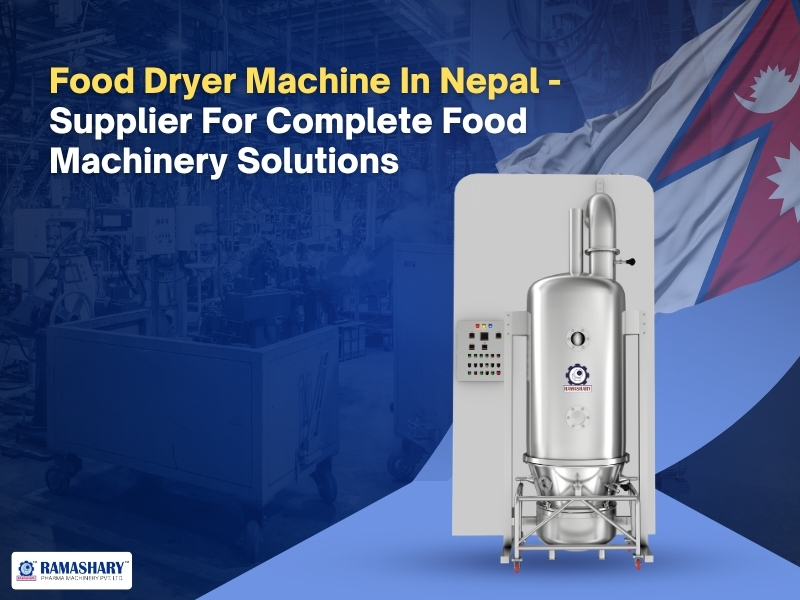
Machine 3: Fluid Bed Dryer

Introduction. The fluid bed dryer removes moisture from wet granules quickly and evenly. This is a GMP design in stainless steel with an air handling unit and filters. A good dryer protects granule quality and shortens the time between granulation and compression.

Working principle. Hot filtered air passes upward through a bed of wet granules at a speed that lifts and suspends them. Each particle floats in the air stream and exposes its whole surface. Heat and mass transfer are fast and uniform. The result is rapid and even drying without hot spots.

Materials handled. Wet granules from pharmaceutical and ayurvedic and food and chemical processes. It suits materials that tolerate warm air.

Real-world products. Granules for paracetamol and antacid tablets and for many powders and herbal extracts.

Machine 4: Ramashary’s Automatic Tablet Coating Machine

Introduction. Coating gives tablets protection and a smooth look and sometimes controlled release. Ramashary’s Automatic Tablet Coating Machine is ideal for sugar and film coating, with pan sizes listed from 30 inches to 60 inches. When teams compare options for a tablet coating machine in Austria, they look closely at the spray system and drying and discharge.

Working principle. Tablets tumble in a rotating perforated pan. A spray system atomises coating liquid onto the moving tablet bed. Warm air passes through the bed and dries each thin layer. Layer by layer, a uniform film forms.

Materials handled. Compressed tablets and pellets or capsules in some applications. Coating liquids include aqueous film coating suspensions and sugar syrups.

Real-world products. Film-coated tablets such as common painkillers and antibiotics and sugar-coated vitamin and Ayurvedic tablets. Enteric and functional coatings are also made on coating pans when the formulation requires them.

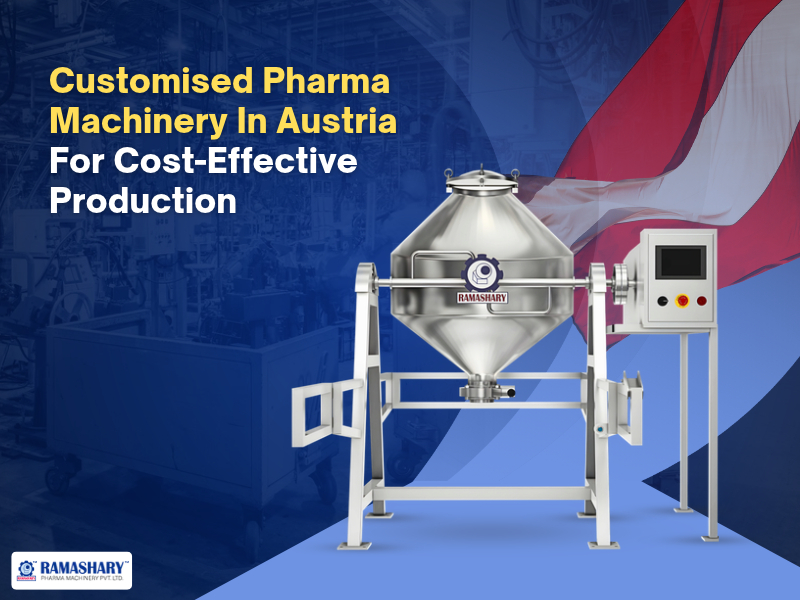
Machine 5: Double Cone Blender

Introduction. The double cone blender is a gentle tumble mixer. Ramashary Pharma Machinery Pvt. Ltd. lists capacities from 10 litres to 6,000 litres. It is a good match for powders of similar density and size. A tablet manufacturing machine in Austria often depends on such a blender for the final mix before compression.

Working principle. The vessel has two truncated cones joined by a cylinder. As it rotates, the powder tumbles and slides and folds over itself. Internal baffles break up the swirling and make the movement more thorough.

Materials handled. Such pharma machinery in Austria can handle free-flowing powders and granules. The working volume is generally about 60% of the total capacity, so the material has room to move.

Found The Pharmaceutical Machines You Were Looking For?

FAQs

1. Are your machines GMP compliant?

Our machines are offered as GMP models. We provide every pharma machinery in Austria and abroad by following CE, ASME BPE, ISO 9001:2015, WHO-cGMP, 21 CFR, SCADA and Industry 4.0 and international validation protocols.

2. What solutions do you provide?

As a supplier of pharma machinery in Austria and abroad, we provide end-to-end solutions that include:
Understanding your needs, conducting space and process analysis, providing the best suggestions, machine design, engineering, manufacturing, site installation, commissioning, operator training, documentation, ongoing after-sales service and assured spare parts.

3. What capacity range can I choose?

It depends on the machine. Tell us your batch size and we will suggest the right model. A pharma machinery in Austria is usually planned for the largest batch you expect in the next five years. Leave some headroom but avoid paying for unused volume.

4. Can you customise the machine for my process?

Yes, we can customise the machine for your process. We offer a range of capacities and configurations for each machine. If your process needs a particular size, finish or feature, we will discuss it with you and confirm what is possible. The goal is to match the machine to your product and not the other way round.

5. How do I start and how do I get a quote?

Visit our contact page and send an inquiry. Share your product type, batch size and the machines you are considering. Our team will respond with technical advice and a quotation.

Conclusion

Austria’s pharmaceutical industry is proud, productive and under pressure. About 25,000 people work in it. Global companies keep investing in Kundl and Linz and Vienna and Orth. At the same time, medicine shortages, high energy costs, low prices and a tight labour market push plants to do more with less. In this setting, pharma machinery in Austria is a strategic choice.
Ramashary Pharma Machinery Pvt. Ltd. can be your reliable machinery partner and a business growth partner for that journey. We manufacture GMP-model machines in stainless steel for solid dose, liquid and semi-solid processing. We offer wide capacity ranges and direct access to the maker and support throughout the partnership. Pharma machinery in Austria is a long-term investment and we treat it that way.

Let’s connect for a discussion now.

Home
Industries
Blogs
Call Us
WhatsApp

Let’s Talk

Contact Form New

I am looking to

My business belongs to

My name is

I represent

Where I hold the position of

My number is

My email is

I am planning to purchase the machine

I heard about Ramashary from

I would like a free consultation

Schedule a Call Now

Schedule a call

Fill the Form to Download Company Profile

Company Profile

Fill the Form to Download Brochure

Download Brochure