Ramashary.com

CGMP-Compliant Chemical Machinery in Germany

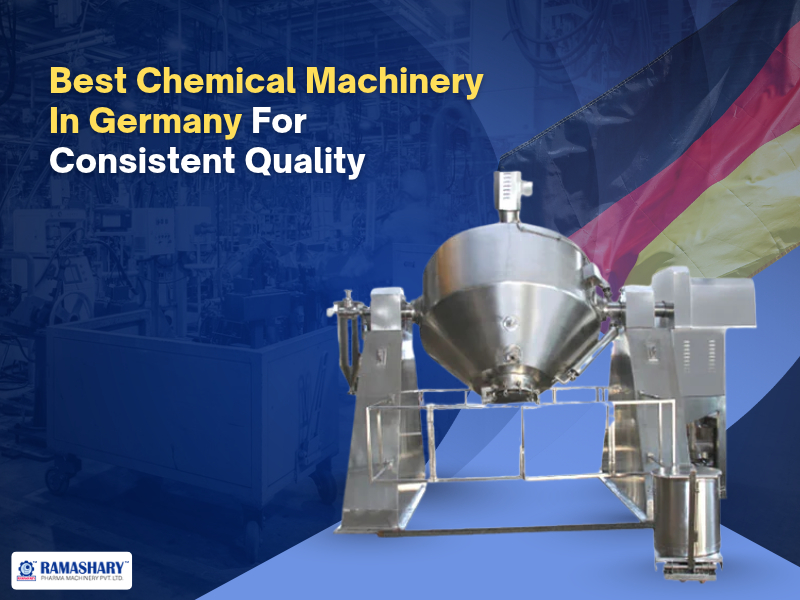
Germany has built its reputation on precision engineering, and chemical machinery in Germany is a clear example of that strength. Companies that need chemical process equipment in Germany look for machines that are accurate, durable and easy to maintain, and a good chemical processing machine in Germany is designed to deliver consistent results batch after batch. A trusted chemical machinery supplier in Germany offers a wide range of equipment for mixing, blending, granulating and liquid handling, so buyers can source everything from one reliable partner. Among the most in-demand machines, the ribbon blender supplier in Germany plays a key role for industries that need uniform dry powder blending, whether in pharmaceuticals, food, cosmetics or specialty chemicals. In the same way, a rapid mixer granulator supplier in Germany helps manufacturers produce even granules with better flow and compression quality, which is vital for tablet and powder production. For companies working with creams, syrups, lotions and other fluids, a complete liquid manufacturing plant in Germany brings mixing, heating, homogenizing and storage into one connected setup that saves space and cuts down on production time. When you choose chemical process equipment in Germany, you also benefit from strict quality standards, advanced stainless steel construction and strong after-sales support. Whether you are setting up a new facility or upgrading an existing one, working with an experienced chemical machinery supplier in Germany ensures that your chemical machinery in Germany matches your capacity needs, safety requirements and budget. From a dependable ribbon blender supplier in Germany to a skilled rapid mixer granulator supplier in Germany and a turnkey liquid manufacturing plant in Germany, the right chemical processing machine in Germany can improve efficiency, product quality and long-term profitability for your business.
Germany has one of Europe’s largest chemical manufacturing industries. However, its established industrial infrastructure does not make production challenges any less demanding. Manufacturers must continuously manage energy expenses, raw material costs, regulatory requirements, process consistency and competition from international companies.
Chemical machinery in Germany is becoming an important consideration for manufacturers to improve production efficiency, maintain consistent product quality and manage increasingly demanding manufacturing operations.
Manufacturers need to improve energy efficiency, reduce waste and adopt more sustainable production methods. At the same time, they must remain competitive in international markets. The European Commission’s chemical industry action plan highlights the importance of industrial competitiveness, energy security, decarbonisation, circular production and innovation.
These priorities have direct implications for machinery investment decisions. Equipment that consumes excessive energy, creates avoidable material losses or requires frequent maintenance can become a long-term operational disadvantage.

Overview Of The German Chemical Industry

For a production manager in Ludwigshafen or a procurement head evaluating equipment for a chemical manufacturing facility in North Rhine-Westphalia, purchasing machinery is not simply about increasing production capacity. It is about finding equipment that fits the actual manufacturing process.
Another important consideration is equipment suitability. A machine that works effectively for one chemical formulation may not deliver the same performance with another. Differences in particle size, bulk density, viscosity, moisture content and chemical compatibility influence equipment selection.
Manufacturers handling powders, granules, liquid formulations and intermediate chemical compounds need machinery designed around their specific process requirements. In regulated pharmaceutical and API manufacturing, GMP-oriented design and documentation also become important purchasing considerations.
This is where choosing the right chemical machinery supplier in Germany becomes a strategic decision. German manufacturers should evaluate suppliers on more than the initial equipment price. Process understanding, customisation capabilities, material compatibility, manufacturing quality, installation support and long-term service considerations all deserve attention.
The objective should be straightforward: invest in machinery that supports the production process instead of forcing the production team to work around equipment limitations.

1. Germany Is A Major Chemical Manufacturing Centre In Europe

Germany’s chemical industry has a significant position in the European and global manufacturing landscape. Its strength comes from a combination of large-scale chemical production, specialised manufacturers, research institutions, industrial clusters, established logistics infrastructure and a highly developed engineering ecosystem.

According to Germany Trade & Invest (GTAI), Germany’s chemical industry recorded approximately €189 billion in revenue in 2025. The country had around 1,700 chemical companies and approximately 342,000 employees in the sector. Its chemical industry accounted for approximately 30% of total EU-27 chemical sales in 2025.

These figures demonstrate the scale of the opportunity for companies supplying industrial equipment. German chemical manufacturers operate across different production categories. The requirements related to chemical machinery in Germany can range from powder blending and material handling to drying, filtration and specialised liquid processing.
For a chemical machinery supplier in Germany entering this market, understanding these different production requirements is more valuable than simply targeting the broad term chemical machinery in Germany.
Research and development facilities need chemical process equipment in Germany that can support product trials and process development. A chemical processing machine in Germany must therefore be evaluated according to the material being processed and the required production outcome.

2. Understanding The Scale Of Germany's Chemical & Pharmaceutical Industry

It is important to distinguish the chemical industry from the combined chemical and pharmaceutical industry when examining market statistics. Reportedly, Germany’s combined chemical and pharmaceutical industry generated approximately €220.4 billion in turnover in 2025, with 2,086 companies and 476,261 direct employees.
The combined industry also recorded approximately €9.7 billion in capital expenditure and €16.5 billion in research and development investment.
Chemical manufacturers continuously work on improving formulations, developing new materials and adapting production methods. Such activities can require changes in mixing, drying, filtration and material transfer processes.
For example, a manufacturer developing a speciality powder formulation may need to evaluate different blending arrangements before finalising commercial production. The selected chemical process equipment in Germany must accommodate the formulation’s flow characteristics and achieve the required blend uniformity.
A chemical machinery supplier in Germany must understand that machinery selection begins with process requirements rather than a standard equipment catalogue.

3. The Importance Of Chemical Parks & Integrated Manufacturing Infrastructure

One of Germany’s major industrial advantages is its network of integrated chemical parks. Unlike isolated manufacturing facilities, chemical parks bring multiple industrial companies together within a shared infrastructure. They may provide access to utilities, pipelines, logistics facilities, technical services and connections between neighbouring production units.
According to GTAI, Germany has an established network of chemical production infrastructure, including:
  • 13 refineries with a combined capacity of approximately 115 million tonnes per year.
  • Eight steam crackers supplying essential chemical building blocks.
  • Approximately 145 million tonnes of chemicals are transported annually.
  • Around 36% of these chemical transport volumes move through pipelines.
This infrastructure supports the movement of raw materials and intermediate products between industrial locations. For the suppliers of chemical machinery in Germany, these integrated facilities represent an important market segment. Chemical production does not depend on a single machine. It involves multiple connected operations, and equipment performance at one stage can influence the next.
Consider a manufacturer producing a powdered speciality chemical:
  1. Raw materials are received and prepared.
  2. Materials undergo size reduction or preliminary processing where required.
  3. A blending system combines the ingredients.
  4. A screening operation separates unwanted oversized particles.
  5. A suitable drying operation controls residual moisture where required.
  6. The finished material is transferred for packaging or further processing.

4. Germany's Chemical Manufacturing Market Is Facing Economic Pressure

The size of Germany’s chemical industry should not be mistaken for an absence of business difficulties.
A difficult operating environment was reported during 2024. Chemical and pharmaceutical industry sales declined by 2% to approximately €221 billion. Although combined production increased by 2%, output remained significantly below earlier levels. Also, chemical production in 2024 was approximately 17% below its 2018 level.
These figures are important because they explain why manufacturers are becoming more careful about capital expenditure.
When production margins are under pressure, procurement departments cannot evaluate chemical machinery in Germany solely on its advertised capacity. They need to understand:
  • How much energy does the machine consume?
  • Can it handle the actual material characteristics?
  • How much production time is required for each batch?
  • Does the equipment require frequent cleaning?
  • How easily can operators maintain it?
  • Can the machine accommodate future production requirements?
  • What are the costs associated with spare parts and downtime?
For instance, purchasing a high-capacity blending machine does not automatically improve production economics. If the machine cannot achieve uniform mixing within the required cycle time, the manufacturer may face repeated processing, additional energy consumption and delayed batch release.
A suitable chemical processing machine in Germany should deliver measurable operational value. Its performance should be assessed against production output, energy consumption, material losses, maintenance requirements and product consistency.

5. Machinery Quality Matters Across Different Chemical Manufacturing Segments

Germany’s chemical manufacturing industry is diverse. A machinery requirement in one segment may be completely different from that of another.
The following table explains how equipment selection relates to different manufacturing activities.
Chemical manufacturing segment Typical processing requirements Relevant machinery considerations
Speciality chemicals
Blending, formulation and material preparation
Mixing uniformity and material compatibility
Chemical powders
Powder mixing and particle separation
Ribbon blenders, octagonal blenders and vibro shifters
Chemical intermediates
Drying and moisture management
Tray dryers and vacuum drying systems
Inorganic chemicals
Solid-liquid separation
Filter presses and compatible filtration equipment
API manufacturing
Controlled mixing, drying and processing
GMP-oriented equipment and documentation
Industrial formulations
Liquid preparation and material blending
Suitable tanks and mixing arrangements
Chemical additives
Powder handling and batch consistency
Blending and screening equipment
This diversity creates opportunities for manufacturers that can supply more than one category of machinery. However, equipment suitability must always be established through a technical assessment. A machine listed for chemical and API applications is not automatically compatible with every chemical. Corrosion resistance, operating temperature, solvent compatibility, dust hazards and other process conditions must be reviewed before purchase.

Looking For Machines That Handle Complex Chemical Formulations?

Evaluation Before Selecting A Chemical Machinery Supplier In Germany

A German procurement team typically has to consider the complete commercial and technical implications of a machinery purchase. A chemical machinery supplier in Germany may offer an attractive quotation, but the actual value of that offer depends on whether the equipment can meet the buyer’s production requirements.
Before selecting a chemical machinery supplier in Germany, or an international supplier serving German manufacturers, decision-makers should examine the following:

Technical Suitability

  • Is the machine suitable for the specific chemical material?
  • Can it handle the required batch size?
  • Does it achieve the required mixing, drying or filtration performance?
  • Are the product-contact materials compatible with the formulation?

Manufacturing & Quality

  • What material specifications are available?
  • Can the supplier provide relevant technical drawings?
  • Are inspection and testing procedures documented?
  • Can GMP-oriented design requirements be accommodated where applicable?

Long-Term Partnership

  • Can the supplier understand changing production requirements?
  • Is technical assistance available?
  • Can the machinery be customised?
  • Is there a clear communication process for handling technical issues?
A reliable supplier of chemical machinery in Germany should be willing to discuss these questions before recommending a machine. For a German manufacturer, the right purchasing decision is not necessarily the machine with the lowest purchase price. It is the machine that offers the best balance of process suitability, production performance, quality, maintainability and long-term operating value.

Major Trends Changing Germany's Chemical Industry

Germany’s chemical manufacturing sector is not simply dealing with a temporary change in demand. It is facing a broader industrial transition. Manufacturers must reconsider production economics, energy consumption, raw material sourcing, environmental responsibilities and equipment investment.
For procurement heads and plant managers, these developments have a direct impact on machinery purchasing decisions. A chemical processing machine in Germany that was suitable for an established production process may not necessarily meet the requirements of a new formulation, alternative raw material or more sustainable manufacturing method.

Trend 1: Cost Competitiveness Is Becoming a Major Production Priority

German chemical manufacturers are facing a difficult commercial environment. High energy costs, international competition, weak demand and pressure on production margins are affecting the economics of domestic manufacturing.
Reportedly, in the fourth quarter of 2025, Germany’s chemical production declined by 3.3% over the full year. Chemical plant capacity utilisation averaged just 72.5% in 2025. This is a significant concern for manufacturers because chemical plants generally need sufficient utilisation to distribute fixed operating costs across production volumes.
The challenge is particularly important for producers of basic chemicals and petrochemicals. International competitors with access to lower-cost energy and large production capacities can place considerable pressure on German manufacturers.
For a plant manager, the question is no longer simply how much a machine can produce. The more important question is how efficiently it can produce.
Consider a speciality chemical manufacturer operating a powder blending line. If the existing blender requires repeated processing to achieve the required uniformity, the additional operating time increases electricity consumption and reduces available production capacity.
Similarly, an inefficient drying cycle can delay subsequent production batches. These limitations become more expensive when production margins are already under pressure.
So, German manufacturers should evaluate machinery according to:
  • Batch processing time.
  • Energy consumption per batch.
  • Material recovery and product losses.
  • Equipment utilisation.
  • Maintenance frequency.
  • Cleaning and changeover time.
  • Consistency across production batches.
A well-selected chemical processing machine in Germany can support better utilisation of existing manufacturing resources. However, the actual benefit depends on the machine design, material properties and operating conditions. For buyers comparing domestic and international suppliers, the decision should be based on the complete cost of ownership rather than the initial purchase price.

Trend 2: Energy Efficiency & Industrial Decarbonisation Are Reshaping Equipment Investment

Energy consumption has become one of the most important considerations in German chemical manufacturing. Chemical production requires energy at multiple stages. Heating, drying, cooling, mixing, pumping, compression and material transfer all contribute to overall consumption.
Germany’s chemical industry also has a particular challenge: energy is not only a utility expense. Natural gas and other energy sources can serve as essential chemical feedstocks.
For example, manufacturers introducing new drying technologies must evaluate thermal efficiency, heat requirements, operating temperatures and moisture removal performance. A conventional drying process that consumes excessive energy may become less attractive as companies work towards reducing their production-related emissions.
Similarly, manufacturers investing in automated blending systems may examine motor efficiency, operating duration and the possibility of reducing unnecessary machine cycles.

What should machinery buyers consider?

  • Installed motor power and operating requirements.
  • Heating arrangements and thermal requirements.
  • Expected operating cycles.
  • Insulation and heat-loss considerations where relevant.
  • Opportunities for process optimisation.
  • Energy requirements under the intended production conditions.
Energy efficiency should be assessed using actual operating data and realistic production assumptions. A Liquid Manufacturing Plant in Germany with a lower installed power rating does not automatically consume less energy in every application.

Trend 3: Circular Economy & Sustainable Raw Materials Are Gaining Importance

Chemical manufacturers are under increasing pressure to reconsider how they source, process and recover raw materials. Traditionally, many chemical production processes have relied heavily on fossil-based feedstocks. However, sustainability targets and resource constraints are encouraging manufacturers to explore alternative inputs.

These include:

  • Recycled industrial materials.
  • Recovered solvents.
  • Bio-based feedstocks.
  • Recovered chemical intermediates.
  • Recycled polymers and plastic waste.
  • Secondary raw materials from other industrial processes.

For example, a manufacturer introducing recycled polymer powder into an existing blending process may encounter differences in:

  • Particle size distribution.
  • Bulk density.
  • Moisture content.
  • Flowability.
  • Surface characteristics.
  • Mixing behaviour.
An existing blending system may need to be reassessed before it can handle the new material consistently. The same issue applies to filtration and drying. Recovered chemical materials may contain different levels of impurities or moisture than conventional inputs.
Machinery Implications For German Manufacturers:
Manufacturers should evaluate whether their equipment can accommodate the material characteristics of alternative feedstocks. A suitable ribbon blender may be considered for compatible dry powder and granular formulations. A filter press may be appropriate for suitable solid-liquid separation applications.
Drying equipment may be required where the recovered material needs moisture reduction. However, equipment selection must account for the actual chemical composition and operating conditions. For companies exploring chemical process equipment in Germany, the ability to evaluate different material characteristics is becoming an important part of machinery procurement.

Trend 4: Speciality Chemicals & High-Value Formulations Are Increasingly Important

Germany has a diversified chemical manufacturing base. Its production activities extend beyond basic industrial chemicals into speciality chemicals, advanced materials, coatings, adhesives, additives and other high-value formulations. These products often require more specific manufacturing conditions than standard bulk chemicals.
A speciality chemical producer may manufacture several formulations using different raw materials and batch sizes. The company must maintain the required product characteristics while managing changeovers between production runs.
This creates a different set of machinery requirements. For example, consider a manufacturer producing powdered additives for industrial applications. One formulation may contain fine powders with low bulk density while another may contain heavier granular ingredients.
A blending machine must be suitable for the actual material characteristics. The manufacturer must consider mixing uniformity, loading capacity, discharge arrangements and cleaning requirements. A machine that works effectively with free-flowing granules may not automatically deliver the same results with cohesive powders.

Speciality chemical production places importance on:

  • Consistent formulation quality.
  • Accurate batch processing.
  • Suitable mixing arrangements.
  • Flexible production capacity.
  • Controlled moisture levels.
  • Effective material discharge.
  • Product changeover and cleaning procedures.
A manufacturer researching a ribbon blender supplier in Germany should therefore look beyond the machine’s nominal capacity. The important question is whether the blender’s configuration can achieve the required mixing performance with the specific ingredients.
The same applies to buyers evaluating drying and filtration equipment. The process must be developed around the chemical’s physical and chemical properties.

Trend 5: Digitalisation, Automation & Data-Driven Manufacturing Are Becoming More Important

German chemical manufacturing has traditionally relied on advanced engineering and industrial automation. However, digitalisation is creating new opportunities to improve production monitoring and process control.

Manufacturers are increasingly exploring:

  • Industrial Internet of Things (IIoT).
  • Artificial intelligence (AI).
  • Predictive maintenance.
  • Digital production monitoring.
  • Automated material handling.
  • Process data analytics.
  • Production planning and optimisation.

If machine operating information is recorded consistently, the production team can identify recurring problems.

For instance:

  • Increasing motor load may indicate a developing mechanical problem.
  • Repeated cycle-time variations may indicate inconsistent material behaviour or operating conditions.
  • Unexpected temperature fluctuations may affect a drying process.
  • Frequent stoppages may indicate a maintenance or material-handling issue.
Digital systems can help identify these patterns. However, digitalisation is not achieved simply by purchasing a machine with a control panel. It requires suitable instrumentation, data collection, system integration and an effective maintenance strategy.

When purchasing a chemical processing machine in Germany, manufacturers should discuss:

  1. Available control and automation options.
  2. Operating parameter monitoring.
  3. Compatibility with the plant’s existing automation architecture.
  4. Safety interlocks and operating safeguards.
  5. Maintenance accessibility.
  6. Possibilities for future automation upgrades.
Not every machine needs an advanced digital control system. The level of automation should reflect the complexity of the process, production volume and the manufacturer’s operational requirements. For a chemical machinery supplier in Germany, understanding how equipment fits into the customer’s wider production system is increasingly important.

Trend 6: Regulatory Compliance & Chemical Safety Are Influencing Machinery Design

Regulatory compliance is a major consideration for chemical manufacturers operating in Germany. Companies must understand the applicable European and German requirements relating to chemical substances, workplace safety, emissions, environmental protection and product handling.
These developments can influence raw material selection, formulation changes, product development and manufacturing procedures. From a machinery perspective, chemical safety and material compatibility cannot be overlooked.
Consider a manufacturer processing corrosive chemical compounds. The machine’s product-contact surfaces, seals, gaskets and associated components must be suitable for the actual chemical composition and operating conditions.
Similarly, a manufacturer handling combustible dust must evaluate the relevant explosion-protection requirements. Selection of chemical machinery in Germany should consider the material’s hazard characteristics and the applicable requirements where relevant.
For pharmaceutical and API manufacturers, additional GMP considerations may apply. These can include equipment cleanability, documentation, material traceability and process validation requirements according to the specific manufacturing activity.

Questions German buyers should ask a machinery supplier

  • Are product-contact materials compatible with the chemicals being processed?
  • Can the supplier provide material specifications?
  • Are suitable surface finishes available?
  • Can cleaning requirements be accommodated?
  • Are appropriate safety and guarding arrangements available?
  • Can the supplier provide relevant equipment documentation?
  • Can additional GMP-oriented requirements be incorporated where applicable?
A chemical machinery supplier in Germany must understand that regulatory suitability is application-specific.

Trend 7: Supply Chain Resilience & Equipment Investment Are Becoming Strategic Decisions

Supply chain resilience has become a significant concern for Germany’s chemical industry. Chemical manufacturers depend on reliable supplies of raw materials, intermediate products, energy, spare parts and specialised engineering services.
The VCI’s reporting on the German chemical and pharmaceutical industry highlights the continuing pressure from weak demand, high costs and international competition. A report has identified global trade pressures and energy-price disadvantages as important challenges for European chemical producers.
These conditions are encouraging manufacturers to examine how much operational flexibility they have. For example, a plant dependent on a single ageing blending machine may experience serious disruption if that machine requires an extended repair. Similarly, a manufacturer relying on equipment with long spare-parts lead times may face difficulty maintaining production schedules.
This is why machinery procurement should include a long-term maintenance and supply assessment while selecting a Liquid Manufacturing Plant in Germany or any related machine.

What German Manufacturers Should Prioritise

  • Reliable machinery construction.
  • Availability of critical replacement components.
  • Clear technical documentation.
  • Practical maintenance access.
  • Supplier responsiveness.
  • Installation and commissioning arrangements.
  • Long-term technical communication.
International sourcing can also form part of a manufacturer’s procurement strategy. An Indian manufacturer may offer an alternative to domestic machinery sourcing when its technical capabilities, quality systems, commercial terms and support arrangements meet the buyer’s requirements.
However, a lower quotation alone is not sufficient justification for choosing an overseas supplier.
The procurement team must also consider delivery arrangements, applicable import requirements, technical communication, installation responsibilities and after-sales support.
For manufacturers comparing a ribbon blender supplier in Germany with international alternatives, the right decision should come from a documented technical and commercial comparison.

What These Seven Trends Mean

The seven trends point towards one important change: German manufacturers must evaluate machinery as part of their overall production strategy. The purchasing decision should connect equipment performance with actual factory requirements.
Industry trend What manufacturers need from machinery
Cost competitiveness
Efficient processing and lower avoidable operating costs
Energy transition
Appropriate energy consumption and process efficiency
Circular economy
Compatibility with changing raw material characteristics
Speciality chemicals
Flexible and consistent batch processing
Digitalisation
Suitable automation and process monitoring
Regulatory compliance
Material compatibility, safety and appropriate documentation
Supply chain resilience
Maintainability, spare parts and dependable supplier support
A manufacturer investing in chemical machinery in Germany should not begin by asking which machine is the most popular. It should begin by identifying the production problem that needs to be solved. Is the current blending process inconsistent? Is the drying cycle taking too long? Is filtration affecting downstream production? Are material losses increasing? Is the existing equipment difficult to clean or maintain?
These questions help procurement teams identify the correct machinery specifications.

Facing Challenges With Mixing, Blending Or Chemical Processing?

5 Major Chemical Manufacturing Cities In Germany

Germany’s chemical manufacturing industry is concentrated around several important industrial regions. These locations are supported by chemical parks, specialised manufacturers, research facilities, logistics networks and established industrial infrastructure.
For a supplier of chemical machinery in Germany entering the market, understanding these locations helps identify where different types of equipment may be relevant. A manufacturer operating in Ludwigshafen may have very different machinery requirements from a speciality chemical producer in Frankfurt or a polymer manufacturer in the Cologne region.
The following five locations have been selected because of their established chemical manufacturing activities and industrial ecosystems. They are not presented as an official ranking of Germany’s largest chemical-producing cities.

1. Ludwigshafen am Rhein: Germany's Largest Integrated Chemical Manufacturing Location

Ludwigshafen am Rhein in Rhineland-Palatinate is one of the most important locations in Germany’s chemical industry. It is home to BASF’s headquarters and the world’s largest integrated chemical complex. The scale of the location is particularly significant for industrial machinery manufacturers.
According to BASF, its Ludwigshafen site covers approximately 10 square kilometres. Around 33,000 employees work at the site and approximately 125 production facilities operate within the complex.
The facility also has an extensive internal infrastructure, including approximately 2,850 kilometres of pipelines. Its integrated production system connects manufacturing facilities, energy flows and logistics operations. Instead of treating every manufacturing operation as an isolated activity, the system connects different production stages so that materials, energy and by-products can be used efficiently across the complex.

What Is Manufactured In Ludwigshafen?

BASF manufactures thousands of products at the location for customers across numerous industries. Its activities include:

  • Basic and intermediate chemicals.
  • Performance materials.
  • Industrial chemicals.
  • High-performance plastics.
  • Chemicals used in agricultural applications.
  • Speciality chemical products.
The range of products makes Ludwigshafen an important industrial location for companies involved in chemical processing and manufacturing.

What Machinery Requirements Are Relevant In Ludwigshafen?

The requirements of a large integrated chemical complex are different from those of a small batch-processing facility. Nevertheless, several supporting manufacturing operations involve machinery categories that are relevant to specialised equipment suppliers.

For example:

Powder blending: Manufacturers handling compatible powdered additives, intermediates and speciality formulations may require industrial blending equipment. A ribbon blender supplier in Germany can play an important role when the material characteristics and required mixing performance are important.

Drying operations: Chemical intermediates and other compatible solid materials may require controlled moisture removal. The selection of a tray dryer, vacuum dryer or fluid bed dryer depends on the material’s thermal sensitivity, particle characteristics and process requirements.
Solid-liquid separation: Certain chemical processes generate suspensions that require filtration. A filter press may be suitable for applications involving compatible slurries and the required filtration conditions.
Material screening: Powder and granular products may require particle separation before subsequent processing or packaging. Vibro shifters can be considered for appropriate screening applications.
For procurement heads in Ludwigshafen, the important consideration is whether a machinery supplier can understand the material and processing requirements before proposing a standard machine. A supplier offering chemical machinery in Germany must be able to discuss material compatibility, batch capacity, construction materials and maintenance requirements.

2. Leverkusen: A Strong Chemical Manufacturing & Speciality Materials Ecosystem

Leverkusen in North Rhine-Westphalia has a long association with Germany’s chemical manufacturing industry. Its industrial development is closely connected with the history of Bayer and the wider Rhineland chemical region. Today, Leverkusen is home to one of the three CHEMPARK locations, alongside Dormagen and Krefeld-Uerdingen.
The CHEMPARK network brings together chemical manufacturers, research organisations, technical service providers and industrial support companies. The wider CHEMPARK network has a substantial industrial infrastructure, with companies involved in manufacturing, research, development, logistics and technical services.

Leverkusen and the surrounding chemical region support a diverse range of industrial activities, including:

  • Speciality chemicals.
  • Polymer and performance materials.
  • Inorganic chemicals.
  • Organic chemical intermediates.
  • Pigments and colourants.
  • Pharmaceutical and life science-related activities.
  • Industrial chemical formulations.
The presence of multiple manufacturers makes the region relevant for suppliers of specialised processing equipment.

Why Machinery Selection Matters In Leverkusen

Consider a manufacturer producing speciality chemical powders. The company may purchase several raw materials from different suppliers. These ingredients may have different particle sizes, densities and flow properties.

The production team must achieve a consistent final blend without damaging the material or creating unnecessary processing delays. In this situation, the procurement team may investigate a ribbon blender supplier in Germany or consider an international supplier capable of providing a suitable blending configuration.

However, the decision must be based on:

  • Powder characteristics.
  • Required mixing uniformity.
  • Batch capacity.
  • Loading and discharge arrangements.
  • Product-contact material requirements.
  • Cleaning and maintenance accessibility.
A chemical processing machine in Germany must be selected according to the actual formulation and process. Machinery suitability should not be assumed simply because the equipment is marketed for chemical applications.

3. Frnkfurt am Main: Chemical Manufacturing, Fine Chemicals & Pharmaceutical Production

Frankfurt am Main is an important location for Germany’s chemical, pharmaceutical and life sciences industries. Its industrial significance is closely associated with Industriepark Hochst, one of Europe’s major chemical and pharmaceutical manufacturing locations.
The site is home to approximately 90 chemical and pharmaceutical companies and around 20,000 employees. It covers approximately 460 hectares and has attracted roughly €8.5 billion in investment since 2000.
The industrial park supports research, development and commercial manufacturing. Its companies operate across several sectors, including basic chemicals, speciality chemicals, fine chemicals, polymers, pharmaceutical products and biotechnology.

What Makes Frankfurt Relevant To Chemical Machinery Suppliers?

Unlike locations dominated primarily by large-scale basic chemical production, Frankfurt has a particularly important speciality chemical and pharmaceutical manufacturing ecosystem. The presence of fine chemical manufacturers, pharmaceutical businesses and research organisations creates demand for equipment suited to controlled batch processing.

The chemical machinery in Germany must be appropriate for the formulation and the required quality specifications. Another example involves a manufacturer producing a pharmaceutical intermediate. The intermediate may require moisture reduction before it can be transferred to the next processing stage.

An Important Consideration For Pharmaceutical & Fine Chemical Manufacturers

Frankfurt’s industrial ecosystem includes regulated pharmaceutical production. This makes equipment documentation, cleaning arrangements, material traceability and process suitability particularly important for relevant applications.

For example, a pharmaceutical manufacturer evaluating a new drying system may need to consider:

  • Product-contact material specifications.
  • Cleaning and contamination-control requirements.
  • Drying temperature and product stability.
  • Residual moisture specifications.
  • Batch documentation.
  • Validation requirements where applicable.

4. Cologne: The Rhineland's Extensive Chemical Manufacturing Network

Cologne is an important centre within the Rhineland chemical manufacturing region. Its industrial significance extends beyond the administrative boundaries of the city to neighbouring locations such as Wesseling, Hürth, Dormagen and Leverkusen.

According to ChemCologne, the region had:

  • More than 260 chemical businesses.
  • Over 70,000 employees.
  • Approximately €35.7 billion in chemical industry turnover in 2024, excluding pharmaceuticals.
The region generated approximately 70% of North Rhine-Westphalia’s chemical industry turnover and around 22% of Germany’s national chemical industry turnover. These figures demonstrate why the Cologne region deserves attention from companies targeting chemical process equipment in Germany.

What Machinery Requirements Are Relevant Around Cologne?

The wider Rhineland region includes large-scale producers as well as specialised manufacturers. Machinery requirements therefore vary considerably. Thus, a Vibro Shifter supplier or a Ribbon Blender supplier in Germany has to be selected accordingly.

Why International Machinery Suppliers Should Pay Attention To Cologne

The Cologne region offers a broader target market than a single industrial facility.

An international supplier can potentially approach:

  • Speciality chemical manufacturers.
  • Chemical intermediate producers.
  • Industrial additive manufacturers.
  • Polymer and material manufacturers.
  • Small and medium-sized chemical businesses.
  • Companies developing new chemical formulations.
However, the sales approach should be technical rather than catalogue-driven. A plant manager looking for a ribbon blender supplier in Germany will want to know whether the machine can handle the actual formulation, achieve the required mixing uniformity and operate reliably under the intended production conditions. The supplier must be prepared to discuss these matters before making a commercial proposal.

5. Hamburg: Chemical Manufacturing, Petrochemicals & Industrial Logistics

Hamburg is an important gateway for the chemical industry in Northern Germany. Its industrial importance comes from its port infrastructure, access to international raw material markets, petroleum processing facilities and connections with neighbouring chemical manufacturing locations.
One important distinction is that Hamburg’s chemical manufacturing ecosystem extends beyond the city itself. The wider Hamburg Metropolitan Region includes industrial locations such as Stade, Brunsbüttel, Walsrode and Hamburg-Harburg.
Major Chemical Manufacturing Activities
The Hamburg Metropolitan Region supports several important chemical manufacturing activities.
A. Basic chemicals and petrochemicals
The availability of raw materials and transport infrastructure has helped establish basic chemical and petrochemical production across Northern Germany. Industrial locations such as Stade and Brunsbüttel manufacture chemical intermediates and raw materials used by downstream industries.

These include:

  • Chemical intermediates.
  • Petrochemical products.
  • Plastic industry feedstocks.
  • Fertiliser-related products.
  • Industrial chemical compounds.
B. Speciality chemicals
The region also has manufacturers producing specialised chemicals and formulations.

These include products used in:

  • Automotive manufacturing.
  • Industrial coatings.
  • Paints and varnishes.
  • Hygiene products.
  • Personal care.
  • Technical materials.
What Machinery Requirements Are Relevant In Hamburg?
A manufacturer producing industrial chemical additives may require equipment for blending different powdered ingredients. A company manufacturing compatible coatings or speciality formulations may need suitable mixing and material preparation systems. A producer handling chemical intermediates may require filtration or drying equipment depending on its process.
The supplier of chemical machinery in Germany should understand the formulation and required mixing performance before recommending equipment.
Why Hamburg Matters To International Machinery Suppliers
Hamburg should not be approached only as a market for large petrochemical equipment. The wider region includes smaller and medium-sized manufacturers that produce specialised chemical formulations and industrial materials. These companies may have different purchasing requirements from large integrated chemical producers.
For an international chemical machinery supplier in Germany, potential customers may include speciality chemical manufacturers, chemical formulation companies and more. The procurement team may be interested in machinery customisation, competitive pricing, technical specifications and long-term supplier communication.

Choose Machinery That Supports Consistent Production Quality

7 Factory-Floor Challenges Faced By Chemical Manufacturers In Germany

A chemical plant can have advanced reactors, experienced process engineers and a well-equipped laboratory and still lose money because of problems occurring between individual production stages.
A powder blend that takes too long to achieve uniformity. A dryer that consumes more energy than expected. A filter press that slows down the next batch. A transfer system that creates dust or material loss. These are not isolated equipment problems. They affect production capacity, product consistency, operating costs and delivery schedules.
For procurement heads and plant managers evaluating chemical machinery in Germany, the important question is not simply which machine has the highest capacity. It is whether the equipment can handle the actual material, maintain the required process conditions and perform reliably within the factory’s production system.
The following seven challenges deserve attention when manufacturers review their production equipment and consider upgrades.

1. High Energy Costs & Inefficient Processing Cycles

Energy consumption is a major operating concern for chemical manufacturers in Germany. Heating, drying, mixing, vacuum generation, material transfer and air handling all contribute to the energy requirements of a production facility.
German chemical and pharmaceutical manufacturers face higher electricity and gas prices. For plant managers, the problem is not limited to the energy tariff. The way the Liquid Manufacturing Plant in Germany uses energy during production matters just as much.
When evaluating chemical process equipment in Germany, procurement teams should look beyond the machine’s purchase price. They should assess energy consumption per batch, processing time, usable capacity and the effect on total production cost. A machine that appears less expensive at the quotation stage may become more expensive over several years if it consumes excessive energy or restricts production throughput.

2. Inconsistent Powder Blending & Batch Quality

Chemical manufacturers often work with powders that differ in particle size, density, flow characteristics and moisture content. Even when two ingredients appear similar, their behaviour inside a mixer can be very different. This creates a practical challenge: achieving a uniform blend without extending the mixing cycle unnecessarily or damaging the material.

For a chemical producer, this can mean:

  • Variation in product performance between batches.
  • Inconsistent concentration of active ingredients or additives.
  • Reprocessing or rejection of non-conforming material.
  • Additional laboratory testing and quality-control work.
  • Delays in packaging or dispatch.
The solution is not simply to purchase a larger mixer. The chemical machinery in Germany must suit the formulation and the behaviour of the ingredients. A ribbon blender may be suitable for certain dry powder and granular blending applications.
An octagonal blender may suit other applications where gentle tumbling and batch uniformity are required. The correct choice depends on particle characteristics, bulk density, batch size, required homogeneity and the possibility of segregation.
Manufacturers considering a ribbon blender supplier in Germany should ask for more than the machine’s rated capacity. They should discuss the actual formulation, ingredient ratios, loading percentage, mixing time and the required uniformity test.
A chemical processing machine in Germany should be selected around the material and process, not just the product catalogue description.

3. Drying Difficulties & Moisture-Control Requirements

Drying is one of the production stages where equipment suitability has a direct effect on product quality. Chemical powders, intermediates and granules may require controlled moisture removal before they can be transferred to the next stage. However, drying is not simply a matter of applying heat until the material becomes dry.
Different materials respond differently to temperature, airflow, vacuum and processing time. Some are heat-sensitive. Others may form lumps, develop uneven moisture levels or change their physical properties if the drying conditions are unsuitable.

Common factory-floor consequences include:

  • Uneven moisture levels within a batch.
  • Longer drying cycles and reduced equipment availability.
  • Product agglomeration or changes in powder flow.
  • Excessive energy consumption.
  • Repeated sampling and additional quality checks.
  • Material degradation when temperature limits are not properly controlled.
The selection of chemical process equipment in Germany should follow the material’s drying characteristics. A tray dryer, fluid bed dryer or roto cone vacuum dryer may be appropriate for different applications, but they are not interchangeable solutions.
A tray dryer may suit certain batch-drying requirements. A fluid bed dryer can be considered where fluidisation is appropriate for the material. A rotary cone vacuum dryer may be evaluated for products requiring vacuum drying under controlled temperature conditions.
Before selecting a chemical processing machine in Germany, the production team should establish the initial and final moisture content, maximum allowable product temperature, batch size, solvent characteristics where applicable and required drying time. For manufacturers evaluating a chemical machinery supplier in Germany, these process details are more useful than a general claim about drying capacity.

4. Raw Material Losses & Inefficient Filtration

In chemical manufacturing, filtration is often treated as a routine separation stage. In practice, it can become a production bottleneck when the equipment is not suited to the slurry, solids concentration or required filtration rate. A filter press handling a slurry with difficult filtration characteristics may take longer to complete each cycle. The filter cake may retain more liquid than expected. Discharge and cloth cleaning may also take additional time.
For manufacturers working with valuable intermediates or speciality chemicals, material recovery is another important consideration. Product retained in the filter cake, left in pipelines or lost during manual handling can reduce the usable yield.

What should production and procurement teams evaluate?

  • Filtration area and expected filtration rate.
  • Slurry characteristics and solids concentration.
  • Filter media compatibility with the chemical being processed.
  • Cake moisture and the possibility of recovering retained product.
  • Ease of cake discharge and filter cloth cleaning.
  • Whether the filtration system can handle the required batch volume.
A filter press should be selected according to the material and separation objective. Simply choosing a larger unit does not guarantee faster filtration or better recovery.
For a plant assessing chemical process equipment in Germany, the filtration trial and material data should form part of the equipment selection process. Procurement teams should also establish whether the machine’s wetted parts and filter media are compatible with the process chemicals.

5. Chemical Compatibility, Process Safety & Regulatory Requirements

A chemical machinery in Germany can have the right capacity and still be unsuitable for a chemical application if its construction materials, seals, surface finish or operating design are incompatible with the product.
Chemical manufacturers may handle corrosive substances, solvents, reactive powders, flammable liquids and combustible dusts. Each material brings different requirements for equipment construction and safe operation.
Equipment selection must instead consider the substances handled and the applicable safety and environmental requirements. Similarly, GMP-oriented equipment requirements are relevant where machinery is used in pharmaceutical or other regulated manufacturing processes. They should not automatically be applied to every general chemical production line.

Before approving a chemical processing machine in Germany, manufacturers should review:

  • Product-contact material compatibility.
  • Seal and gasket compatibility.
  • Operating temperature and pressure limits.
  • Dust and vapour explosion risks.
  • Earthing and bonding requirements where applicable.
  • Enclosure, containment and dust extraction arrangements.
  • Cleaning and inspection access.
  • Relevant ATEX requirements where explosive atmospheres may occur.
  • Documentation required for the intended application.
For a chemical machinery supplier in Germany, the ability to understand the process and discuss these requirements is essential. A machine specification should be developed around the actual chemical hazards and operating conditions rather than relying on a standard configuration.

6. Equipment Downtime, Maintenance & Spare-Parts Concerns

Unplanned downtime is particularly disruptive when a machine sits between two dependent production stages. If a dryer stops working, material waiting for drying may occupy intermediate storage. If a blender develops a mechanical fault, the next stage may not receive its batch on schedule. A problem with a filter press can delay the entire downstream process.
The impact can extend beyond the repair itself. Production teams may need to reschedule batches, arrange additional shifts, repeat quality checks or inform customers about delayed deliveries. The German chemical industry has already been under pressure from high operating costs and weak capacity utilisation. In this environment, manufacturers cannot afford to treat equipment reliability as an afterthought.
Maintenance planning should begin before the machine is installed. Procurement teams should understand which components require periodic inspection, which parts are subject to wear and how quickly critical spares can be obtained.
Predictive maintenance can also help manufacturers identify developing faults before they cause a breakdown. The use of sensors, machine data and predictive analysis anticipates maintenance needs and improves equipment availability. The results depend on the equipment, data quality and implementation.

7. Skilled Labour Availability, Automation & Production Flexibility

Chemical manufacturing requires trained personnel who understand process conditions, equipment operation, material behaviour and safety procedures. However, manufacturers also need to manage production efficiently when experienced operators and maintenance specialists are not always available.
Germany’s Federal Employment Agency reported in September 2026 that 157 occupational categories were experiencing skills shortages in 2025. This is a national labour-market indicator, not a figure specific to chemical manufacturing, but it demonstrates the wider recruitment challenge facing German employers.

Automation can help, but it should solve a defined production problem. Installing an automated machine without reviewing the surrounding process may simply move the bottleneck to another stage.

Areas where manufacturers can assess automation include:

  • Controlled material charging and discharge.
  • Automated powder transfer between process stages.
  • Timed mixing cycles and defined operating parameters.
  • Temperature and vacuum monitoring.
  • Process alarms and safety interlocks.
  • Batch records and operating data.
  • Easier access for cleaning, inspection and maintenance.
Production flexibility matters as well. A chemical manufacturer may produce multiple formulations or batch sizes using the same equipment. A machine designed for only one narrow operating condition may restrict future production planning.
For companies looking at a chemical processing machine in Germany, the best automation investment is not necessarily the most complicated one. It is the solution that improves repeatability, reduces avoidable manual work and fits the plant’s actual production sequence.

Leading Chemical Machinery Supplier In Germany

A chemical manufacturer does not need another machine catalogue. It needs equipment that works with its materials, fits its production process and addresses the problems already affecting its factory.
That distinction matters when investing in chemical machinery in Germany. A blending problem cannot always be solved by increasing mixer capacity. A drying bottleneck needs more than a machine with a higher heating rating. Filtration performance depends on the slurry, filter media and required separation result.

With 40+ years of experience and 700+ site installations, Ramashary Pharma Machinery Pvt. Ltd. (an ISO & GMP-certified company) approaches industrial machinery manufacturing across pharmaceutical, chemical, food, cosmetic and allied industries.

For a German chemical manufacturer, the first conversation should cover five points:

  1. Material characteristics: Is the material a fine powder, granule, slurry, solvent-based product or heat-sensitive intermediate?
  2. Production requirement: What batch size, daily output and cycle time does the plant need?
  3. Process conditions: What temperature, pressure, moisture level and mixing or separation performance are required?
  4. Safety and compatibility: Which construction materials, seals, containment measures and safety provisions are appropriate?
  5. Future production plans: Will the plant process different formulations or increase its production capacity?
Our chemical and API equipment is intended to address process requirements involving pressure, temperature, flow control, wear resistance and consistent mixing. We have in-house manufacturing facilities that include machine shop, fabrication, assembly, buffing and polishing sections. This is a relevant starting point for customised chemical machinery in Germany.

Top 7 Chemical Processing Machines For Manufacturers In Germany

The following seven are particularly relevant to the factory-floor challenges discussed in the previous instalment. The selection focuses on blending, drying, filtration and particle-size separation.

1. Octagonal Blender

Use: For gentle tumbling and dry powder blending

Not every powder requires the same mixing action. Some materials need gentle tumbling rather than an aggressive mixing mechanism. Our Octagonal Blender rotates a mixing bin around its axis. Its baffles help influence the movement of the material inside the vessel. It is suitable for gentle blending of sensitive materials.

Capacity Range: 5 L to 12,500 L

Potential chemical applications include:

  • Blending dry powders with compatible physical properties.
  • Mixing certain powdered additives.
  • Preparing dry chemical mixtures where gentle tumbling is appropriate.
  • Blending granules that require controlled handling.

2. Ribbon Blender

Use: For dry powder and granular material blending
A chemical formulation can contain several ingredients with different particle sizes, bulk densities and flow characteristics. The challenge is to distribute these ingredients consistently without creating unnecessary processing time or material segregation.

The Ribbon Blender uses a horizontal U-shaped trough and a double-helical ribbon agitator to move material through the mixing chamber.

Capacity Range: 50 L to 12,000 L 

Where it may fit in a chemical plant:

  • Blending compatible dry chemical powders.
  • Mixing powdered additives and formulation ingredients.
  • Preparing certain fertiliser blends.
  • Blending dry intermediates before subsequent processing.

Capacity Range: 50 L to 12,000 L 

Where it may fit in a chemical plant:

  • Blending compatible dry chemical powders.
  • Mixing powdered additives and formulation ingredients.
  • Preparing certain fertiliser blends.
  • Blending dry intermediates before subsequent processing.
A ribbon blender supplier in Germany should be evaluated on the ability to demonstrate that the mixing principle suits the actual formulation. A high-capacity machine is not automatically the right machine for a difficult-to-blend material.

3. Roto Cone Vacuum Dryer

Use: For controlled drying of suitable heat-sensitive materials
Drying can become a major bottleneck when a chemical intermediate is sensitive to heat or oxidation. Extending the drying cycle may increase energy consumption while exposing the material to processing conditions for longer than necessary.

Roto Cone Vacuum Dryer uses a rotating vessel, steam heating and vacuum to remove moisture. Its product information also identifies solvent recovery, reduced dust generation and low residual moisture as design features.

Potential applications include:

  • Drying suitable chemical intermediates.
  • Drying certain crystalline materials.
  • Processing materials that require vacuum drying.
  • Applications where solvent recovery is part of the process design.

4. Tray Dryer

For batch drying of powders, granules and suitable chemical materials Some chemical plants need a straightforward batch-drying arrangement for materials that can be spread across trays and dried under controlled conditions.

A Tray Dryer is ideal for batch drying through hot-air circulation inside a chamber. The key specification is not simply the number of trays. Manufacturers should establish the material’s maximum allowable temperature, loading depth, airflow requirement, drying uniformity, moisture endpoint and solvent characteristics.

Potential applications include:

  • Drying suitable chemical powders.
  • Drying certain pigments and resins.
  • Batch drying of granules and intermediates.
  • Processing materials that require controlled hot-air circulation.

5. Filter Press

Use: For solid-liquid separation and recovery of suitable process liquids
Filtration performance can affect the entire production schedule. If a slurry takes too long to separate or valuable liquid remains trapped in the filter cake, the plant may experience longer cycles and unnecessary material losses.

Filter Press helps in solid-liquid separation using filter plates and filter cloth. The filter press must be specified according to slurry composition, solids concentration, filtration rate, operating pressure, cake moisture target and filter-media compatibility. Corrosion resistance and seal selection also need to be established against the chemicals being handled.

Potential applications include:

  • Separating solids from chemical process liquids.
  • Recovering suitable filtrates for further processing.
  • Catalyst separation where the process allows it.
  • Certain chemical wastewater treatment operations.

6. Fluid Bed Dryer

Use: For drying suitable powders and granules through fluidisation

A Fluid Bed Dryer uses heated air to suspend particles and promote heat and mass transfer. When the material has suitable fluidisation characteristics, this approach can provide relatively uniform drying across the product bed. It uses a stainless-steel chamber and a controlled airflow arrangement.

Capacity Range: 5 kg to 500 kg

Potential chemical applications include:

  • Drying suitable wet granules.
  • Removing moisture from free-flowing powders.
  • Processing certain chemical intermediates.
  • Applications where controlled airflow is necessary for drying.
For a plant considering a supplier of chemical machinery in Germany, the air-handling system, filtration, exhaust arrangement, temperature control and dust-explosion protection deserve particular attention. These requirements become especially important when combustible powders are processed.

7. Vibro Shifter

Use: For screening, grading and particle-size separation

A chemical powder may meet its formulation requirement but still create problems if its particle-size distribution is inconsistent. Oversized particles, agglomerates and foreign material can affect downstream blending, dissolution or processing. Vibro Shifter uses vibration and screening to separate material according to the selected mesh size. Applications involve grading, separation and scalping.

Models Available: 8” Dia to 72” Dia

Potential applications include:

  • Screening chemical powders.
  • Separating oversized particles and agglomerates.
  • Grading suitable granular materials.
  • Removing unwanted particles before downstream processing.

Beyond The Machine: What We Offer As A Machinery Partner

For an overseas buyer, the relationship with a machinery manufacturer should not end when the purchase order is issued. Technical documentation, operator understanding, maintenance planning and access to spare parts all influence the machine’s long-term performance.
  • We follow ASME BPE, 21 CFR, SCADA, CE, WHO-cGMP, GMP, Industry 4.0 standards and international validation protocols.
  • DQ, IQ, OQ and FAT reports and MOC certificates that we provide help the manufacturers further maintain compliance.
  • The machines are made with a focus on space efficiency, energy efficiency, operator safety and ease of use.
  • Required levels of automation can be added. Also, the machines are IoT-ready, which helps get real-time insights.
  • Instruction and maintenance manuals and operator training are provided, which help in easy handling of the machines.

Our End-To-End Solutions:

Pre-Fabrication Stage:

  1. Understanding your requirements
  2. Space and process analysis
  3. Suggestion of the best options

Fabrication Stage:

  1. Machine design
  2. Engineering
  3. Manufacturing

Post-fabrication Stage:

  1. Site installation
  2. Commissioning
  3. Operator training
  4. End-to-end documentation
  5. Ongoing after-sales service
  6. Assured spare parts

Discuss A Machinery Solution For Your Specific Formulation

FAQs

1. Can chemical machinery be customised for different production capacities and formulations?

Yes, we provide customised chemical machinery designed to suit different production capacities, product formulations and specific manufacturing requirements. Our team considers factors such as batch size, material compatibility, processing conditions and operational requirements to develop equipment that aligns with your production goals.

2. What types of chemical processes can your machinery handle?

We supply chemical process equipment in Germany for a range of industrial operations, including mixing, blending, heating, drying and material handling. Equipment selection and configuration depend on the specific process, material properties and required production capacity.

3. Can the equipment handle high-viscosity, corrosive or temperature-sensitive materials?

Our machinery can be customised to handle different material characteristics. Depending on the application, we consider factors such as agitation requirements, material compatibility, operating temperature and processing conditions while designing the equipment.

4. Can the machinery be integrated into an existing chemical production line?

Yes. We can customise machinery to suit existing plant layouts and production line requirements. Our team considers factors such as available installation space, process flow, equipment capacity, utility connections and automation requirements before finalising the machine configuration.

5. What materials of construction do you use?

We primarily work with SS304/316L, depending on the chemical composition of the product, corrosion resistance requirements and operating conditions. The appropriate material of construction is selected based on product compatibility, process requirements and the intended application.

Conclusion

Germany’s chemical manufacturers operate in a demanding environment. Energy costs, production efficiency, material compatibility, safety and equipment reliability all influence manufacturing performance. The right machinery investment starts with understanding the production problem.
For procurement teams exploring chemical machinery in Germany, the supplier’s engineering approach matters as much as the equipment itself. Ramashary Pharma Machinery Pvt. Ltd. offers machinery for chemical and API applications, including blending, drying, filtration and screening equipment. German manufacturers can discuss their process requirements with the company before deciding which configuration may be suitable.

Planning a chemical production line or upgrading existing equipment? Let’s connect now to discuss your machinery requirements.

Home
Industries
Blogs
Call Us
WhatsApp

Let’s Talk

Contact Form New

I am looking to

My business belongs to

My name is

I represent

Where I hold the position of

My number is

My email is

I am planning to purchase the machine

I heard about Ramashary from

I would like a free consultation

Schedule a Call Now

Schedule a call

Fill the Form to Download Company Profile

Company Profile

Fill the Form to Download Brochure

Download Brochure