

#1 Cosmetic Machinery Supplier in Indonesia
As a leading ISO and GMP certified cosmetic machinery supplier in Indonesia, we design and manufacture reliable equipment for producing powders, creams, lotions, gels, ointments, and color cosmetics. Our range of cosmetic manufacturing equipment is built to meet strict hygiene and quality standards, so brands of every size can scale production with confidence. Whether you are setting up a new facility or upgrading an existing line, our cosmetic machinery in Indonesia is engineered for precision, consistent batch quality, and long service life, with installation and support across Surabaya, Jakarta, Bandung, and beyond.
Indonesia’s beauty market is large and still climbing. Reportedly, the national cosmetics market reached roughly USD 9.74 billion in 2025. Exports are rising too. The number of registered cosmetic producers keeps growing every year. Most of these manufacturers are small and medium-sized industries that started with basic kettles and hand mixing. Now they face bigger orders from marketplaces, stricter audits from BPOM and a hard halal deadline.
A common challenge faced by cosmetic manufacturers in Indonesia is that low-cost, generic equipment can become a production bottleneck. That is why customised cosmetic machinery in Indonesia is no longer a luxury. A skincare brand making gel moisturisers needs different shear and heating than a factory making talc-based body powder. A contract manufacturer running 40 SKUs a month needs quick-clean vessels and flexible batch sizes.
A new ointment manufacturing plant in Indonesia needs equipment that matches its cleanroom layout and documentation from day one. One size never fits all in cosmetics. To address these requirements with machinery for creams, lotions, lipsticks and powders, the need for the right cosmetic machinery supplier in Indonesia is an important business decision.
Indonesia's Cosmetic Industry - An Overview
The Indonesian cosmetics market is one of the largest and fastest-growing beauty markets in Southeast Asia. In May 2026, the Ministry of Industry (Indonesia) reported that survey agencies expected the market to exceed USD 10 billion in 2026, with average growth of more than 5.5% over the next 5 years.
Cosmetic exports also increased from USD 416.8 million in 2024 to USD 473.8 million in 2025. Reportedly, Indonesia’s skincare market was valued at USD 3.07 billion in 2025 and is projected to reach USD 4.64 billion by 2032, growing at a 6.1% CAGR during the forecast period.
Indonesia also has a large and growing base of cosmetic manufacturers. According to Kemenperin, the number of cosmetic businesses reached 1,039 in 2023, with 89% classified as small and medium industries (SMEs). More recent data show that the number increased to 1,292 cosmetic industries in 2024 and more than 1,500 by the end of 2025, with around 90% classified as SMEs.
Reported figures also showed the number of cosmetic businesses increasing from 819 in 2021 to 913 in 2022. In 2022, the national cosmetics industry employed 59,886 workers, reflecting the scale of the sector and its manufacturing base.
These numbers have a direct impact on manufacturing decisions. With more cosmetic manufacturers competing for consumers, consistent product quality becomes increasingly important for repeat orders and market acceptance. Since most manufacturers are SMEs, they often need cosmetic manufacturing equipment that is appropriately sized, practical to operate and capable of supporting future production increases, rather than unnecessarily large production lines.
Growing exports add another layer of requirements. International buyers can have stricter expectations around manufacturing practices, documentation, hygiene and product consistency. As a result, choosing cosmetic machinery in Indonesia based only on its initial price can create problems later if the equipment cannot support consistent batches, efficient production or the required quality standards.
For manufacturers looking to expand, equipment selection needs to consider production capacity, formulation requirements, cleaning, changeovers and long-term operating efficiency.
7 Trends Shaping The Indonesian Cosmetic Industry In 2026
The top seven trends are changing what plants make, how fast they make it and which cosmetic machinery in Indonesia they need.
1. Mandatory Halal Certification Is Here
Halal certification for cosmetics became mandatory on 17 October 2026. BPJPH has said there will be no further extension. Fines for serious violations can reach IDR 2 billion. For factories, this is not only a paperwork issue. Compliance depends on clean, traceable and segregated processing. Easy-to-clean vessels and closed material transfer help a lot here.
2. Local Brands & Contract Manufacturing (Maklon) Are Booming
Cosmetic contract manufacturing, commonly known as maklon in Indonesia, allows brand owners to launch products without investing in their own manufacturing facilities. JCI East Java has highlighted Maklon as an opportunity for entrepreneurs, noting that the model allows cosmetic brands to focus on branding, marketing and innovation while relying on specialised manufacturers for production and regulatory requirements.
This model is also visible in Surabaya, where local Maklon manufacturers provide private-label production for skincare, bodycare and other cosmetic products. Some manufacturers offer minimum orders starting at around 1,000 units per SKU, making contract manufacturing accessible to brands that do not require large initial production runs.
3. Lip Products Remain A Volume Engine
Lipsticks were the largest cosmetics subcategory in Indonesian beauty in July 2025 with 18.3% of total GMV. This keeps demand high for dedicated lipstick lines. Many plants now search for a lipstick manufacturing tank supplier in Indonesia that can deliver heating, high-speed mixing and vacuum in one vessel.
4. Skincare-Led Formulas With Sensitive Actives
Facial cleansers, moisturisers, sunscreens and serums together accounted for over 50% of beauty GMV in Indonesia in July 2025, highlighting the strong demand for everyday skincare products. These emulsions and gels need controlled temperature, homogenisation and de-aeration. Demand for them is the main reason owners plan a new ointment manufacturing plant in Indonesia.
5. Push For Local & Natural Raw Materials
Indonesia has around 30,000 plant species with potential for herbal medicine development. Government agencies are also working to increase the use of domestic plant-based raw materials and develop the country’s herbal medicine industry.
As more botanical ingredients and plant-based formulations enter production, manufacturers may require processing equipment for tasks such as paste preparation, powder sieving and controlled blending. This creates demand for an experienced cosmetic machinery supplier in Indonesia.
6. Stricter Enforcement & Safety Awareness
BPOM recalled more than 100 cosmetic products in 2025 because of hazardous ingredients. In August 2025, it revoked distribution permits for 21 products due to mislabelling and ingredient discrepancies. BPOM also issued Regulation No. 8 of 2026 on CPKB certification. Plants that want to stay compliant are upgrading to hygienic, documented cosmetic manufacturing equipment.
Planning Higher Volumes Or More SKUs In Cosmetic Production?
Cosmetic Industry In Key Indonesian Cities
Jakarta, Surabaya, and Bandung stand out as the important cities for cosmetic manufacturing. Each city has a different profile. Each needs a slightly different strategy for buying cosmetic machinery in Indonesia.
1. Jakarta
Jakarta plays a central role in Indonesia’s beauty industry. BPOM’s headquarters and Directorate of Cosmetic Supervision are located in Central Jakarta, while the Ministry of Industry regularly brings together cosmetic brands, IKM, associations and other industry stakeholders through events such as Cosmetic Day at its Jakarta complex.
What This Means For Machinery Buyers In Jakarta
Jakarta plants are close to regulators and big retail buyers. Audits are frequent. Space is expensive. Plants here prefer compact machines with small footprints and clean designs. Powder handling is a big topic because many Jakarta factories produce loose powders, compact powders and dry shampoo bases alongside creams.
That is why many procurement teams are looking for a vibro sifter supplier in Jakarta. Sieving helps remove lumps, foreign particles and large pigment particles from cosmetic powders. A plant that finds the right vibro sifter supplier in Jakarta can protect every downstream step, from blending to pressing.
A mid-sized Jakarta contract manufacturer producing talc-based body powder and compact powder struggles with pigment specks in finished pans. The root cause is often not the formula. It is inconsistent sieving before blending. A properly sized vibro sifter with the right mesh fixes this in one step.
2. Surabaya & East Java
Surabaya sits at the centre of East Java’s industrial and economic network, a region the provincial government describes as a major centre of economic growth for eastern Indonesia. The Surabaya Industrial Estate Rungkut (SIER) is one of the province’s established industrial estates, while Sidoarjo and Pasuruan add further industrial clusters around the Surabaya metropolitan area.
What This Means For Machinery Buyers In Surabaya
Surabaya plants focus heavily on creams, lotions, hand and body care and derma products. Building a Lotion Manufacturing Plant in Surabaya is one of the most common projects in East Java. Many run maklon operations where one line serves several brand owners. That is why so many engineers look for a Lotion Manufacturing Plant in Surabaya that combines wax phase and water phase vessels, homogenisation and vacuum in one closed system.
An advanced Lotion Manufacturing Plant in Surabaya must handle frequent product changes. It must heat oils and water to the right temperatures. It must emulsify without trapping air. It must discharge cleanly so the next batch is not contaminated. When a factory upgrades its Lotion Manufacturing Plant in Surabaya, the biggest gains usually come from better homogenisation and faster cleaning rather than bigger tanks.
3. Bandung & West Java
Bandung has a reputation as a lifestyle and fashion city. It has also become one of Indonesia’s most active hubs for local beauty brands. In May 2025, the Bandung x Beauty event brought together 150 beauty brands, with organisers expecting around 42,000 visitors over three days. Allegedly, many beauty brands were born and grew up in Bandung.
What This Means For Machinery Buyers In Bandung
Bandung is full of young brands and agile contract factories. They need cosmetic manufacturing machines in Bandung that start small and grow with them. Lab-scale and pilot-scale cosmetic manufacturing machines in Bandung are in high demand. So are machines that can handle both skincare emulsions and colour cosmetics such as lip products.
Plant owners searching for cosmetic manufacturing machines in Bandung usually ask three questions. Can I start with a small batch? Can I scale up without changing the process? Can the supplier train my operators? A supplier that answers yes to all three becomes a long-term partner.
7 Factory-Floor Challenges Faced By Cosmetic Manufacturers In Indonesia
These are the seven challenges we hear most often from plant managers, engineers and QA heads. Each one has a direct link to the cosmetic machinery in Indonesia that runs on your floor today.
Challenge 1: The Halal Deadline & Stricter CPKB Certification
From 17 October 2026, all cosmetic products circulating in Indonesia must be halal certified. Perkosmi says only about 56% of cosmetic products are certified so far.
How it shows up on the floor:
- Auditors ask how you prevent cross-contamination between products and materials.
- They check whether equipment can be fully cleaned and whether cleaning is documented.
- They look at dead zones in vessels, open transfers and manual scooping.
Old open tanks with rough welds and hidden corners make this very hard. Many owners are now rebuilding their Ointment Manufacturing Plant in Indonesia around closed, cleanable vessels. Plants that want to pass audits need equipment designed for cleaning and traceability. This is the first reason to review your cosmetic manufacturing equipment before the deadline.
Challenge 2: Contamination Risk & The Cost Of Recalls
BPOM recalled more than 100 cosmetic products in 2025 because of hazardous ingredients. Most legal producers are not adding banned substances. Yet contamination can still enter through open handling, dirty transfer lines and poor filtration.
How it shows up on the floor:
- Foreign particles in creams from open pouring.
- Microbial growth in lotions due to air contact and slow cooling.
- Specks and lumps in powders because raw materials were not sieved.
A single recall can wipe out a year of profit for an SME. For any ointment manufacturing plant in Indonesia, the cost of prevention is far lower than the cost of a recall. Closed processing, vacuum transfer and inline filtration built into advanced cosmetic manufacturing equipment are the practical answers.
Challenge 3: Heavy Dependence On Imported Raw Materials
Reportedly, 80 to 90% of cosmetic raw materials are still imported. One cosmetic SKU can use different raw materials. When the rupiah weakens or supply chains break, these ingredients get more expensive.
How it shows up on the floor:
- Every kilogram lost as residue in a vessel is expensive imported material thrown away.
- Failed batches from poor mixing waste costly actives.
- Plants cannot afford hold-up losses in pipes, pumps and tanks.
This is why yield and discharge design matter so much when you choose cosmetic manufacturing equipment. A machine that leaves 3 per cent of the batch stuck to the walls is burning money.
Challenge 4: Rising Production Costs & Margin Pressure
In May 2026, industry leaders said plastic packaging prices jumped 100 to 129 per cent compared with pre-conflict levels. Packaging makes up about 25 per cent of production cost. Mid-sized players have been forced to raise prices by 9 to 21 per cent. Associations warned of job cuts if utilisation falls.
How it shows up on the floor:
- Owners push plant managers to cut labour and energy per batch.
- Every manual step, such as carrying buckets or scooping powder, becomes a cost target.
- Rework and rejects are no longer tolerated.
The answer is not always bigger cosmetic manufacturing equipment. It is usually smarter equipment that needs fewer operators and repeats the same result every time.
Challenge 5: Fast SKU Churn Driven By Social Commerce
TikTok Shop has become a major beauty e-commerce channel in Indonesia. Products trend quickly and fade quickly. Contract manufacturers juggle dozens of small orders.
How it shows up on the floor:
- R&D develops a formula on a small scale, but production cannot repeat it on a large scale.
- Changeovers take hours because vessels are hard to clean. Any lotion manufacturing plant in Surabaya serving several brand owners knows this pain well.
- Plants need both 5 kg trial batches and large production batches.
Plants need cosmetic manufacturing equipment that scales with the same working principle from lab to production. This is especially true for cosmetic manufacturing machines in Bandung, where many brands start tiny. This keeps the formula behaviour predictable.
Challenge 6: Tropical Heat & Humidity In Powder & Emulsion Processing
Indonesia’s climate is hot and humid for most of the year. Business analysts note that humidity, sun exposure and pollution also shape what consumers buy. Inside the factory, the same climate creates problems.
How it shows up on the floor:
- Powders like talc, starch and pigments absorb moisture and form lumps.
- Open powder handling spreads dust across the room and increases cross-contamination.
- Emulsions exposed to air pick up bubbles and oxidation.
Plants that make both powders and creams need sieving, gentle blending, closed transfer and vacuum processing. Powder producers in the capital often start by talking to a vibro sifter supplier in Jakarta.
Challenge 7: Operator Skill Gaps & Weak After-Sales Support
About 85 per cent of Indonesian cosmetic producers are small and medium industries. Many do not have large in-house engineering teams. Imported machines often arrive with thin manuals and slow service.
How it shows up on the floor:
- Operators run machines at the wrong speed or temperature.
- Seals and gaskets wear out and spares take weeks.
- Nobody on site knows how to recalibrate a temperature controller.
Machines are only as good as the people running them. A good cosmetic machinery supplier in Indonesia must therefore train as well as sell. Training, documentation and dependable spare parts are as important as the stainless steel itself. Choosing the right cosmetic machinery supplier in Indonesia means choosing a partner who stays with you after installation.
Best Cosmetic Machinery Supplier In Indonesia
Ramashary Pharma Machinery Pvt. Ltd. is an ISO and GMP-certified company and an industrial machinery manufacturer based in India. We design, manufacture and install machinery for the pharmaceutical, cosmetic, food, beverage and chemical industries.
As a cosmetic machinery supplier in Indonesia, our manufacturing equipment covers creams, lotions, lipsticks, pastes and powders. We export globally, including the UAE, the Philippines, Malaysia, Russia, Mexico, Germany, the USA, Japan and Saudi Arabia.
What makes Ramashary Pharma Machinery Pvt. Ltd. different?
- ISO and GMP-certified manufacturing with machines built to international validation protocols.
- In-house manufacturing with a machine shop, fabrication shop, assembly line and buffing and polishing sections.
- Customisation under GMP guidelines so machines match your formula, capacity and floor plan.
- Complete documentation from design to quality assurance and operating parameters, supplied with the machine.
- Training for your operators and production team.
- Site installation services and a dedicated spare parts offering.
- Machines for small and large scale including lab models for R&D.
- End-to-end range covering creams and ointments, lotions, lipsticks, pastes, powders, sieving, blending, milling, filtration and material transfer.
Solution To Challenge 1: Supporting Halal & CPKB Readiness Through Hygienic Design
- CGMP Compliance. The machines are manufactured at our full-fledged manufacturing unit according to CGMP standards.
- Cleanable construction. Contact parts are made from SS 304 or SS 316L, with jacketed vessels, temperature controls, interlocking and proper sealing. Similarly, CIP/SIP ease helps in saving cleaning time and effort.
- Documentation supplied with the machine covering design, quality assurance and operating parameters. Your QA team can use this in your equipment files for audits.
For a manufacturer looking for an ointment manufacturing plant in Indonesia before the October 2026 deadline, this combination of GMP design and documentation shortens audit preparation.
Solution To Challenge 2: Closed Processing To Cut Contamination & Recall Risk
- Closed-circuit manufacturing. The cream plant offers closed-circuit manufacturing of solid and liquid cosmetics at controlled temperatures.
- Vacuum and pump transfer of product between vessels instead of manual pouring.
- Vacuum Transfer System to move powders without human touch using negative pressure.
When the product moves through pipes, vessels and filters instead of buckets and scoops, the chance of foreign particles and microbial contamination drops sharply. This is why many QA heads see the right cosmetic manufacturing equipment as their strongest recall-prevention tool.
Solution To Challenge 3: Protecting Expensive Imported Raw Materials
- Low-residue discharge. The discharge system of the Lipstick Manufacturing Tank is designed to leave minimal or no trace of product in the tank.
- Zero Hold Up Filter Press made from high-quality stainless steel for filtering high-value liquids with minimal hold-up.
- No segregation or degradation in the Vacuum Transfer System, with air velocity that prevents particle build-up.
- Uniform mixing so costly actives, pigments and fragrances are evenly spread and batches pass QC.
For a lipstick line, less residue means more sticks per kilogram of wax and pigment. Ask any lipstick manufacturing tank supplier in Indonesia how much product stays in the tank after discharge. For a lotion line or an ointment manufacturing plant in Indonesia, it means fewer kilograms lost per batch. Over a year, these savings add up to real money. This is a key reason to work with a lipstick manufacturing tank supplier in Indonesia that designs for yield and not only for capacity.
Solution To Challenge 4: Lower Labour & Energy Per Batch
- Minimum manpower design. The Ointment and Cream Manufacturing Plant can be run with a minimum amount of manpower while making good use of existing labour.
- Control panels with visual display of operations so one trained operator can monitor the whole process.
- Lower power consumption on the Vibro Shifter compared with mechanical shifters, with fewer moving parts.
- PLC-based automation can be available on the liquid manufacturing plant according to the requirements.
Solution To Challenge 5: Scaling From Lab To Production Without Surprises
- Lab models available. Ramashary Pharma Machinery Pvt. Ltd. supplies lab models and machines in various capacities.
- Wide capacity ranges. Cream plants run from 5 kg to 1,500 kg. Paste kettles from 10 L to 500 L. Octagonal blenders from 5 L to 12,500 L. Vibro sifters from 8-inch to 72-inch diameter.
- Customised design of mesh size, vibration speed, agitator types and speeds to suit each formulation.
This means an R&D manager in Bandung working with a lipstick manufacturing tank supplier in Indonesia can develop a lip cream on a lab tank and the production team can scale it on a larger tank with the same heating, mixing and vacuum logic.
The same applies when a lotion manufacturing plant in Surabaya needs to add a bigger line for a new client or when an ointment manufacturing plant in Indonesia adds a lab model for R&D.
Solution To Challenge 6: Handling Powders & Emulsions In A Humid Climate
- Vibro Shifter with gyratory vibrations for grading, separating and scalping powders, including double and triple check arrangements.
- Octagonal Blender with a slow-speed, gentle blending action and baffles to remove dead zones, suited to powders in the cosmetics industry.
- Vacuum Transfer System that moves powders in a closed pipe network with a cyclone separator.
For a powder plant looking for a vibro sifter supplier in Jakarta, this means the sifter, blender and transfer system can come from one source and be designed to work together.
Solution To Challenge 7: Training, Lifetime Support & Spare Parts
- Operator and production team training on the machines supplied.
- Ongoing after-sales service for the machinery it supplies.
- Site installation, commissioning and complete documentation so machines are set up correctly.
- Assured spare parts.
- Operator-friendly design even when automation is added.
- Clear instructions and maintenance manuals.
Do Your Batches Get Contaminated During Production?
Best Cosmetic Manufacturing Equipment In Indonesia
Most plants that invest in cosmetic machinery in Indonesia for creams, lotions, lip products and powders rely on a core set of machines. Below are some machines from Ramashary Pharma Machinery Pvt. Ltd., chosen the way a careful cosmetic machinery supplier in Indonesia would recommend them, that fit Indonesian cosmetic production.
1) Cream / Ointment Manufacturing Plant
The Ointment Manufacturing Plant is a complete closed system for making creams, ointments, lotions and similar emulsions. It is the backbone of any ointment manufacturing plant in Indonesia and the most common choice for a lotion manufacturing plant in Surabaya.
Oil-soluble ingredients and water-soluble ingredients are heated separately in dedicated vessels. They are then combined under vacuum in the main manufacturing vessel. A bottom-entry homogeniser applies high shear to break droplets into a fine, stable emulsion. Vacuum removes air during mixing.
Materials it can handle:
- Waxes such as beeswax, cetyl alcohol and stearic acid
- Oils and moisturisers
- Purified water with humectants and thickeners
- Emulsifiers, actives, preservatives and fragrances added at the right stage
How it works step by step:
- Wax Phase: Waxes are melted in the wax-phase vessel using controlled heating and slow-speed agitation.
- Water Phase: Water is heated in the water-phase vessel with variable-speed agitation for uniform mixing.
- Transfer: Both phases are transferred to the main manufacturing vessel using vacuum and metering pumps. A storage vessel can hold melted wax when required.
- Homogenisation: A bottom-entry homogeniser creates a smooth, uniform product. Vacuum supports de-aeration, emulsification and reduced boiling points.
- Filtration & Storage: The finished product is pumped through inline filters into the storage vessel.
- Cleaning: The hydraulically lifted lid provides easy access for quick and effective vessel cleaning.
Available Capacity:
5 kg to 1,500 kg
Real-world cosmetic products made with it:
- Face creams, day and night creams and cold creams
- Body lotions and hand creams
- Face wash
- Sunscreen creams and moisturisers (subject to your formulation)
- Derma-style ointments and balms
2) Lipstick Manufacturing Tank
The Lipstick Manufacturing Plant contains a heated mixing tank built for lipsticks and similar wax-based colour products. It is the core machine that Indonesian buyers mean when they look for a lipstick manufacturing tank supplier in Indonesia.
How it works step by step:
- Ingredient Charging: Required liquid and solid ingredients are added to the manufacturing tank as per the batch formulation.
- Heating: The product is heated through the vessel’s heating system to achieve the required processing temperature.
- Agitation: An agitator continuously mixes the contents to promote uniform distribution and prevent settling.
- Processing: The product is processed under controlled temperature and mixing conditions until the desired consistency and uniformity are achieved.
- Filtration & Transfer: The finished liquid is passed through suitable inline filtration and transferred to the storage vessel or filling line.
- Cleaning: After batch completion, the tank is cleaned through the designated cleaning arrangement before the next production cycle.
Real-world cosmetic products made with it:
- Bullet lipsticks in matte and satin finishes
- Lip balms
- Wax-based lip colours and tinted balms (depending on formula)
A brand upgrading its cosmetic manufacturing machines in Bandung or any region and scaling a matte lipstick line can see fewer pinholes and more even colour because vacuum and controlled heating remove the two main defects. This is the practical value of choosing the right lipstick manufacturing tank supplier in Indonesia.
3) Vibro Shifter
A Vibro Shifter contains a vibrating screen that separates powder particles by size. It is also known as a vibrating sifter, check screen, vibro sieve or safety screener.
The machine uses gyratory vibrations. The screen both revolves and vibrates. Fine particles pass through the mesh while oversized particles and lumps stay on top and are discharged separately. The enclosed screening removes harmful dust.
How it works step by step:
- Powder is fed onto the top of the screen deck.
- The vibratory motor creates gyratory movement across the mesh.
- Particles smaller than the mesh opening fall through to the lower outlet.
- Oversized particles, lumps and foreign matter move to the edge and leave through a separate outlet.
- Double and triple check arrangements can add extra screening stages.
Available Capacity:
8-inch to 72-inch diameter
Real-world cosmetic products that depend on it:
- Loose face powder and setting powder
- Compact powder and eyeshadow bases (screening before blending and pressing)
- Talc-based body and baby powders
- Dry shampoo powders
4) Octagonal Blender
An Octagonal Blender uses tumbling for dry powders and granules.
The octagonal mixing bin tumbles around its own axis. An electric motor drives it through a reduction gearbox that lowers speed and raises torque. Internal baffles create the right flow pattern so every particle moves through the mix.
How it works step by step:
- Material Charging: The required powders or granules are loaded into the blender through the charging port.
- Blending: The octagonal vessel rotates at a controlled speed, causing the material to tumble and mix uniformly.
- Mixing Action: As the vessel rotates, the material moves through different sections of the chamber, promoting consistent distribution.
- Baffle Assistance: Internal baffles, where provided, enhance product movement and improve mixing efficiency.
- Discharge: Once the required blend uniformity is achieved, the outlet is opened to discharge the blended material.
Available Capacity:
5 L to 12,500 L
A plant that lists cosmetic manufacturing machines in Bandung or any region as part of its expansion plan might pair an octagonal blender with a vibro sifter. Sieve first, then blend. This two-step routine is the base of good powder quality.
5) Starch Paste Kettle
The Starch Paste Kettle is perfect for cooking and mixing pastes.
Steam flows through the jacket to heat the product inside. An agitator moves the paste in a circular path so it cooks evenly. Insulation outside the jacket holds the heat. A tilting mechanism pours the finished paste out. As a leading cosmetic machinery supplier in Indonesia, we provide customised machines for small-scale and large-scale manufacturers.
How it works step by step:
- Ingredient Charging: Starch, water and other required ingredients are added to the kettle according to the batch formulation.
- Heating: The mixture is heated through the kettle’s heating system to reach the required processing temperature.
- Agitation: The agitator continuously mixes the contents to prevent settling and maintain uniform heat distribution.
- Gelatinisation: Controlled heating and mixing allow the starch to absorb water and form a consistent paste.
- Temperature Control: Heating and agitation are regulated until the required viscosity and paste consistency are achieved.
- Discharge: The finished starch paste is discharged through the outlet for further processing or use.
Available Capacity:
10 L to 500 L
Real-world cosmetic uses:
- Starch-based thickener pastes for creams and masks
- Binder pastes for pressed powder or natural cosmetic formulas
- Herbal and natural paste bases for traditional Indonesian beauty products (formula dependent)
6) Colloidal Mill
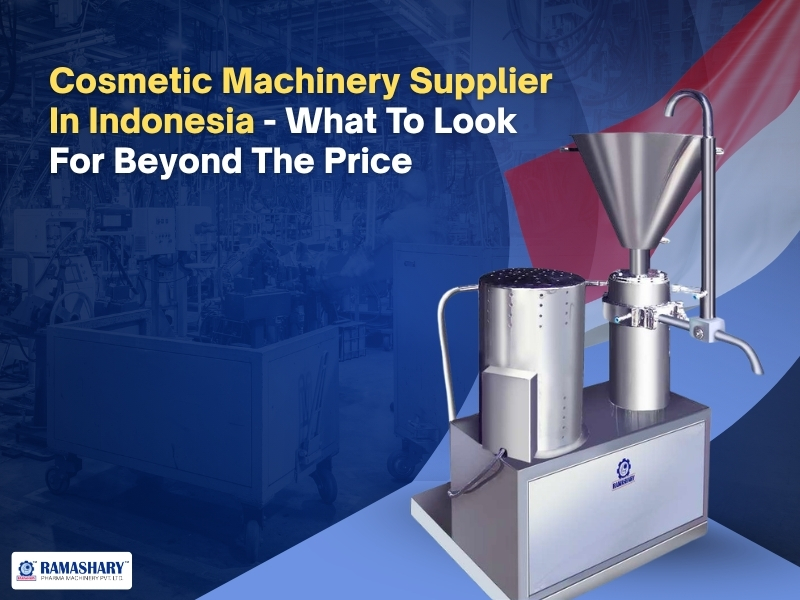
The Colloidal Mill reduces particle and droplet size in liquids and suspensions.
The product passes through a narrow adjustable gap between a fast-spinning rotor and a fixed stator. High hydraulic shear rubs, cuts and shears the material. The rotor can bring particles to micron size and make the final suspension more stable. As an experienced cosmetic machinery supplier in Indonesia, we first analyse your process and customise the machine so that it can be used as a standalone equipment or incorporated into the existing manufacturing line.
How it works step by step:
- Material Feeding: The product is introduced into the mill through the feed inlet.
- Controlled Flow: The material moves into the milling chamber at a controlled rate.
- Shearing: A high-speed rotor operates close to the stationary stator, creating intense shear between the surfaces.
- Particle Reduction: The shear force breaks down clumps and reduces particle size for a finer, more uniform product.
- Homogenisation: Continuous circulation through the milling zone improves product consistency and dispersion.
- Discharge: The processed product exits through the outlet and is collected for further processing or filling.
Real-world cosmetic uses:
- Refining pigment dispersions before they go into lipstick or cream bases
- Smoothing creams, pastes and suspensions for a finer skin feel
- Improving stability of suspension-type products
How These Seven Machines Fit Together
Think of a complete cosmetic plant as three connected lines:
- Emulsion line: Starch Paste Kettle for thickener pastes, Colloidal Mill for fine dispersions and the Ointment and Cream Manufacturing Plant for creams and lotions. Together, they support the complete ointment manufacturing plant in Indonesia.
- Colour cosmetics line: Colloidal Mill for pigment dispersion and the Lipstick Manufacturing Tank for lip products. This is the pair every lipstick manufacturing tank supplier in Indonesia should be able to offer.
- Powder line: Vacuum Transfer System to feed materials, Vibro Sifter to screen and Octagonal Blender to mix. Many factories with cosmetic manufacturing machines in Bandung or any region can follow this order.
Sourcing all three lines from one cosmetic machinery supplier in Indonesia keeps documentation, spares and training in one place. That simplicity matters for SMEs with small engineering teams.
How to Choose the Right Cosmetic Machinery Supplier in Indonesia - A 10-Point Checklist
This checklist for selecting a cosmetic machinery supplier in Indonesia works whether you are buying one kettle or planning a full ointment manufacturing plant.
- Certification. Is the manufacturer ISO and GMP certified? Ask for the certificates, not just a logo.
- Material of construction. Are all product-contact parts SS 316L or SS 304 as needed? Ask for material test certificates.
- Documentation. Will you receive design documents, QA records and operating parameters with the machine? Your QA team will need them for audits.
- Customisation. Can the supplier change speed, mesh size, capacity or heating to match your formula? Standard catalogue machines rarely fit cosmetics perfectly.
- Scale-up path. Does the supplier offer lab models that share the same working principle as production machines?
- Yield design. Ask how much product stays in the vessel after discharge. Low residue protects imported raw materials.
- Training. Is operator training included?
- After-sales. Are spares easy to order? Is there lifetime support?
The cheapest quote from a cosmetic machinery supplier in Indonesia often becomes the most expensive machine once you count rejects, downtime and audit findings. This is the main lesson plant managers share after their first big upgrade of cosmetic machinery in Indonesia.
Getting Air In Lipsticks Or Lumps In Powders?
FAQs
1) Do the machines support herbal formulations?
Yes, the machines can be customised to support herbal formulations. We first understand your products, requirements and the current process, suggest the best options and then engineer the machinery accordingly. This positions us as a leading cosmetic machinery supplier in Indonesia.
2) Can the same plant make different types of lotions?
Yes, the same plant can be used for making different types of lotions. As an experienced cosmetic machinery supplier in Indonesia, we understand your products and processes so that batch inaccuracies do not occur during production.
3) Do you provide machines for new manufacturing units?
Yes, we provide cosmetic machinery in Indonesia for new as well as well-established manufacturing units. Every manufacturer has a different working process and our machines are customised accordingly with a focus on scalability.
4) Do you manufacture individual cosmetic machines or complete processing systems?
Both options can be considered before supplying cosmetic machinery in Indonesia. Clients can source individual machines for a specific process or discuss an integrated equipment requirement based on the overall manufacturing line.
5) Can I increase my batch size later?
The equipment can be planned with your expected production growth in mind. Future batch sizes, available space and utility requirements can be considered during the initial design to make later expansion more practical.
Conclusion
The cosmetic industry is one of the leading industries in Indonesia. Reportedly, the organisations involved in the cosmetic industry were more than 1,500. Out of that, 90% consisted of SMEs. Similarly, exports are rising. This means that the country can perform well when it comes to exports. However, the manufacturers need to have a strong core and high-quality products to match the international standards.
Plants in Jakarta, Surabaya and Bandung that invest in the right cosmetic machinery in Indonesia now will be the ones that pass audits, protect margins and scale their hero products when demand spikes.
This is where Ramashary Pharma Machinery Pvt. Ltd. can help as an ISO and GMP-certified company providing end-to-end solutions. With 40+ years of experience and 700+ site installations, we have analysed the unique challenges faced by every manufacturer and focused on providing the best solutions. That’s what makes us more than just a cosmetic machinery supplier in Indonesia; it makes us a dependable industrial machinery partner around the globe.
Facing challenges in cosmetic production? Let’s connect now for a technical consultation.