India’s chemical sector has grown into one of the largest in the world. However, a very large share of its installed base is still ageing, semi-manual and built for a time when nobody asked for batch traceability.
Buyers used to ask one question: what is the price per unit capacity?
Those 5 questions are the reason a good chemical processing equipment manufacturer in India is no longer a vendor. That firm is a risk-management partner.
A speciality chemical plant in Vapi exporting dye intermediates to Europe has to prove its process is controlled. An API intermediate unit in Hyderabad supplying a regulated market has to demonstrate cleanability and cross-contamination control. A fine chemicals unit in Vadodara handling a solvent-wet cake needs a closed drying route because open handling is both a safety hazard and a solvent loss.
Off-the-shelf machines rarely fit these realities. This is why genuine chemical equipment manufacturers in India now design around the product rather than around a catalogue page.
There is a second pressure that most buyers underestimate. Product mix is changing faster than plants can adapt. A unit that made 3 products in 2018 now makes eleven. Campaign lengths are shorter. Changeovers are more frequent. Equipment that cannot be stripped, cleaned and reassembled quickly quietly eats a huge percentage of your available capacity.
Experienced chemical process equipment manufacturers in India design for changeover time as carefully as they design for throughput, because that is where hidden capacity lives.
Before you shortlist a single supplier, it helps to see the scale you are operating inside. The numbers explain why equipment quality has become a competitive asset rather than a cost line.
India ranks as the world’s sixth-largest chemical producer and holds the third position in Asia. The sector contributes approximately 7% to the country’s GDP. Valued at nearly US$250 billion in 2024, India’s chemicals market is projected to grow to reach around US$1 trillion by 2040. That trajectory is not a gentle slope. It is a doubling and then a tripling inside a working career.
The Indian chemical industry employs over two million people and accounts for roughly 2.8 to 3% of the global chemical industry. The sector is highly diversified, covering more than 80,000 commercial products across bulk chemicals, agrochemicals, speciality chemicals, polymers, petrochemicals and fertilisers.
Eighty thousand products is the single most important statistic for anyone buying chemical machinery in India. It means no two processing lines are alike. It also means a generic machine will underperform on most of them.
Export exposure changes everything about equipment specification. An overseas client will ask for documentation you cannot generate from an undocumented machine. That is the practical reason buyers now filter for chemical equipment manufacturers in India who provide end-to-end documentation rather than a single-page drawing.
Speciality chemistry is low-volume, high-value and highly sensitive. Particle size matters. Residual moisture matters. Blend uniformity matters. These are precisely the parameters a well-designed blender, granulator, dryer or sifter controls. A competent chemical machinery manufacturer in India partner is therefore directly tied to your margin, not just your capex.
India’s chemical manufacturing activity is largely concentrated in Maharashtra and Gujarat, while West Bengal and Tamil Nadu are also key production centres. The country ranks as the world’s fourth-largest agrochemical producer and manufacturer.
A market heading towards US$ 1 trillion by 2040 cannot be served by manually controlled, undocumented equipment. More than 80,000 products means customisation is the default requirement, not a premium add-on. Export orientation to 175-plus countries makes compliance documentation non-negotiable.
Speciality growth means tighter tolerances on particle size, moisture and uniformity. Concentration in a handful of clusters means downtime is visible. Your competitor is two kilometres away.
This is why the choice of a chemical machinery manufacturer in India is a strategic decision. The right chemical machinery supplier or manufacturer helps improve yield, shorten changeovers, reduce solvent loss and survive audits. The wrong one creates a decade of workarounds.
These are the trends that actually change what you buy, not the ones that only sound good in a conference deck.
What it means for equipment: new lines are being built to qualify for international customer audits from day one. Buyers increasingly ask a chemical processing equipment manufacturer in India for material test certificates, surface finish records and documentation before placing the order.
What it means for equipment: demand is rising sharply for a Rapid Mixer Granulator manufacturer in India who can deliver reproducible granule size across scales and for Fluid Bed Dryer suppliers in India who can hold moisture within tight bands.
What it means for equipment: buyers now shortlist chemical equipment manufacturers in India who provide documentation, material traceability and installation qualification support as standard.
What it means for equipment: PLC and HMI control is moving from optional to expected. Recipe storage, batch logs and interlocks are now specified on mid-sized machines, not only on large plants.
What it means for equipment: closed-loop drying, vacuum drying with solvent recovery, dust-free transfer and efficient filtration are being specified far more often. A chemical machinery supplier who understands solvent recovery is important for that reason.
What it means for equipment: machines that are simple to clean, safe to operate and forgiving of operator variation win. This is a design philosophy question, which is why the choice of chemical process equipment manufacturers in India matters.
What it means for equipment: greenfield and brownfield expansion inside clusters is creating steady, repeatable demand for standardised yet customisable equipment lines from a dependable chemical machinery manufacturer in India.
India’s chemical industry map is not evenly spread. It is a set of dense, specialised clusters. Each one has a different process profile, which means each one needs different machinery. Here is how the ground reality looks in the hubs that matter most.
What makes Mumbai distinctive is the mix. You have corporate headquarters, trading houses, formulation units, speciality producers and an unusually deep engineering supply chain across Vasai, Thane, Palghar and Navi Mumbai.
That engineering density is the reason a large number of respected chemical equipment manufacturers in India are headquartered in and around Mumbai. When a plant in Raigad needs a jacketed blender modified for a corrosive slurry, the fabrication shop is a few hours away rather than a few days away.
For a chemical machinery supplier, Pune is a useful reality check. If a design survives scrutiny from a Pune process engineering team, it might survive most audits.
Its 1,600-kilometre coastline gives direct access to raw material imports, with ports such as Kandla, Hazira, Dahej and Mundra serving as lifelines for global trade.
The equipment implication is scale plus variety. Gujarat plants run everything from bulk inorganic salts to high-purity speciality intermediates. A chemical machinery manufacturer in India serving Gujarat has to be comfortable quoting small-scale as well as large-scale equipment.
For plant managers in Vapi, the machinery priority is clear: closed handling, dust control and corrosion resistance. Dye intermediates are aggressive. Standard SS 304 is often not enough. This is where a chemical processing equipment manufacturer in India that can offer SS 316 contact parts and appropriate materials becomes important.
What that density means practically is that downtime is expensive and visible. Spare parts availability and service response time become as important as machine performance. Buyers in Ankleshwar consistently rank after-sales support among their top selection criteria when choosing a chemical machinery manufacturer in India.
Vadodara adds a strong combination of chemical, petrochemical and engineering industries, making the wider region one of India’s most concentrated chemical manufacturing corridors. Dahej is where scale lives. Bharuch sits between the two, with a heavy agrochemical and intermediates profile.
Equipment demand here skews towards larger batch sizes, robust construction and drying systems that can handle solvent-wet cakes safely. A chemical machinery supplier providing customised Roto Cone Vacuum Dryers and Filter Presses is important in this belt.
These are not theoretical problems. Every one of them shows up in a daily production meeting somewhere in Ankleshwar, Vapi, Hyderabad or Vadodara. Each one also quietly explains why the choice of a chemical machinery manufacturer in India carries so much importance.
The usual root causes are mechanical, not chemical. Wrong agitator geometry. Excessive space between the ribbon tip and the trough wall. Fill levels outside the design window. Worn ribbons after years of abrasive work. A blender running at the wrong speed for the bulk density it is handling.
The cost is brutal. Reworking a batch consumes energy, labour, cleaning time and capacity. In many plants, rework alone accounts for a meaningful share of lost production hours every month. This is why buyers evaluate Ribbon Blender suppliers in India on equipment design detail rather than on headline capacity.
Tray dryers with poor air distribution produce a moisture gradient across trays. Operators compensate by extending the cycle, which wastes hours. In a plant running eight batches a day, an extra forty minutes per drying cycle is more than five hours of lost capacity daily.
Plants in Vapi, Ankleshwar and Bharuch working with solvent-wet intermediates feel this most acutely. The answer is correct dryer selection, which is why Fluid Bed Dryer suppliers in India are in steady demand.
The common mistake is buying a machine with moderate-quality contact parts to save cost, then running a chloride-bearing product through it. Pitting starts within months. Product colour drifts. Customers complain. The machine is then replaced years earlier than budgeted.
Coastal locations such as Visakhapatnam and Chennai add atmospheric corrosion on top of process corrosion. Serious chemical equipment manufacturers in India insist on confirming the exact chemistry before quoting a material of construction.
Cleaning is also a compliance risk. Crevices, blind pockets, rough welds and hard-to-reach corners are where cross-contamination hides. Auditors look for exactly these features.
Design decisions made by the manufacturer determine changeover time far more than operator effort does. An experienced chemical processing equipment manufacturer in India can focus on cleanability from the first drawing.
Solvent vapour exposure during wet-cake transfer is the other big one. Open transfer between a filter and a dryer is where most solvent loss and most exposure incidents occur.
Closed transfer, contained charging and vacuum conveying solve this. These features are not exotic. They simply need to be specified correctly to the chemical machinery supplier.
Many buyers have lived the same story. A machine bought from a distant supplier fails. The spare is not stocked. The drawing is not shared. The engineer is unavailable for a week. Production loses ten days.
In dense clusters such as Ankleshwar and Vapi, where more than a thousand units compete for the same service engineers, response time becomes a genuine commercial differentiator. Buyers increasingly shortlist chemical process equipment manufacturers in India on service network strength rather than on price alone.
The root cause is geometric dissimilarity. If the lab machine and the production machine have different bowl shapes, impeller-to-bowl ratios or air distribution designs, the metrics simply do not transfer.
An experienced Rapid Mixer Granulator manufacturer in India can solve this by offering a geometrically consistent range from lab scale to full production scale, so process parameters scale predictably.
That is the entire argument for choosing your chemical machinery manufacturer in India carefully. You are not buying steel. You are making decisions you will live with for at least 5 years.
Most bad equipment purchases are not caused by bad suppliers. They are caused by incomplete evaluation. Use this as your internal checklist when you compare chemical equipment manufacturers in India.
Step 1: Define Your Needs Precisely
Step 2: Check The Track Record
Step 3: Evaluate Quality Systems
Step 4: Interrogate After-Sales Service
Step 5: Get A Complete Quotation
It is the operational reason Ramashary Pharma Machinery Pvt. Ltd. functions as a chemical processing equipment manufacturer in India rather than as a trading intermediary. Design, fabrication, polishing, assembly and trials happen under one roof.
Indian cities and states we supply to:
Mumbai, Gujarat, Bangalore, Pune, Ankleshwar, Hyderabad, Kolkata, Chennai, Vapi, Visakhapatnam, Vadodara, Bharuch, Dahej, Valsad, Delhi, Himachal Pradesh, Uttarakhand, Lucknow, Patna and more.
Now let us map each of the seven factory-floor challenges to what we actually do about it.
Solution 1: Solutions For Blend Uniformity
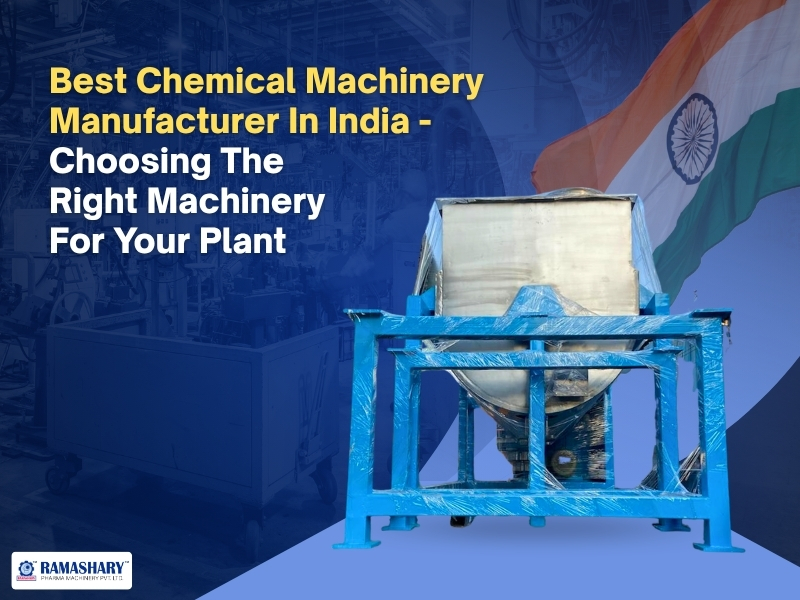
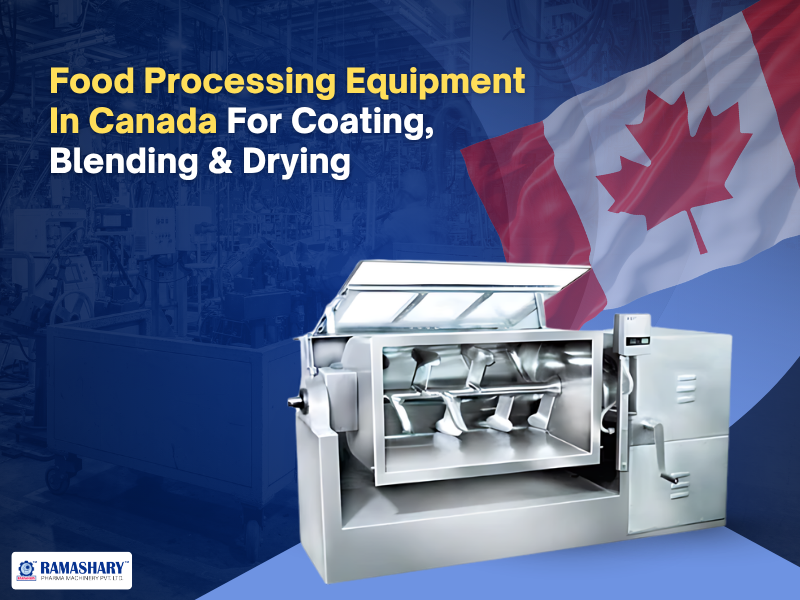
Our Ribbon Blender is built around a U-shaped horizontal trough with a double helical ribbon agitator. The working principle follows a triple-action technique. The outer moves material from both ends towards the centre while the inner moves material in the opposite direction, producing simultaneous axial and radial movement.
Why this matters for the dead-zone problem:
As one of the top Ribbon Blender suppliers in India, we treat the geometry as a process variable rather than a fixed catalogue dimension. For gentle, low-shear blending of free-flowing dry chemicals, we also offer the Octagonal Blender, where the eight-sided chamber creates a tumbling motion that minimises shear force and gives every component time to distribute evenly through slow rotation cycles supported by internal baffles.
Solution 2: Drying Matched To The Product, Not Forced Onto It
A standard custom size is not offered for every application. That is the single most important thing about how we handle the drying problem. Three distinct drying routes are offered, each solving a different failure mode.
For heat-sensitive or solvent-bearing chemicals: the Roto Cone Vacuum Dryer. It lowers the boiling point of solvents and moisture in the mixture so drying happens at a lower temperature. The conical bottom promotes a tumbling motion so material dries evenly rather than baking at the wall.
The dryer operates as a closed-loop system where evaporated solvent is captured and condensed. The unit is heated through a jacket of hot water or steam. It handles crystalline or irregularly shaped input material and still provides uniform dried product without lump formation.
For fast, uniform drying of granules and powders: the Fluid Bed Dryer. Particles are suspended in a stream of hot air, creating a fluidised bed that behaves like a boiling liquid. Heat and mass transfer rates rise sharply, so drying time drops compared with conventional tray drying. Air velocity and temperature are controlled through the panel. Among Fluid Bed Dryer suppliers in India, our units are offered across a capacity range of 5 kg to 500 kg, built to CGMP standards.
A standard custom size is not offered for every application. That is the single most important thing about how we handle the drying problem. Three distinct drying routes are offered, each solving a different failure mode.
For simple, flexible batch drying: the Tray Dryer. Hot air is circulated through the chamber so material spread across trays dries uniformly. It requires minimal operator training and has simple maintenance procedures, which is exactly what a small or mid-sized unit in Kolkata or Chennai needs.
Matching the right dryer to the right product is the core value a chemical machinery manufacturer in India adds at the enquiry stage.
Solution 3: Material Of Construction Chosen For Your Chemistry
Equipment must be built from materials resistant to the chemicals being handled and capable of withstanding process temperature and pressure. Thus, we confirm the chemistry, the temperature range and the process conditions before finalising the material of construction.
For plants in Vapi, Ankleshwar, Bharuch and Visakhapatnam, this single discipline decides whether a machine lasts five years or fifteen. It is also the first thing serious chemical equipment manufacturers in India are judged on.
Solution 4: Changeover & Cleaning Designed In From The Drawing Stage
Our equipment for multi-product plants is designed with easy accessibility to internal parts, simple dismantling and CGMP compliance. The Tray Dryer is specifically positioned as a machine that can handle different products without major adjustment. The Octagonal Blender is designed for easy loading and unloading. The Roto Cone Vacuum Dryer’s interior can be inspected and the design addresses cross-contamination control.
For a multi-product unit, the practical benefits are:
This is where working with GMP-oriented chemical process equipment manufacturers in India pays back every month, not just at purchase.
Solution 5: Contained Handling, Dust Control & Safer Operation
Our chemical machinery range directly addresses dust and vapour exposure through the Vacuum Transfer System, which uses suction to move dry chemicals through enclosed pipes for dust-free movement. Combined with closed blending and closed drying, this removes the most common exposure points on a powder-handling floor. Our own positioning for the chemical sector is built on this point: minimise safety risks, reduce hazardous waste and use resources efficiently.
Solution 6: Uptime Backed By Installation, Training & After-Sales Support
This is the area where a chemical machinery supplier either earns long-term trust or loses it. Our approach covers 3 things beyond the machine itself.
We follow CE, WHO-cGMP, GMP, ISO 9001:2015, ASME BPE, SCADA, 21 CFR, Industry 4.0 standards and international validation protocols.
For a single-line plant in Kolkata or a high-density estate in Ankleshwar, this support structure is often worth more than a lower quotation from a supplier with no service presence.
Solution 7: Scale-Up That Actually Transfers From Lab To Plant
Ramashary Pharma Machinery Pvt. Ltd. addresses the scale-up problem by offering equipment across genuinely wide capacity ranges with consistent design logic.
What this gives an R&D manager in Bangalore or Hyderabad:
As a chemical machinery manufacturer in India, this range continuity is one of Ramashary Pharma Machinery Pvt. Ltd.’s most practical advantages for companies.
Chemical processing is a sequence, not a single step. You mix, you granulate, you dry, you sieve, you separate and you transfer. Each step has a machine that does it well and several that do it badly.
The seven machines below are the ones Ramashary Pharma Machinery Pvt. Ltd. supplies most often to global chemical plants and each one is explained the way an engineer would want it explained: what the principle is, what materials it handles, how it actually works and what real products come out of it. If you are comparing chemical equipment manufacturers in India, this is the level of detail you should be demanding from every quotation.
Materials it can handle – Dry powders, free-flowing granules, crystalline solids, semi-solid materials, pastes and viscous liquids that need to be incorporated into dry ingredients.
Applications – Dry blended detergent powders and cleaning formulations, water-treatment chemical blends, pigment and dye powder blends, construction chemical dry mixes, agrochemical wettable powders, catalyst and adsorbent blends, rubber and polymer compounding masterbatches, pesticide dust formulations and speciality additive premixes.
Why it matters when choosing between Ribbon Blender suppliers in India – Two blenders of the same capacity can perform completely differently depending on ribbon pitch, ribbon width, tip clearance, shaft deflection and drive sizing. As a Ribbon Blender manufacturer in India we set the ribbon and trough configuration against your actual product, which is the difference between a blender that works and a blender that is merely delivered.
Materials it can handle – Fine chemical powders, active ingredients and excipients, agrochemical actives, catalyst precursors, mineral powders, nutraceutical and ayurvedic powders, food-grade powders and any dry blend that needs a binder solution worked into it to form granules.
Applications – Granular agrochemicals, detergent granules, granulated catalysts, granular fertiliser blends, granulated food and nutraceutical actives, ceramic and mineral granules for pressing and API intermediates moving towards formulation.
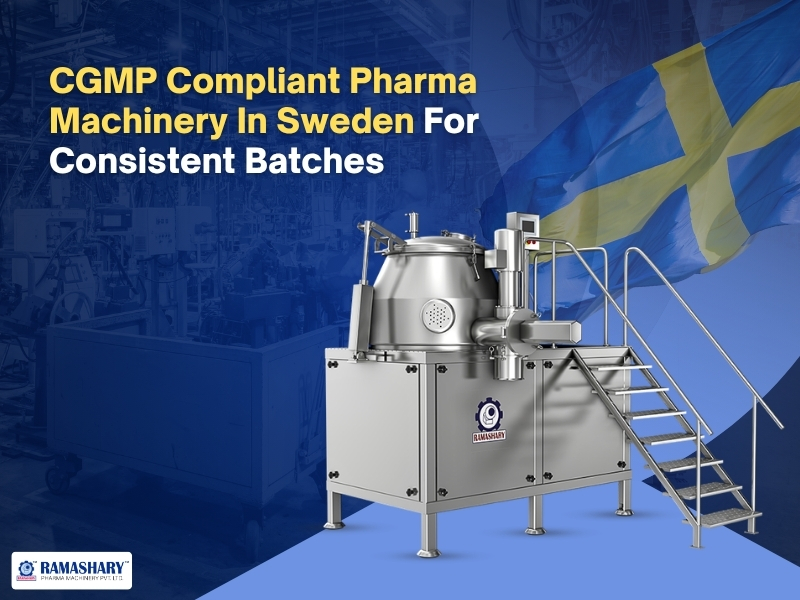
Ramashary Pharma Machinery Pvt. Ltd. offers the RMG in models from 5 litres to 1,500 litres, which is why it is regularly specified by buyers looking for a Rapid Mixer Granulator manufacturer in India who can support both pilot development and full production from the same design family.
Materials it can handle – Wet granules from a granulator, crystalline chemical solids, powders, pellets and heat-sensitive materials that cannot tolerate long exposure to high temperature. It is particularly suited to free-flowing granular material rather than sticky pastes.
Applications – Dried agrochemical granules, detergent and surfactant granules, dried dye and pigment intermediates, water-soluble fertiliser granules, catalyst granules, food and nutraceutical granules, crystalline speciality chemicals and API intermediates.
Why buyers compare Fluid Bed Dryer suppliers in India carefully. Two FBDs of the same nominal capacity can differ enormously in air distribution plate design, filter area, blower sizing and pressure rating. A poorly designed distribution plate produces channelling, where air finds a preferred path and leaves the rest of the bed wet.
Materials it can handle – Free-flowing dry powders and granules, particularly friable materials that must not be broken, coated granules whose coating must not be damaged and blends where a small quantity of one component must be distributed through a large mass of another.
Applications – Blended speciality chemical powders, pigment and colourant blends where particle damage would shift the shade, coated granule blends, catalyst mixtures, nutraceutical and ayurvedic powder blends, dry premixes for the cosmetic and personal care chemical segment and more.
Practical note – The octagonal design handles a larger working volume in a smaller footprint than several comparable geometries, which matters in the space-constrained plants common in Mumbai and Vapi.
Materials it can handle – Heat-sensitive chemicals, solvent-wet cakes from filtration, toxic or hazardous materials that must be handled in a closed system, crystalline products, materials that tend to form lumps and products where solvent recovery has commercial value.
Applications – Dye and pigment intermediates, agrochemical technical-grade actives, solvent-wet speciality chemical cakes, API and bulk drug intermediates, thermolabile organic compounds, hygroscopic salts and high-purity crystalline chemicals.
Where it is most used in India – This is an important equipment in Vapi, Ankleshwar, Bharuch, Vadodara, Hyderabad and Visakhapatnam, wherever solvent-wet cakes come off a filter and need a closed, low-temperature drying route.
Materials it can handle – Powders, granules, crystals, wet cakes, pastes spread on trays and irregular or fragile solids that cannot be fluidised. It accepts a very wide range of products with little or no mechanical change to the machine, which is exactly why multi-product plants keep one.
Applications – Dye intermediates, pigment cakes, inorganic salts, speciality chemical powders, herbal and ayurvedic extracts, fertiliser and micronutrient products, small-batch speciality intermediates, laboratory and pilot quantities of new products and any product where batch sizes are too varied to justify a dedicated dryer.
Commercial note – For small and mid-sized units in Kolkata, Chennai and the Pune belt, the Tray Dryer is often the most cost-effective machinery offered by a chemical machinery manufacturer in India point into controlled drying.
Materials it can handle – Dry powders, granules, crystals and, with the right mesh and deck arrangement, slurries and liquids for straining. It handles free-flowing materials easily.
Applications – Grading of crystalline chemical products, removal of oversized lumps and foreign matter from powders, sieving of pigments and dyes, classification of catalyst and adsorbent granules, screening of fertiliser and agrochemical granules, de-lumping of hygroscopic powders before packing and safety screening of finished chemical products before dispatch.
Why is it right for a chemical plant – It removes the lumps, tramp material and oversize that would otherwise reach the customer. It is a final safety screen to be asked to a chemical processing equipment manufacturer in India.
India’s chemical industry is in the strongest position it has ever occupied. It is the sixth-largest chemical producer in the world and the third-largest in Asia, Gujarat alone accounts for over half of India’s chemical production; Hyderabad supplies more than 40% of the country’s bulk drugs and clusters from Vapi and Ankleshwar to Visakhapatnam, Vadodara, Bharuch and Dahej are expanding at the same time.
But scale brings scrutiny. Global customers now audit processes, not just products. Environmental compliance has become a condition of market access. Product mixes are widening and batch sizes are shrinking.
This is where Ramashary Pharma Machinery Pvt. Ltd. fits. As an experienced chemical machinery manufacturer in India with 40+ years of experience, 700+ successful site installations and exports to the USA, UAE, Russia, Mexico, Germany and the Philippines, we build equipment for the problems that actually cost Indian chemical plants money.