The United States is the world’s second-largest chemical producer after China. The American Chemistry Council reports that the US chemical industry generated $639 billion in shipments in 2022, while the broader business of chemistry currently generates approximately $673 billion annually and supports industries contributing around 25% of US GDP.
If you are looking for a reliable chemical machinery supplier in USA, it is important to choose a supplier that understands your specific processing requirements and provides the right equipment for your application. A large chemical plant on the Gulf Coast has very different equipment requirements than a fine chemical plant in New Jersey. This is why choosing the right chemical process equipment supplier in USA is important.
For buyers, these requirements can directly affect equipment specifications, documentation, safety features and certifications. This is why, when evaluating a chemical machinery supplier in USA, compliance and technical documentation can be just as important as the equipment itself.
Equipment requirements can vary significantly depending on the location, production environment and industry served. Buyers searching for a chemical processing machine in Texas may prioritise high production capacity, continuous operation and Gulf Coast logistics.
Those looking for a chemical equipment supplier in New Orleans may place greater emphasis on petrochemical-scale performance, environmental requirements and permitting.
In New Jersey, buyers researching chemical machinery may focus more on GMP compliance, pharmaceutical-grade documentation and precise process control. Choosing the right chemical processing equipment means considering the specific requirements of your location, process and industry.
The US chemical industry has undergone significant shifts throughout 2026, influenced by changes in manufacturing, investment, technology and regulatory priorities. These trends are shaping how chemical manufacturers plan production and invest in processing equipment.
Major pharma companies have collectively pledged well over 480 billion dollars toward new or expanded American facilities, though most of that capacity will not be fully operational before 2028 to 2030, which means the near-term window belongs to companies that can move fast on equipment procurement.
Process engineers, maintenance technicians and process operators are the hardest roles to backfill, which pushes buyers toward equipment that needs less specialised manual intervention.
As a result, equipment that enables solvent recovery, reduces dust emissions and improves water and energy efficiency is becoming increasingly important. In many facilities, these capabilities are no longer simply operational advantages but can play a key role in meeting permitting and regulatory requirements.
The U.S. chemical industry is concentrated across several major manufacturing regions, each with different production requirements. Texas and Louisiana are known for large-scale chemical and petrochemical operations, while New Jersey has a strong base of pharmaceutical and fine chemical manufacturers.
These differences influence the type of equipment manufacturers need, from high-capacity processing systems to flexible, GMP-compliant machinery. Understanding these regional requirements can help buyers choose the right chemical machinery supplier in USA for their specific application.
The Houston Ship Channel alone, a 52-mile industrial waterway, is lined with more than 500 facilities producing polyethene, ethylene oxide, styrene and dozens of other basic and speciality chemicals, moving around 200 million tonnes of cargo a year.
This concentration exists because of shale gas economics. Ethane from Texas shale formations costs a fraction of the naphtha feedstock that European and Asian producers rely on and that cost advantage has drawn roughly 300 billion dollars in new US chemical investment since 2010, most of it along the Gulf Coast.
For a plant sourcing a chemical processing machine in Texas, the practical reality is scale and speed. Texas crackers and derivative plants run continuously, so unplanned downtime on a blender, dryer or transfer system is measured in lost production hours that add up fast.
Buyers here tend to prioritise strong build quality, quick spare parts availability and equipment that can be validated and commissioned without disrupting an already running line.
Speciality and fine chemical operations further inland from the coast, including agrochemical and coatings producers, look for a chemical processing machine in Texas that can be customised for smaller, more varied batch sizes rather than the continuous-flow scale of a Gulf Coast cracker.
Either way, a chemical machinery supplier in USA with relationships that understands both continuous and batch operations has a real advantage in this state, because Texas buyers rarely fit into one mould.
Consider three Texas manufacturers with very different production needs, even though all may be searching for a chemical processing machine in Texas. A speciality coatings manufacturer near Houston may need a Ribbon Blender for frequent small batches of different pigment formulations, making quick cleaning, easy changeovers and a compact footprint more important than maximum capacity.
An agrochemical manufacturer may need a chemical processing machine in Texas that can dry and screen large quantities of fertiliser granules without damaging their structure, making a Fluid Bed Dryer more suitable than a traditional tray dryer.
A contract manufacturer serving several oil-field chemical customers may need a chemical processing machine in Texas that can handle different formulations on the same blender and dryer line.
These examples show why every manufacturer has different equipment requirements. The right chemical processing machine in Texas depends on factors such as the material being processed, batch size, production volume, cleaning requirements and the flexibility needed between different formulations. A single equipment configuration may not be suitable for every application.
Labour availability is another factor to consider when selecting a chemical processing machine in Texas. Equipment that is easy to operate and requires less manual intervention can help manufacturers maintain production even when experienced operators are limited. Features such as vacuum charging, automated cycle control and user-friendly control panels can make daily operations simpler and more consistent.
As a chemical machinery supplier in USA, Ramashary Pharma Machinery Pvt. Ltd. focuses on practical automation and reliable equipment designed to simplify chemical processing. The company is ISO 9001:2015 and cGMP certified, reflecting its commitment to consistent quality and manufacturing standards. Its equipment incorporates control panels and automated loading systems to reduce manual intervention and support more efficient, reliable and easy-to-manage operations.
The industry contributes around $62 billion in annual economic output, representing approximately 10% of the U.S. chemical industry’s total. The region also benefits from abundant natural gas, salt dome storage caverns and direct access to the Mississippi River and deepwater ports, making it an important production and trade hub.
This concentration of chemical facilities has also brought greater environmental and community attention. Regulators and local communities are increasingly focused on emissions monitoring and hazardous waste management along the river corridor.
For manufacturers looking for a chemical equipment supplier in New Orleans, this makes enclosed and low-emission processing systems increasingly important. Equipment with features such as sealed vacuum transfer, solvent recovery during drying and enclosed material handling can help reduce dust and emissions while supporting after-processing.
Large-scale petrochemical facilities may need heavy-duty blending and material transfer equipment designed for continuous operation and minimal downtime. Smaller speciality and fine chemical manufacturers, including those producing dye intermediates, water-treatment chemicals and agrochemical products, may place greater importance on batch flexibility, containment and dust control. A chemical equipment supplier in New Orleans needs to account for these different requirements rather than offering the same configuration for every application.
For large-scale operations, durable construction, reliable performance and quick access to spare parts can be important considerations. For speciality chemical applications, enclosed systems such as the Roto Cone Vacuum Dryer and Vacuum Transfer System can help keep fine or potentially hazardous powders contained during processing and transfer.
Compliance and documentation are also important when selecting a chemical equipment supplier in New Orleans. Providing information on solvent recovery, dust containment, equipment design and waste reduction can help manufacturers address regulatory requirements more effectively.
New Jersey’s chemical industry generates around $15.48 billion in annual output, making it the 8th-largest chemical-producing state in the U.S. and employs nearly 48,000 people.
The sector also includes a significant pharmaceutical and medicine manufacturing workforce. Average annual wages are around $106,822, while chemical and pharmaceutical manufacturing accounts for approximately 21% of the state’s industrial workforce, more than any other manufacturing category.
The reshoring trend discussed earlier is particularly relevant to New Jersey because of its established pharmaceutical and fine chemical manufacturing base. The state is well positioned to support the return of API and sterile manufacturing operations to the U.S., while the FDA’s PreCheck Pilot Program also includes New Jersey among its initial group of participating states.
As a result, demand for chemical machinery in New Jersey is strongly influenced by pharmaceutical manufacturing requirements. Buyers are more likely to need GMP-compliant, fully documented equipment for pharmaceutical-grade blending, drying and coating rather than machinery designed primarily for bulk commodity production.
For a buyer searching for chemical machinery in New Jersey, the equipment may be intended for a new API production suite or an upgrade to an existing GMP manufacturing line.
This makes documentation, material quality, validation support and process control important considerations when choosing a chemical machinery supplier in USA. Manufacturers with genuine ISO 9001:2015 and cGMP certification can provide the quality standards and documentation needed for these demanding applications.
Quality assurance teams evaluating chemical machinery in New Jersey often look closely at documentation and qualification requirements alongside equipment performance and price. Design records, material certificates and validation protocol support can help simplify the qualification process and prevent equipment from becoming a bottleneck during installation and production.
Coating equipment is also important for pharmaceutical manufacturers, particularly those producing tablets and pellets. A coating machine used in New Jersey pharmaceutical facilities may need to support frequent product changeovers, easy cleaning between batches and precise control of film or sugar coating thickness while meeting the same GMP documentation requirements expected from blending and drying equipment.
Beyond large pharmaceutical companies, New Jersey also has a strong base of contract manufacturers, generic drug producers and fine chemical manufacturers.
These businesses may need chemical machinery in New Jersey on a smaller and faster timeline than a major greenfield manufacturing project. Instead of waiting 12 to 36 months for a new facility, they may need to install or replace a single blender, dryer, or coating machine within an existing GMP facility in just a few months.
For these manufacturers, a chemical machinery supplier in USA that can provide timely quotations, application-specific customisation, delivery, operator training and long-term technical support can offer greater value than a supplier competing only on equipment price.
The US chemical industry is facing several operational challenges that are influencing how plants manage production, safety, compliance and equipment investment. These factory-floor challenges are making reliable and efficient processing equipment increasingly important.
Process engineers, maintenance technicians, machinists and process operators are the hardest roles to fill and hiring lead times keep stretching. Plants cannot simply hire their way out of this, so equipment that reduces the skill and manual intervention needed to run a batch safely has become an operational necessity rather than a convenience.
Chemicals, pharmaceuticals, pigments and plastics all appear on OSHA’s list of materials with heightened combustible dust risk, which makes open manual transfer of fine powders one of the most dangerous routine tasks on a chemical factory floor.
Unexpected equipment downtime at a Gulf Coast chemical plant or a Mid-Atlantic pharmaceutical facility can cause more than repair delays. It can lead to missed delivery schedules and, in regulated production environments, may even result in an entire batch being rejected.
Equipment that mixes or dries materials efficiently and uses less energy per batch can help reduce operating costs and improve overall profit margins.
These changes can affect equipment costs, shipping schedules and project timelines, making the selection of a chemical process equipment supplier in USA an important part of planning an equipment purchase.
Open, dust-generating or solvent-releasing processes are becoming harder to permit, pushing buyers toward closed, resource-efficient systems as a matter of regulatory survival rather than corporate preference.
Ramashary Pharma Machinery Pvt. Ltd. is an ISO and GMP-certified company. These certifications reflect documented and controlled processes covering equipment design, fabrication, quality checks and final testing.
Every machine is supplied with the required design, quality and validation documentation, helping customers meet their production and compliance requirements. With 700+ successful site installations across 20+ industries, we export our equipment to markets including the USA, UAE, Russia, Mexico, Germany and the Philippines.
Each machine comes with end-to-end solutions that include operator training and ongoing after-sales service. This support can be especially useful for manufacturers looking for equipment that is easy to operate and maintain with limited manual intervention.
The control panels allow operators to manage settings such as temperature, flow rate and processing cycles. These features reduce manual work and make the equipment easier to operate without requiring years of experience.
Operator training is also provided, helping production teams learn how to use the equipment properly and maintain day-to-day operations.
This focus on quality and proper documentation makes Ramashary Pharma Machinery Pvt. Ltd. a reliable chemical machinery supplier in USA for pharmaceutical and fine chemical manufacturers, where meeting GMP and regulatory requirements is an important part of the production process.
As a chemical machinery supplier in USA, we focus on reliable equipment, quality manufacturing and after-sales support to help reduce unexpected downtime and keep your production running smoothly.
The machines are specifically energy-efficient and space-efficient. This gives manufacturers more flexibility and can help control energy and operating costs instead of relying on a standard setup for every application.
For buyers, choosing an established chemical process equipment supplier in USA with international export experience can help reduce paperwork-related delays and keep equipment procurement projects on schedule.
Taken together, this is why procurement heads, plant managers and quality teams consider Ramashary Pharma Machinery Pvt. Ltd. when evaluating equipment suppliers for their plants. As a chemical machinery supplier in USA, we offer customised equipment solutions backed by certified manufacturing standards and reliable turnaround times. Its experience as a chemical process equipment supplier in USA helps manufacturers find practical machinery suited to their specific mixing, drying and coating requirements.
Ramashary Pharma Machinery Pvt. Ltd. offers equipment designed for these key processes along with material handling solutions that support safe and efficient production. The following seven machines are among the important equipment options for manufacturers, with an overview of their working principles, suitable materials and practical applications.
These machines can address a range of processing requirements across different regions of the USA. A chemical processing machine in Texas may be selected for high-volume blending and drying applications, while a chemical equipment supplier in New Orleans may need equipment suitable for enclosed processing of sensitive or solvent-based materials.
Chemical machinery in New Jersey can support applications involving fine blending and coating, while a conventional coating machine in USA facilities can be used for uniform functional or protective coating applications across various industries.
The machine uses an electric motor and reduction gearbox to provide the required speed and torque for smooth operation. The Octagonal Blender is available in capacities ranging from 5 litres for laboratory applications to 12,500 litres for large production batches.
It can be used for products such as agrochemical granules, catalyst powders, powder coating resins, pigments and speciality polymer additives. Its gentle mixing action is particularly useful when maintaining the original structure of granules is important.
This makes the Octagonal Blender useful across several industries, including chemical, pharmaceutical, cosmetic, nutraceutical and detergent manufacturing.
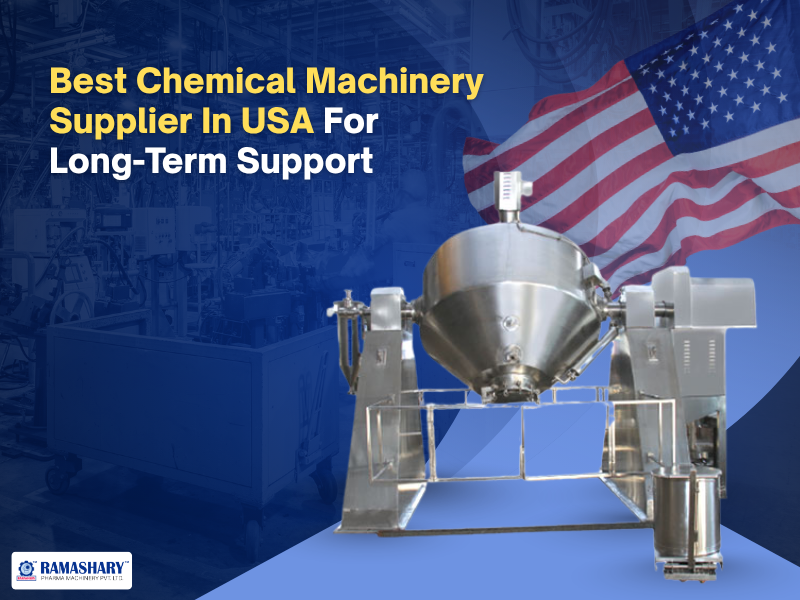
Its design has a triple-action mixing principle. Together, these actions help create a consistent mixture in a shorter time. The finished material can also be discharged through a bottom valve, which makes batch unloading easier and faster.
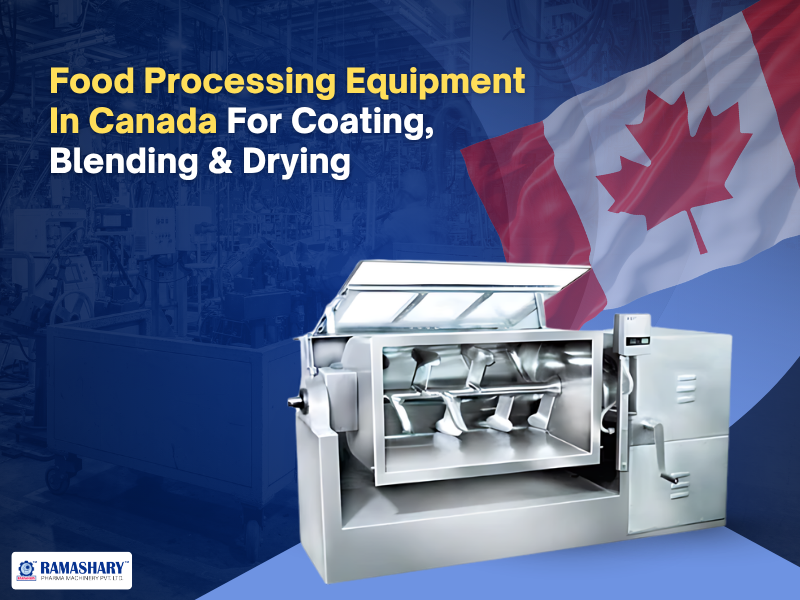
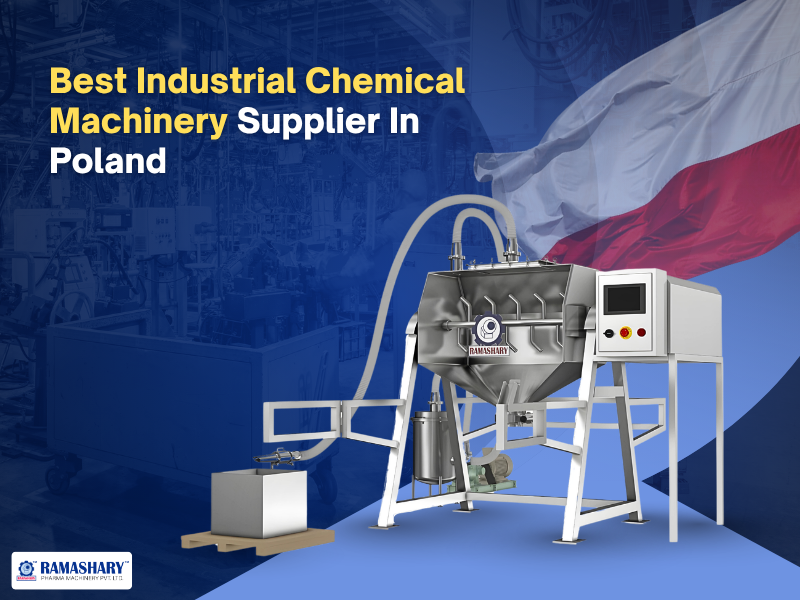
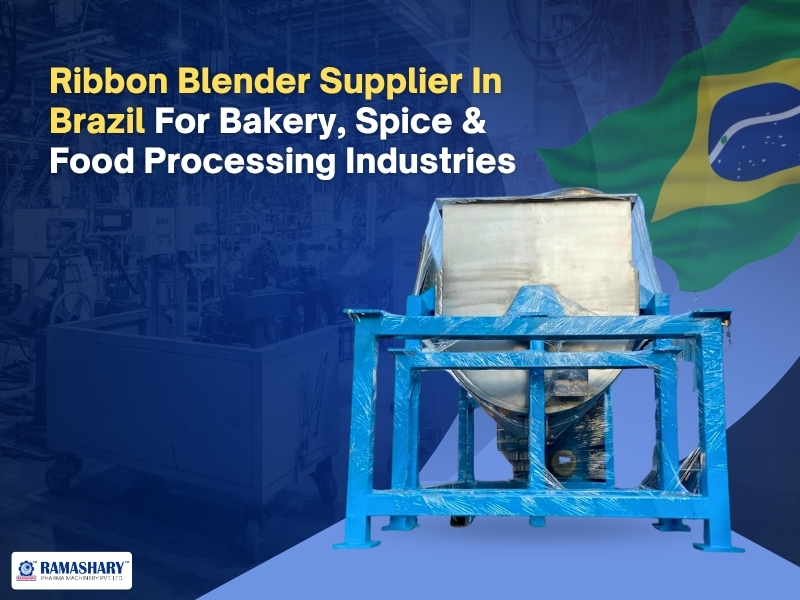
The Ribbon Blender is available in capacities ranging from 50 litres to 12,000 litres, depending on production requirements. In chemical manufacturing, Ribbon Blenders can be used for fertiliser and agrochemical blends, detergent powders, pigment and dye mixtures and water-treatment chemical powders where uniform mixing is important for consistent product quality.
Because of its wide range of applications, the Ribbon Blender is used across industries such as chemicals, pharmaceuticals, food, fertilisers and animal feed. For manufacturers looking for a chemical machinery supplier in USA, it can be a practical option for large-scale powder and semi-solid mixing applications.
The airflow is carefully controlled to keep the material properly suspended during the drying process. Temperature, airflow and drying time can be managed through a control panel, which reduces the need for manual adjustments and helps maintain consistent drying conditions from batch to batch.
The Fluid Bed Dryer can handle capacities ranging from 5 kg for laboratory and pilot batches to 500 kg for larger production batches. Its efficient heat and moisture transfer can reduce drying time compared with conventional static tray drying.
Because it can handle different types of granular and powder materials while providing controlled and uniform drying, the Fluid Bed Dryer is a useful option for manufacturers looking for reliable chemical processing equipment for granulation and drying applications.
The vessel, shaped like a rotating cone, is heated externally using a steam or hot water jacket rather than direct hot air, while a vacuum pump removes moisture-laden air from inside the sealed chamber.
This lets the material dry thoroughly at a lower temperature than atmospheric drying would require, which protects volatile or thermally sensitive compounds. As the cone rotates, internal lump breakers keep the material moving and prevent clumping, so the final product comes out dry and free-flowing rather than caked.
This machine is built specifically for materials that are too sensitive or too hazardous for open drying, heat-sensitive catalysts and speciality and pharmaceutical intermediates where solvent recovery is required rather than solvent loss to the atmosphere.
Because loading, drying and discharge take place within a sealed system, the Roto Cone Vacuum Dryer helps manufacturers reduce dust generation and minimise the risk of cross-contamination.
For manufacturers looking for a chemical equipment supplier in New Orleans or any city, the machine can be a practical solution for handling sensitive or solvent-containing materials. Its solvent recovery capability can also help recover valuable solvents that might otherwise be lost during drying, improving material utilisation and process efficiency.
Operators periodically check moisture content, either by comparing the weight of the material before and after drying or using a moisture meter and unload once the target moisture level is reached. Inert gas can be introduced for materials that dry faster or more safely at lower temperatures.
Tray Dryers handle a broad range of chemical materials and Ramashary Pharma Machinery Pvt. Ltd. specifically lists resins, pigments and chemical powders alongside pharmaceutical herbal extracts and wet granules as typical applications.
In practice, this means a Texas speciality chemical plant might use a Tray Dryer to dry pigment powders or resin flakes, while a New Jersey pharmaceutical facility uses the same design principle to dry herbal extracts or wet granulated actives.
The design is also easy to sanitise and clean between batches, which matters when the same dryer runs multiple different chemical products across a production week and it recovers and condenses toxic solvent vapour during the drying cycle rather than releasing it, reducing environmental pollution from the process.
As the electric motor rotates the pan, the units move continuously while the coating solution is applied to their surface. A controlled hot and cold air system then dries the coating. This helps achieve an even coating across the batch. Temperature and airflow can be adjusted through the control panel according to the process requirements.
The conventional coating machine in USA can be used for tableted or pelletised chemical products that require a protective or functional outer layer. Applications include chlorine and other water-treatment tablets, effervescent industrial cleaning tablets and coated agrochemical formulations.
The stainless-steel enclosure is also designed for easy cleaning, while the polishing and coating pans can be changed according to the application. For manufacturers looking for a conventional coating machine in USA, consistent coating quality and efficient production are important considerations.
The machine can help protect the core material from moisture, provide controlled dissolution where required and create a consistent outer layer. For chemical manufacturers producing different coated products, easy cleaning and flexible operation can also help simplify product changeovers and reduce unnecessary downtime.
A conventional coating machine in USA can be selected based on factors such as batch size, product characteristics, coating requirements and available production space. Choosing the appropriate machine size can help manufacturers maintain efficient coating cycles without overloading or underutilising the equipment.
A conventional coating machine in USA can also support manufacturers producing different coated chemical products within the same facility. Whether the requirement is for water-treatment tablets, industrial cleaning products or coated agrochemical formulations, a conventional coating machine in USA should deliver uniform coverage, controlled processing and reliable batch-to-batch performance.
For plants comparing a conventional coating machine in USA, equipment construction and operational controls are also important. The stainless-steel design supports hygienic processing, while controlled air circulation helps maintain consistent drying conditions during coating. These features make the equipment suitable for manufacturers that need repeatable results across multiple production batches.
With reshoring pressure, labour shortages and tightening compliance all converging at once, picking a chemical machinery supplier in USA that teams can rely on has become a genuinely strategic decision rather than a routine purchasing task. Procurement heads, plant managers and quality assurance leads consistently come back to the same handful of criteria once they move past the initial price comparison. Below is a practical checklist drawn from exactly the conditions described throughout this guide.
Many US buyers still believe that working with an overseas chemical processing equipment manufacturer automatically means longer delivery times and lower quality compared with buying from a local supplier. However, this is not always the case.
US manufacturers can also face long equipment lead times because of skilled labour shortages and high manufacturing costs. An experienced chemical process equipment supplier in USA with established export capabilities and proper manufacturing standards can offer competitive pricing, reliable documentation and efficient delivery without compromising on equipment quality.
The key difference is not simply whether the supplier is based in the USA or overseas. What matters is whether the supplier has proper manufacturing standards, clear documentation, technical expertise and accountability. Whether a chemical machinery supplier in USA is based locally or works with American customers from India, these are the factors that should guide the final purchasing decision.
For example, Ribbon Blenders and coating pans may need different capacities or configurations depending on the production requirement. A capable chemical processing equipment manufacturer should evaluate the process and operating conditions rather than simply offering a standard catalogue model.
Buyers should check the supplier’s export credentials, international shipment experience and ability to provide the documentation required for the shipment. Asking about previous exports to the United States and requesting references where available can also help during supplier evaluation.
These six factors should be considered before comparing final equipment prices. The goal is not simply to find the lowest quotation but to identify a supplier that can provide suitable equipment, proper documentation and dependable support throughout the project.
The same approach applies across different US manufacturing regions. A procurement head evaluating a chemical processing machine in Texas, a manufacturer looking for a chemical equipment supplier in New Orleans or a plant manager sourcing chemical machinery in New Jersey should assess suppliers against the same core criteria.
The chemistry, production volume and equipment requirements may vary, but quality, documentation, technical capability and accountability should remain consistent.
One practical step can make supplier comparisons much easier: request the same documentation and technical information from every shortlisted supplier. Compare certifications, equipment specifications, testing documents, installation experience and after-sales support side by side.
A supplier that provides clear and complete information from the beginning gives buyers greater confidence in the relationship that will continue after the purchase order is signed.
The US chemical industry is going through a major period of change. As more companies bring manufacturing back to the US, manufacturers across Texas, Louisiana and New Jersey are facing skilled labour shortages, stricter compliance requirements, safety risks, rising energy costs and long equipment lead times.
For procurement heads and plant managers, it ultimately comes down to one key decision: which equipment to buy and which supplier to trust. Ramashary Pharma Machinery Pvt. Ltd. is positioned to support manufacturers with these requirements. With 40+ years of experience, ISO and cGMP certification and 700+ completed installations across 20+ industries, the company provides equipment for mixing, drying, coating and material transfer.
Whether a manufacturer needs a chemical processing machine in Texas for an agrochemical facility, a chemical equipment supplier in New Orleans for solvent-handling applications or chemical machinery in New Jersey for a regulated production facility, Ramashary Pharma Machinery Pvt. Ltd. provides the same focus on quality and reliable support.
As an experienced chemical processing equipment manufacturer, we combine manufacturing expertise with international export experience. Its approach is focused on providing suitable equipment, clear documentation and support throughout the equipment lifecycle.
Whether the requirement is for a chemical processing machine in Texas, chemical machinery in New Jersey or a conventional coating machine in USA facilities, Ramashary Pharma Machinery Pvt. Ltd. can help manufacturers evaluate their requirements and select the appropriate equipment.