

Malaysia’s food manufacturing sector is not short of demand. What it is often short of is dependable machinery, skilled hands on the factory floor and a supplier who understands the pressure of running a production line seven days a week. The order book is full, but the equipment on your floor was not built for this pace.
It is exactly why more decision-makers across Kuala Lumpur, Penang, Johor Bahru and beyond are looking for a food machinery supplier in Malaysia they can actually rely on for the next 10 years.
Talk to enough production managers across the Klang Valley and a pattern emerges. Very few complain about lacking customers. More complain about a mixer that cannot keep up with a new product line, a dryer that leaves half a tray under-dried or a blender that needs three operators instead of one because the controls are outdated.
These are not strategic problems. They are equipment problems and they grow quietly until a missed shipment or a failed audit forces the issue into the open. Thus, high-quality machinery has to be sourced from an experienced food machinery supplier in Malaysia to solve them.
Whether you run a family-owned sauce manufacturing unit in Johor Bahru or a fast-scaling snack export business in Penang, the questions are the same: can this machine handle my current volume, will it hold up to daily use in Malaysia’s climate and can the supplier actually support me after the sale?
Overview Of Malaysia's Food Manufacturing Industry
Food manufacturing is one of the stronger parts of Malaysia’s industrial economy. Reportedly, the manufacturing of food processing products grew 11.6% in January 2026. The food, beverage and tobacco segment also created more jobs than most other manufacturing categories during the same period, showing that companies are actively scaling up rather than standing still.
Reportedly, the food and beverage sector’s share of Malaysia’s manufacturing GDP rose to 8.8% in 2024, up from 8.7% in 2023 and 8.1% in 2022, a steady climb even while overall GDP contribution has stayed roughly flat. Exports from the food processing industry rose from RM 8.3 billion in 2006 to RM 23.9 billion in 2020.
Malaysia’s food market was expected to be roughly USD 61.38 billion in 2025 and expected to grow at a compound annual rate of 6.59% through 2030, with meat products forming the largest single segment. It addresses the need for quality food machinery Malaysia. Foodservice, a related but distinct category, is expected to nearly double from USD 14.75 billion in 2025 to USD 27.5 billion by 2030.
None of this growth happens on its own. It depends on manufacturers having the right food processing machine Malaysia to mix, dry, blend and coat products consistently, batch after batch, without breakdowns. It is where the conversation usually turns from market opportunity to operational reality and it is where the search for a capable food machinery supplier in Malaysia begins.
It is worth breaking this down by product category too, since ‘food manufacturing’ covers a wide range of very different operations. Bakery and confectionery makers need consistent mixing and drying equipment. Sauce, paste and condiment producers need closed-system mixing and heating systems that protect flavour.
Snack and dried food companies need dehydration equipment that manages Malaysia’s humidity without over-drying or under-drying a batch. Spice and powder blenders need sieving and blending machines that keep particle size and flavour distribution even. Each of these sub-sectors is growing and each one runs into a slightly different version of the same underlying problem: ageing or poorly matched machinery that cannot keep pace with rising order volumes.
There is also a regional dimension, which affects the need to partner with an experienced food machinery supplier Malaysia. Food manufacturing activity is not evenly spread. Penang, with its established electronics and manufacturing base, has also grown a meaningful food and beverage processing cluster, which is why demand for equipment like a Ribbon Blender in Penang has grown alongside the state’s manufacturing base.
Johor Bahru has become an increasingly attractive location for food exporters who want proximity to Singapore’s ports and logistics infrastructure, which is fuelling demand for a dependable food machinery supplier in Johor Bahru who can support scale-up plans.
Understanding these regional differences matters when you are choosing machinery, because a food machinery supplier in Malaysia who provides food machinery in Kuala Lumpur for a large-scale manufacturer should also understand specific space, budget or workforce constraints of a growing exporter in another region.
Does Your Food Machinery Support Your Manufacturing Growth?
Factory Floor Challenges In Malaysia's Food Manufacturing Industry
Ask any production manager in Selangor or Penang what keeps their shift running late and the answers rarely involve strategy decks. They involve very specific problems on the factory floor. Below are ten challenges that Malaysian food manufacturers deal with regularly and why each one points back to the need for high-quality, customised food machinery Malaysia from a supplier who understands local conditions.
1.A Shrinking & Costlier Skilled Workforce
Malaysia’s labour shortage is not temporary. The shortfall of employess is estimated at around 1.2 million, with manufacturing and food services among the hardest-hit sectors.
Reportedly, a large share of manufacturers now view automation as a core strategy to offset this shortage. For food factories, this means fewer hands available for repetitive tasks like mixing, filling and drying and a growing need for food machinery Malaysia that reduces manual dependency without needing a specialist engineer every time.
The knock-on effect is felt most sharply during peak seasons, such as the run-up to festive periods when demand for cakes, snacks and confectionery spikes. A factory that depends on a large manual workforce is exposed every single year to the same risk: not enough employees, higher overtime costs and rushed batches that are more likely to fail quality checks.
Thus, food machinery in Kuala Lumpur, Johor Bahru, Penang and all across Malaysia that reduces the number of workers needed per production line, without reducing output, has become a must for many Malaysian food manufacturers.
2. Meeting JAKIM Halal Certification Without Slowing Production
Halal certification from JAKIM is mandatory for food manufacturers who want to sell into Malaysia’s own market or export to other specific countries and it goes well beyond ingredient sourcing. JAKIM’s Malaysian Halal Management System requires that processing equipment be used exclusively for halal production, kept free of contamination and easy to clean and inspect.
This means a mixer, kettle or dryer that cannot be cleaned quickly becomes a certification risk, not just a maintenance headache. Manufacturers need food processing machinery Malaysia designed from the start with hygienic, easy-to-clean surfaces that satisfy audits without disrupting the production calendar.
A production line built around equipment that was never designed with dedicated, contamination-free processing will struggle to keep pace with that documentation burden, no matter how good the recipe is.
3. Rising Energy & Utility Costs
Utility costs are consistently flagged by Malaysian manufacturers as one of their top operating pressures, alongside raw material inflation. Drying, heating and mixing processes are energy-intensive by nature and older machinery without proper variable speed drives or heat recovery tends to waste a large share of that energy.
A more energy-efficient tray dryer or steam-heated kettle directly reduces the electricity and steam load on a factory. It addresses the need for energy-efficient food machinery in Kuala Lumpur, Penang, Johor Bahru and all across Malaysia.
Unlike raw material prices, which are set by global markets, energy consumption per batch is largely a function of equipment design. A dryer with poor insulation or an outdated heating element can run for hours longer than necessary to hit the same moisture target. That inefficiency repeats every single day, all year, quietly eating into margins that procurement heads assume are fixed.
4. Tropical Heat & Humidity Affecting Shelf Life
Malaysia’s climate is hot and humid almost year-round, which is a genuine operational challenge for any business drying, storing or packaging food products. Moisture control during processing is important to prevent microbial growth and spoilage, especially for snacks, spices, dehydrated fruits and powdered ingredients.
This is why a dependable food dehydrator machine Malaysia, one built to manage airflow and temperature precisely across every tray, is not a luxury purchase. It is what stands between a product that survives distribution and one that spoils in the warehouse.
Manufacturers who export to drier climates often discover this the hard way. A product that dried perfectly in a Malaysian factory during the dry season can behave very differently during the wetter months if the drying equipment does not compensate for humidity changes.
Consistent, climate-adjusted drying is what allows a manufacturer to promise the same shelf life to a retail buyer in January and in November. It all can be achieved by partnering with an experienced food machinery supplier in Malaysia.
5. Inconsistent Batch-To-Batch Quality
When mixing, blending or coating relies heavily on manual judgment, no two batches turn out exactly alike. That inconsistency shows up as customer complaints, rejected export shipments or wasted raw material. Manufacturers need machines with programmable settings, controlled speeds and repeatable cycle times so that batch 1 and batch 100 taste, look and perform the same way.
This is also where larger retail contracts are won or lost. A shipment with visible variation between units, whether in colour, texture or coating thickness, is far more likely to be rejected or renegotiated at a lower price. Consistency is not just a production goal. It is a commercial requirement for staying on a retailer’s approved supplier list. High-quality food processing machine Malaysia can help reduce these inconsistencies.
6. Hygiene & Contamination Control
Food safety expectations in Malaysia are shaped by both JAKIM’s framework and general good manufacturing practice (GMP) standards. Manual handling multiplies the risk of cross-contamination, whether from allergens, foreign particles or bacteria.
Stainless steel construction, sealed processing chambers and designs that avoid dead zones where residue can collect are now baseline expectations, which can be fulfilled through hygienic food machinery in Kuala Lumpur, Penang, Johor Bahru and all across Malaysia.
A hygienic machine is only as useful as how easily it can actually be cleaned between shifts or between different product runs. If taking a mixer apart for a deep clean takes an hour of downtime every single day, that time adds up to weeks of lost production capacity across a year. The best-designed food processing machine Malaysia treats ease of cleaning as a production efficiency question, not just a compliance checkbox.
7. Import Dependency & Supply Chain Disruption
Malaysia imports a meaningful share of its food ingredients, which exposes manufacturers to currency swings and global shipping delays. Geopolitical instability, tariff changes and supply chain disruption are ongoing concerns for exporters.
Reliable, well-maintained food machinery in Kuala Lumpur, Penang, Johor Bahru and all across Malaysia becomes even more important in this context, because production delays caused by breakdowns increase the delays.
Some manufacturers respond by diversifying their raw material sourcing across multiple countries, but that strategy usually means dealing with ingredients that vary slightly in moisture content, particle size or fat content between suppliers.
Machinery that can be recalibrated quickly for these variations, rather than requiring a complete process redesign every time a supplier changes, gives a manufacturer far more flexibility. It can be easily achieved by partnering with an experienced food machinery supplier in Malaysia.
8. Capital Constraints For SMEs Wanting To Automate
Small and medium food manufacturers are the backbone of Malaysia’s food sector, but they typically operate on thinner margins than multinational players and have less capital available for large automation projects. Smaller businesses are generally less automated than large factories, even though they need automation the most to compete for the same orders.
The mistake many first-time buyers make is assuming automation means buying the largest, most expensive machine available. In reality, the better approach for a growing SME is to select equipment that matches current output with room to scale, ideally from a supplier willing to customise capacity rather than force a fixed model.
Partnering with a food machinery supplier in Malaysia who provides customised machines helps prevent overspending on industrial-scale machinery that sits underutilised for years.
9. Corrosion, Wear & Downtime In Humid Conditions
High humidity accelerates corrosion in machinery that is not built with the right grade of stainless steel or proper protective finishing. For a factory running multiple shifts, unplanned downtime for repairs is expensive.
Machines need to be engineered for tropical operating conditions, not simply shipped in from a temperate climate and expected to hold up. This is one of the most common blind spots for manufacturers buying equipment without understanding the manufacturer’s material specifications.
A machine that performs well in a dry, temperate factory may develop rust, seal degradation or motor issues far sooner when operating in a humid Malaysian facility that runs long shifts. Asking a food machinery supplier in Malaysia directly about the grade of stainless steel used and the protective coating applied to non-food-contact components is a simple but often skipped due diligence step.
10. Competing Against Regional Exporters
Malaysian food manufacturers are not just competing with each other. They are competing with producers in Vietnam, Indonesia and Thailand who are also investing in advanced food processing machines and, in some cases, having lower production costs.
To win export contracts and retain domestic shelf space, Malaysian manufacturers need production efficiency and consistency that matches or beats regional competition. It again comes back to the quality of the granulator or Ribbon Blender in Penang, Kuala Lumpur, Johor Bahru and all across Malaysia.
This competitive pressure is intensified by shifting trade dynamics. With tariffs affecting some export routes to markets, Malaysian manufacturers are increasingly diversifying toward other regional and Middle Eastern markets. Fulfiling new demands depends heavily on being able to demonstrate consistent production quality backed by properly certified, well-maintained food machinery Malaysia.
Looking For Machines That Meet Your Production Requirements?
Best Food Machinery Supplier In Malaysia
RamasharyPharma Machinery Pvt. Ltd. is an ISO and GMP-certified company based in India, with 40+ years of experience manufacturing processing equipment for the pharmaceutical, food and beverage, cosmetic, chemical and allied industries.
The company has completed 700+ site installations and serves 20+ industries across India and international markets including the USA, UAE, Russia, Mexico, Germany and more.
What makes this relevant to a Malaysian food manufacturer is not the country of origin. It is the fact that their entire operating model is built around the same pressures described above: workforce dependency, hygiene compliance, energy cost and the need for customisation rather than off-the-shelf machinery. Here is how that experience translates into practical solutions.
1. Automated & Easy To Handle Machines
Reducing dependence on manual labour starts with machinery designed for efficient and repeatable production. RamasharyPharma Machinery Pvt. Ltd. provides customised food processing machine Malaysia that can automate important stages such as mixing, blending, heating and material transfer, helping manufacturers maintain output with fewer operators.
Their machines are easy to operate and are supported by installation, operator training and ongoing technical assistance to enable manufacturers to maintain productivity even during labour shortages or seasonal demand fluctuations.
2.Compliance In Manufacturing
Maintaining hygienic production requires equipment designed with compliance in mind. RamasharyPharma Machinery Pvt. Ltd. is a food machinery supplier in Malaysia whose machines are made with food-grade stainless steel and easy-to-clean surfaces. It helps minimise contamination risks. Also, they follow WHO-cGMP, CE, ASME BPE, ISO 9001:2015, GMP, Industry 4.0, SCADA and 21 CFR standards.
Their closed processing systems, hygienic design and engineering approach support manufacturers in maintaining clean production environments while simplifying routine cleaning and inspection. It enables manufacturers to meet food safety expectations without disrupting production schedules.
3.Energy Efficient Machines
Reducing operating costs begins with efficient equipment design. RamasharyPharma Machinery Pvt. Ltd. manufactures energy-efficient and space-efficient food processing machinery that helps reduce energy consumption, minimise product wastage and optimise production cycles.
They provide customised food machinery in Kuala Lumpur, Penang, Johor Bahru and all across Malaysia according to the manufacturer’s production requirements so that businesses can achieve higher throughput while lowering the overall cost per batch.
4. Quality In Every Batch
Maintaining consistent product quality requires precise control throughout the production process. They provide food processing machine Malaysia designed to provide accurate control over important processing parameters such as temperature, mixing and processing time.
This consistency helps manufacturers achieve uniform product quality and moisture control, while supporting longer shelf life despite Malaysia’s changing climatic conditions.
5. Consistent Batch-To-Batch Quality
Consistent production depends on precise process control rather than manual judgement. RamasharyPharma Machinery Pvt. Ltd. is a food machinery supplier in Malaysia that provides machines designed to maintain uniform mixing, controlled processing conditions and repeatable production cycles that improve batch-to-batch consistency.
Their engineering approach focuses on delivering homogeneous mixing and reliable process performance, enabling manufacturers to consistently meet quality standards across every production run.
6. Hygiene & Contamination Control
Food safety begins with hygienic equipment design. RamasharyPharma Machinery Pvt. Ltd. manufactures machines using SS 304/316L stainless steel with closed processing systems that minimise product exposure during production.
Automated transfer systems reduce manual handling, while hygienic construction helps prevent cross-contamination and simplifies cleaning. This enables manufacturers to maintain high food safety standards while improving production efficiency.
7. Ease In Formulation Changes
Supply chain uncertainty requires manufacturing systems that can quickly adapt to changing production requirements. RamasharyPharma Machinery Pvt. Ltd. provides customised granulator, coating machine, sifter and Ribbon Blender in Penang, Kuala Lumpur, Johor Bahru and all across Malaysia, capable of handling multiple products and formulations. It allows manufacturers to modify recipes or process alternative raw materials without extensive equipment changes.
8. Space Efficient Machines
Automation should support business growth without unnecessary investment. They provide customised machinery in multiple capacities, which enables manufacturers to select equipment that matches their current production requirements while allowing room for future expansion.
Their scalable solutions help businesses invest strategically, while avoiding oversized equipment and having better utilisation as production volumes increase. It positions them as a leading food machinery supplier in Malaysia.
9. Solution To Corrosion, Wear & Downtime
Ramashary manufactures machines using high-quality SS 304/316L stainless steel, providing excellent corrosion resistance and long service life under demanding operating conditions. Combined with site installation, lifecycle support and assured spare parts availability, their solutions help manufacturers minimise downtime and maintain uninterrupted production.
10. Ability To Compete Against Regional Exporters
RamasharyPharma Machinery Pvt. Ltd. helps manufacturers improve efficiency, product consistency and operational performance through customised food processing machine Malaysia, designed for long-term growth. With complete plant setup, engineering expertise, scalable machinery and comprehensive after-sales support, manufacturers can strengthen product quality, optimise production costs and confidently compete in both domestic and international markets.
Top Food Manufacturing Machines In Malaysia
As a leading food machinery supplier in Malaysia, RamasharyPharma Machinery Pvt. Ltd. provides 20+ dedicated machines for 20+ industries and some of them are as follows:
1. Mass Mixer
A Mass Mixer handles the closed-circuit manufacturing of food products at controlled temperatures. It makes sure that the ingredients are blended into a uniform mix without relying on manual stirring.
For a Malaysian manufacturer struggling with batch-to-batch inconsistency, this is one of the most direct fixes available. As a food machinery supplier in Johor Bahru, Penang, Kuala Lumpur and all across Malaysia, RamasharyPharma Machinery Pvt. Ltd. customises it with higher bowl capacity, energy-saving features and adjustable speed controls to suit both a growing SME and a large-scale setup.
Applications
Confectionery filling and beverage base manufacturers use Mass Mixers to keep flavour and texture consistent across every batch.
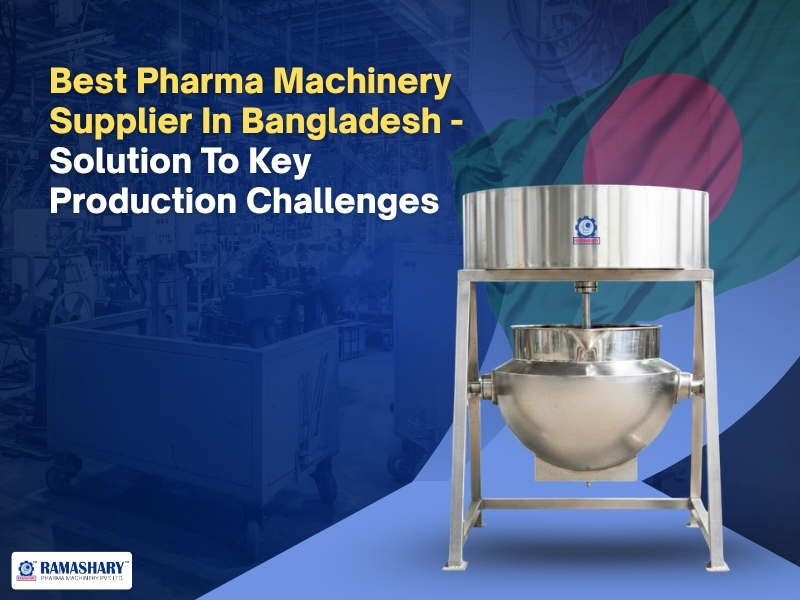
2. Steam Heated Paste Kettle
The Steam Heated Paste Kettle is used to form, mix, homogenise and fill semi-solid products and pours the finished paste out through a tilting mechanism rather than manual scooping. Even heating and a compact, easy-to-clean design reduce the risk of overcooking, burning or contamination through a jacketed kettle that uniformly distributes the heat.
Applications
Sauces, jams, jelly bases and semi-solid fillings benefit from the controlled, even heat this kettle provides.
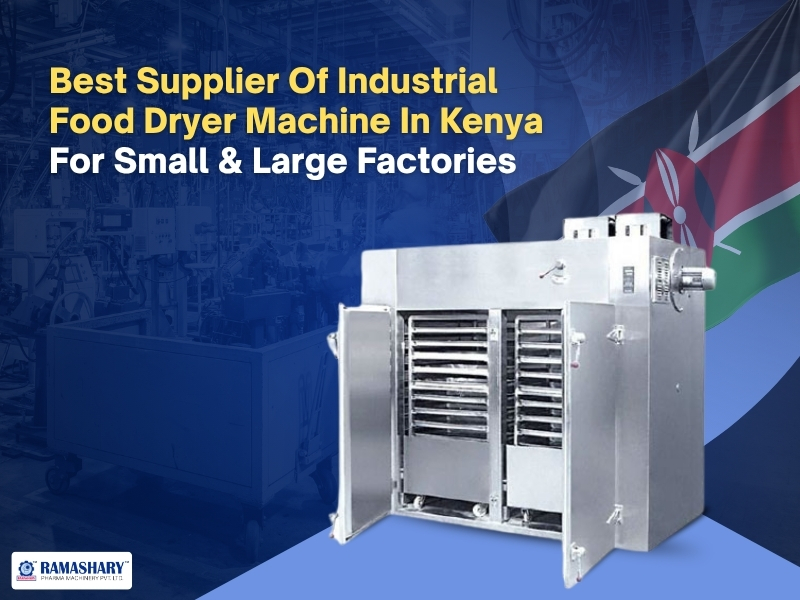
3. Tray Dryers
Tray Dryers use a controlled heating mechanism to dry material spread uniformly across trays in batches, which makes them ideal for manufacturers searching for a dependable food dehydrator machine Malaysia. Given Malaysia’s humid climate, precise, even drying is essential to prevent spoilage and extend shelf life.
These dryers can be customised with energy-efficient designs, adjustable temperature and airflow settings and configurations suited to both small and large production batches.
Applications
Dried fruits, spices, herbs, snack ingredients and bakery components all depend on tray dryers to achieve consistent moisture removal without compromising taste, colour or nutritional value.
4. Octagonal Blender
The Octagonal Blender is used to mix dry powders and granular materials gently and uniformly, while reducing the risk of ingredient separation or uneven distribution. Its design supports thorough mixing without excessive mechanical stress on delicate ingredients using gravity as the main force for blending.
Applications
Spice blends, powdered beverage mixes, bakery pre-mixes and seasoning powders rely on this equipment for uniform blending at both small and large scale.
5. Double Cone Blender
The Double Cone Blender is widely used across food and other industries for blending dry powders and granules with gentle, efficient mixing action. This makes it suitable for ingredients that need to retain their particle structure during processing. As a food machinery supplier in Malaysia, RamasharyPharma Machinery Pvt. Ltd. customises this machine according to the exact requirements to avoid dead spots and offer ease of cleaning.
Applications
Protein powders, flour blends and granulated food additives are commonly processed using double cone blenders where gentle handling is a priority.
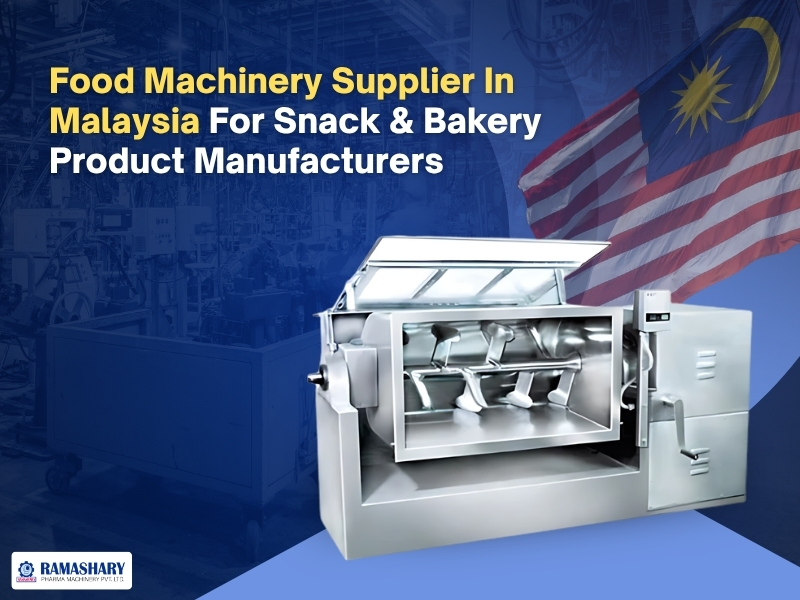
6. Ribbon Blender
A Ribbon Blender is built for high-capacity mixing of powders, granules and semi-solid materials and is a common choice for manufacturers scaling up production volume. It provides fast, thorough mixing for larger batch sizes without sacrificing consistency, addressing the scale-up challenge many Malaysian SMEs face as demand grows.
Applications
Bakery mixes, animal feed components, spice powders and bulk seasoning blends benefit from a Ribbon Blender in Penang or any high-volume production facility that needs to move from small-batch to industrial-scale mixing.
7. Conventional Coating Pan
The Conventional Coating Pan provides a consistent, uniform coating to the inner material while reducing cross-contamination risk, useful anywhere a food product requires an even outer layer, glaze or flavour coating. The products tumble upon each other, which avoids excessive coating. It comes in different capacities and is mainly used for sugar and film coating.
Applications
Coated confectionery, glazed snacks and flavour-coated nuts or cereals rely on this equipment to achieve an even, repeatable finish batch after batch.
8. Vibro Shifter
A Vibro Shifter uses vibratory motion generated by an electric motor and mechanism to sieve, grade and filter powdered ingredients like flour, sugar and spice powders by particle size. This directly supports quality assurance, since removing oversized particles or foreign matter before mixing protects both product quality and food safety compliance.
Applications
Flour sifting, sugar grading and spice powder filtering are common uses, particularly for bakery and snack manufacturers who need consistent particle size for texture and appearance.
Not Sure Which Machine Fits Your Current Production Gap?
FAQs
1.Do small and medium food businesses need the same machinery as large manufacturers?
Not necessarily in scale, but they benefit from the same quality standards. RamasharyPharma Machinery Pvt. Ltd. provides customised machines for smaller production runs while still meeting hygiene, safety and consistency requirements. It positions them as a leading food machinery supplier in Malaysia.
2. Can a food machinery supplier in Malaysia support businesses in specific regions?
Yes, RamasharyPharma Machinery Pvt. Ltd. supplies and supports food machinery installations across multiple regions. So if you are looking for a food machinery supplier in Johor Bahru, Kuala Lumpur, Penang or any region in Malaysia, they will be an ideal choice.
3. What is the difference between buying machinery locally versus from an established international manufacturer?
The decision should come down to certification, customisation and track record rather than geography alone. A manufacturer with decades of cross-industry experience, documented quality certifications and a proven international export history can often provide a level of engineering and after-sales support that is harder to find from any other food machinery supplier in Malaysia.
4. What is the typical lifespan of industrial food processing machinery?
With proper maintenance, high-quality industrial food machinery generally lasts many years of continuous use. Build quality, correct installation and lifecycle support are the biggest factors in extending a machine’s operational life, particularly in humid tropical environments. That’s where RamasharyPharma Machinery Pvt. Ltd. turns out to be an ideal partner.
5. Can the machinery be designed according to my factory layout?
Yes, the machinery can be designed according to your factory layout. RamasharyPharma Machinery Pvt. Ltd. is a food machinery supplier in Johor Bahru, Penang, Kuala Lumpur and all across Malaysia who first understands your production requirements, factory layout, workflow and future expansion plans before designing the machinery.
Conclusion
Malaysia’s food manufacturing sector is growing, but growth is not evenly distributed. It favours manufacturers who have already solved their workforce dependency, energy efficiency and compliance challenges with the right equipment. The businesses that invest now in dependable, customised machinery are the ones positioned to capture that growth.
RamasharyPharma Machinery Pvt. Ltd.’s 40+ years of manufacturing experience, ISO and GMP certification, customisation capability and site installation record make it one option worth evaluating as you plan your next equipment investment. None of this means every manufacturer needs to replace their entire production line overnight. The more realistic path and the one most experienced procurement heads take is to identify the single biggest bottleneck on the floor today and start there.
Let’s connect and discuss your manufacturing requirements with our technical team.