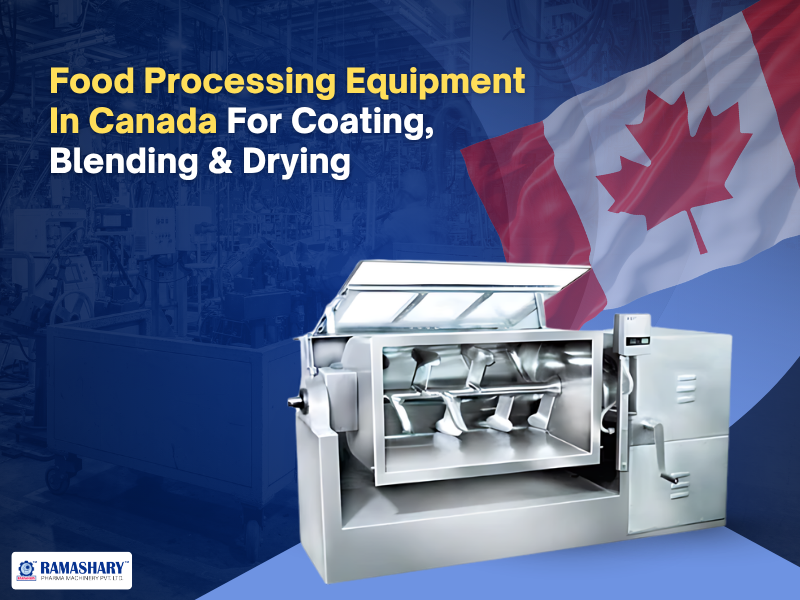
Food Processing Equipment In Canada For Coating, Blending & Drying
When looking for reliable food processing equipment in Canada, businesses can find high-quality food equipment in Canada for various processing and manufacturing needs. From a durable ribbon blender in Canada and efficient ribbon mixer Canada solutions to advanced food dehydrator machine Canada systems, the right equipment can improve productivity and consistency. As an experienced food machinery manufacturer, we provide dependable food processing equipment Canada solutions, including meat processing equipment Canada and specialized machinery for different food industries. We also work as a trusted food machinery supplier in Canada, offering suitable solutions for businesses searching for restaurant equipment suppliers in Canada and reliable processing machinery. If you run a food manufacturing plant in this country and you are searching for high-quality food processing equipment in Canada, you already know the pressure is real. Margins are tight. Labour is scarce. Recalls make headlines. Buyers want cleaner labels, more protein and lower prices at the same time. In that environment, the machine on your floor is not just a machine. It is the difference between a profitable shift and a scrapped batch. Canada’s food and beverage sector is under strain. Sales are growing on paper while volumes shrink. Costs keep climbing. When you put those forces together, one thing becomes clear. You cannot run an advanced plant on inefficient equipment and hope for the best. You need customised, GMP-compliant, hygienic and high-quality food equipment in Canada that holds tolerances, gets cleaned fast and keeps running. This is where the right food machinery manufacturer and supplier earns its place. A good supplier does more than ship a crate. It engineers the machine to your product, installs it, trains your team, stocks your spares and answers the phone. Canada’s Food Industry – An Overview Canada’s food and beverage processing industry is the country’s largest manufacturing sector. Reportedly, in 2022 it recorded sales of goods manufactured worth $156.5 billion; it accounted for 18.2% of total manufacturing sales and for 1.7% of the national Gross Domestic Product (GDP). Reportedly, it is also the largest manufacturing employer and provides employment for approximately 300,000 Canadians. That is the scale of the market you are competing in. The sector is broad and deep. The industry was made up of nearly 15,000 establishments in 2024, contributed $35.2 billion to GDP in 2023 and directly employed over 315,000 people in 2024. Around 8,800 of these are processing businesses that employ at least one person, and the vast majority are small or medium-sized, with roughly 91% having fewer than 100 paid employees. In other words, most food processing equipment in Canada is bought by SMEs who cannot afford a machine that fails. Exports matter too. Canadian processed food and beverage exports reached a record of nearly $60 billion in 2024 and account for a significant share of total national exports. Around 70% of all processed food and beverage products available in Canada are sourced domestically.That domestic strength is exactly why demand for reliable food equipment in Canada keeps rising. If you make it here, you need machines that meet Canadian food safety expectations and export-market standards at the same time. The mix of products is led by meat. Reportedly, Canada’s leading processing sectors in 2024 were meat products at roughly $30 billion (26%), followed by dairy, bakery and tortilla, and other food products at about $13 billion each (11%).This is important context for anyone looking for meat processing equipment in Canada or blending and drying gear for protein products. Meat, dairy and bakery depend on precise mixing, cooking, coating and drying.Here is the tension. While the market is large, growth is not being driven by consumption. The food and beverage manufacturing sales are reportedly expected to increase 0.8 per cent in 2026, driven by higher prices, while sales volumes are expected to decline by 0.7 per cent, marking a fourth consecutive year of falling volumes. The gap between modest sales growth and declining volumes highlights the demand challenge facing food manufacturers. When you sell fewer units at higher cost, every point of yield, every avoided rejection and every hour of uptime matters more. That is the commercial case for high-quality food processing equipment in Canada in one sentence: when volumes are soft, efficiency is survival.So the need is clear. Canadian manufacturers need customised, hygienic, GMP-aligned food equipment in Canada that raises yield, protects food safety and lowers cost per unit. Also, they need a food machinery manufacturer and supplier who will stand behind it. Planning to Increase Production Without Expanding the Plant? Talk To Our Process Engineering Team 7 Trends In Canada’s Food Industry The machines you buy today have to fit the market of tomorrow. Here are seven trends pushing food manufacturers toward better food equipment in Canada. 1) Automation & AI In food manufacturing, automation is now a competitive requirement. Manufacturers that ignore automation might fall behind. Not just in export, but domestically. Labour is scarce, so plants are automating production and shifting people into warehousing and shipping roles. This raises demand for automated, PLC-ready food processing equipment in Canada. 2) Protein Is the Headline There is a broad shift toward protein across seafood, poultry, pork, beef and value-added products such as high-protein yoghurt. Manufacturers are reformulating around protein, which means more blending of powders, more marinade and sauce cooking and more drying. That plays directly to mixers, kettles and dryers. 3) Clean Label & Minimally Processed Plant Foods Consumers are moving away from imitation meat toward authentic, minimally processed plant foods with clean ingredients. Fewer additives means processing has to be gentler and more precise so the product holds together without chemical crutches. 4) Value-Seeking Consumers Canadians have not stopped buying food; they have changed how they decide. Price sensitivity is high and revenue is being driven by price rather than volume. Manufacturers must cut cost per unit and that starts with efficient food processing equipment in Canada. 5) Made In Canada & Reshoring Amid trade tensions and tariffs, the Government of Canada is promoting voluntary ‘Product of Canada’