
Ramashary.com

Find reliable food machinery in Norway with advanced solutions for food processing, fruit and juice production, and seafood industries. Our range includes food processing machinery in Oslo, juice processing equipment in Norway, sifter machine in Rjukan, and rapid mixer granulator in Notodden, making us a dependable food machinery supplier in Norway for modern processing needs.

More production needs more than just more machines.

Norway’s food and beverage manufacturing sector is facing a changing business environment due to evolving consumer preferences, rising operating costs and strict health and safety regulations. Norwegian food and beverage manufacturers must adapt to growing demand for sustainable foods, functional beverages and high-grade seafood while managing high domestic labour costs and strict environmental guidelines set by Mattilsynet.

For that, the facilities across the country have to increase operational capacity without compromising on product consistency or safety standards.

To remain competitive and scale production output effectively, manufacturers require advanced beverage and food machinery in Norway for small-scale and large-scale manufacturing.

Today’s production floors depend on food processing machinery in Oslo, Notodden, etc., that provides automated control, minimises material waste and complies with manufacturing standards. Investing in high-performance beverage and food machinery in Norway allows plants to overcome challenges, reduce batch cycle times and have precise ingredient mixing across all shifts.

Overview Of The Food & Beverage Industry In Norway

The food and beverage industry represents one of the most significant manufacturing sectors in Norway, contributing significantly to national employment and economic output. The seafood industry is the largest sector and food is becoming cheaper compared to other consumer goods. But food prices are still significant. It represents the need to have food machinery in Norway that supports waste reduction.
The seafood segment continues to record remarkable growth. Reportedly, seafood exports reached NOK 15.6 billion in a single month in mid-2026. Concurrently, domestic manufacturers face competitive pressure from cross-border trade.
To counter the margin pressures, domestic food manufacturers are expanding their portfolios into value-added segments, including functional drinks, plant-based proteins and premium seafood products. Thus, the importance of food processing or juice processing equipment in Norway cannot be overlooked.
Key industrial hubs, such as Oslo and surrounding regions, host primary beverage bottling and ready-to-eat meal preparation units that require high-throughput automation. Installing advanced food processing machinery in Oslo and related regions helps local facilities optimise processing workflows and improve yields.
To sustain long-term growth and maintain profitability under tight regulatory standards, Norwegian manufacturers can consider equipment upgradation. Integrating advanced processing lines and partnering with a dependable beverage and food machinery supplier in Norway helps facilities handle increased batch volumes while upholding the highest hygiene standards.
However, when supplying a beverage or seafood processing machine in Norway, customisation requirements have to be considered. Partnering with an experienced beverage and food machinery supplier in Norway enables plant managers to access customised manufacturing solutions, comprehensive technical documentation and long-term aftersales support.
Establishing a long-term partnership with an experienced beverage and food machinery supplier in Norway ensures that plant expansions proceed neatly, meeting exact technical specifications and production timelines.

Can Your Existing Machines Handle High Batch Volumes?

Market Trends In Norway’s Food & Beverage Industry

Norway’s food and beverage market is being shaped by a mix of changing consumer priorities and pressure on manufacturers to operate more efficiently. Price, health, sustainability, Norwegian and local origin, convenience, quality and craftsmanship are among the most important trends influencing food choices.

1. Prices Affect The Buying Decision

Price is no longer something manufacturers can treat as a retail issue alone. Norway has one of Europe’s more expensive food markets. Reportedly, the household final consumption expenditure in Norway in 2025 was 128.6 (28.6% above the EU27 average). The prices for food and non-alcoholic beverages have also increased.
It also creates a difficult situation for manufacturers, especially if they do not have an efficient dryer, blender or sifter machine in Rjukan, Oslo or across any region in Norway. A manufacturer cannot simply keep increasing prices when consumers have cheaper alternatives. At the same time, cutting costs through cheaper ingredients can affect quality.

2. Health & Nutrition Influence Product Development

Health is one of the consumer trends. Price awareness, health and nutrition, sustainability, preference for Norwegian and local products, convenience, quality and craftsmanship are prominent factors affecting food choices.
The important point for manufacturers is that health-conscious demand does not stop at marketing. Changing a formulation can change the way a product behaves during processing, which requires customised food machinery in Norway.
A change in fat content can affect mixing. Altering moisture can affect drying. A new ingredient can change viscosity, flow characteristics or stability. A manufacturer may also need to produce several formulations on the same equipment. That creates a need for a beverage and food machinery supplier in Norway that understands these requirements.

3. Prioritisation To Local & Norwegian Products

Norwegian origin has become a meaningful part of the food buying decision. Reportedly, the share of consumers who were very or fairly interested in Norwegian food specialities increased from 42% in 2013 to 55% in 2023. Also, 82% said people should eat more locally produced food.
This creates a useful opportunity for manufacturers, especially if they have efficient food or juice processing equipment in Norway. Local products are not necessarily about producing at a very small scale forever. Some manufacturers want to move from a local operation into wider retail distribution. That transition changes the production problem.
A product that works well in a small batch operation may not behave the same way when production is increased 10 times. It creates the need to partner with an experienced food machinery supplier in Norway that does not only focus on capacity but also on solving the challenges.

4. Convenience Is Creating More Demands On Processing

Norwegian consumers are increasingly looking for food that fits more easily into everyday life. For manufacturers, convenience creates a production challenge.
A convenient food product often needs to deliver several things at once. It needs predictable preparation, consistent portioning and suitable shelf life. The production process must deliver the same result from one batch to another. That’s where a customised Rapid Mixer Granulator in Notodden or a Sifter machine in Rjukan plays an important role.

5. Sustainability Is Important In Production

Sustainability and environmental considerations are reportedly the major factors influencing consumer food choices. It also places greater emphasis on technology and productivity as part of the competitiveness of Norwegian industry.
For manufacturers, the more immediate questions are often found inside the plant. How much raw material is lost? How much energy is used per batch? How much water is needed for cleaning? How much product is left in the equipment after processing? How much time is spent waiting between production stages? These questions have a cost attached to them.
That’s why the manufacturers need to partner with an experienced beverage or food machinery supplier in Norway who understands these concerns and provides solutions to all the challenges.

6. Automation Is Becoming A Practical Response To Production Costs

Automation in Norwegian food manufacturing should not be reduced to the idea of a ‘smart factory’. The more immediate issue is productivity. Norway’s cost structure makes repetitive manual work expensive. This is one reason manufacturers are looking for beverage and food machinery in Norway for automated dosing, material transfer, weighing, mixing, filling, inspection and production monitoring.
The goal is not necessarily to remove operators from the production floor. It is to stop using skilled employees for tasks that a machine can perform more consistently. This becomes especially relevant when a manufacturer wants to increase output without increasing labour requirements at the same rate.

7. Export Demand Is Encouraging More Value-Added Processing

Norway’s strongest international food opportunity remains seafood. That is a useful signal for manufacturers. Higher value does not always come from producing more tonnes. It can come from doing more with each tonne.
Processing, drying, portioning, blending, preparing and packaging can create products that are easier for international buyers to use. It can also help manufacturers target markets with different product requirements. This creates the need for customised seafood processing machinery in Norway.

Challenges In Norway’s Food & Beverage Industries

Operating a food or beverage processing facility in Norway involves complex regional logistics, strict food safety laws and high operational costs. Addressing these factory-floor issues requires well-engineered food or juice processing equipment in Norway to resist wear and prevent batch contamination.

1. High Operational Labour Costs & Workforce Scarcity

Norwegian manufacturers operate in a relatively high-cost labour environment, making production efficiency an important consideration for processing facilities. According to Statistics Norway, the labour cost index for Norwegian manufacturing was 126.1 in Q1 2026, with the 2020 average set at 100.
For food and beverage manufacturers, reducing repetitive manual intervention can therefore improve operational efficiency while maintaining consistent processing conditions. For instance, an automated Rapid Mixer Granulator in Notodden or any other city can support controlled powder mixing and granulation with reduced dependence on repetitive manual handling.
The focus is not simply on replacing labour but on allowing operators to spend more time on process control, quality and other higher-value activities.

2. Strict Food Hygiene & Equipment Requirements

Norwegian food businesses must maintain documented food-safety controls and conduct mandatory hazard assessments. The Norwegian Food Safety Authority, Mattilsynet, states that food businesses must identify, prevent or reduce food-safety hazards and maintain appropriate routines for cleaning, personal hygiene and other controls.
Reportedly, food-contact equipment is to be constructed and maintained in a way that minimises contamination risks and allows effective cleaning and disinfection.
For seafood and other demanding food-processing environments, beverage and food machinery in Norway should therefore be selected according to the product, cleaning time and operating conditions. Hygienic construction, cleanable surfaces and corrosion-resistant materials can help manufacturers maintain hygienic processing conditions and support their food-safety systems.

3. High Energy Consumption

Energy management is a significant consideration for Norwegian manufacturing facilities. Reportedly, 77,662 GWh of energy consumption was recorded across Norwegian manufacturing, mining and quarrying in 2025, with total energy costs reaching NOK 35.515 billion. Manufacturing alone accounted for 76,402 GWh of consumption.
Food and beverage manufacturing accounted for 4,924 GWh of energy consumption in 2025, demonstrating the large energy demand associated with this processing sector.
This makes thermal efficiency an important consideration for operations involving heating, cooking and drying. Properly designed and closed food or juice processing equipment in Norway can help minimise unnecessary heat loss and improve control over energy-intensive processing operations.

4. Need For More Processing Capacity

Norway’s seafood sector operates at high production volumes, creating a strong requirement for reliable and scalable processing infrastructure. In 2024, Norway produced more than 1.6 million tonnes of seafood through aquaculture and landed more than 2.2 million tonnes from wild fisheries. The country also exported 2.8 million tonnes of seafood worth NOK 175 billion that year.
Aquaculture alone remains one of Norway’s major export industries. Reportedly, in 2024, 1,552,888 tonnes of Atlantic salmon and 95,863 tonnes of rainbow trout were sold.
Such production volumes place considerable importance on processing capacity, throughput and equipment reliability. High-capacity seafood processing machine in Norway can help facilities handle demanding production requirements while maintaining controlled processing conditions. Variable-speed machines can also provide greater flexibility when production rates need to be adjusted.

5. Material Recovery & Yield Efficiency

For food manufacturers handling expensive ingredients, reducing unnecessary product losses can have a direct effect on production economics. This becomes particularly relevant when processing viscous products, pastes, syrups and fine powders that can stick to processing surfaces or remain within transfer systems.
Design of the food processing machinery in Oslo, Notodden, Rjukan or any city in Norway therefore plays an important role in product recovery. Machines designed for efficient discharge, appropriate vessel geometry and effective material transfer can help reduce product retention and simplify cleaning between production runs.
Advanced food machinery in Norway can be designed around the specific characteristics of the product to improve material handling, discharge efficiency and overall process consistency.

6. Cross-Contamination Risks During Product Changeovers

Food manufacturers producing different products on shared equipment must control the risk of cross-contamination during processing and changeovers. Reportedly, unintended allergen contamination is an example of a food-safety hazard that businesses must assess and control.
For facilities handling multiple formulations or SKUs, equipment that can be cleaned efficiently between production runs can therefore help reduce changeover complexity and support hygiene controls. For instance, a Sifter machine in Rjukan or any city with modular build, accessible product-contact areas and hygienic construction can be particularly useful where frequent product changes are part of the production process.

7. Spare Parts Availability

For food and process manufacturers, production continuity depends not only on the performance of installed juice, seafood or fruit processing equipment in Norway but also on access to maintenance support and important replacement components.

This is particularly important in Norway’s large seafood-processing ecosystem. The Norwegian government reports that the seafood sector employed approximately 21,300 people in 2024 and generated NOK 175 billion in seafood export value, underlining the economic importance of maintaining reliable production infrastructure.

For plant operators, equipment selection should therefore include the availability of critical spare parts, technical support and after-sales service alongside machine performance. High-quality beverage and food machinery in Norway, supported by spare parts and technical assistance, can help manufacturers reduce the operational impact of unexpected equipment downtime.

Is Your Manufacturing Facility Facing High Energy Costs?

Best Beverage & Food Machinery Supplier In Norway

Ramashary Pharma Machinery Pvt. Ltd. (an ISO & GMP certified company) is a manufacturer, supplier and exporter of high-precision food machinery in Norway. With global export capabilities, 40+ years of experience and 700+ site installations, we have become a dependable machinery partner across 20+ industries. Thus, besides the food and beverage industry, these machines can be used across the chemical, pharmaceutical, cosmetic, fertiliser and other industries.

But what makes us a long-term machinery partner is our end-to-end support and ability to provide solutions to the above challenges as follows:

1. Reducing Manual Intervention Through Process-Focused Automation

High labour costs make repetitive manual processing increasingly difficult to justify. Instead of treating automation as simply an equipment upgrade, we begin by understanding the formulation, batch size, production objective and existing process before recommending the machinery.
While supplying a Multi Mill, Vibro Shifter, Blender, Fluid Bed Dryer and Rapid Mixer Granulator in Notodden or any city, we make sure that it can be integrated into the appropriate production process. Our machines can also be used as standalone systems.
We also conduct space analysis, helping facilities use available production space more effectively. The objective is to reduce repetitive manual handling, improve process consistency and create a production setup that can support future capacity requirements.

2. Hygienic Equipment Around Food-Safety Requirements

Norwegian food manufacturers operate under strict food-safety and hygiene requirements. This makes equipment selection particularly important where products come into direct contact with processing surfaces.
We design machinery around the product characteristics, cleaning requirements and operating conditions of the facility. We provide food machinery in Norway engineered with SS 304/316L construction.
We follow CE, WHO-cGMP, GMP, ISO 9001:2015, ASME BPE, SCADA, 21 CFR and Industry 4.0 standards and international validation protocols. This allows manufacturers to approach equipment selection as part of their overall hygiene and quality system rather than as an isolated machinery purchase.

3. Energy-Efficient Machines

Energy is a significant consideration for Norwegian manufacturers. Reportedly, NOK 35.515 million in energy costs across manufacturing, mining and quarrying were recorded in 2025, with manufacturing alone accounting for NOK 34.108 million.
Our approach is to match equipment design and capacity with the actual production requirement rather than simply supplying an oversized machine. Our machinery portfolio includes thermal processing equipment such as Steam Heated Paste Kettles, Fluid Bed Dryers, Tray Dryers and Liquid Manufacturing Plants.
For thermal processes, the machine can be engineered around factors such as required capacity, heating requirements, process temperature and operating conditions. Proper equipment selection and thermal design can help manufacturers avoid unnecessary processing loads while maintaining the required product characteristics.

4. Support For Scalability

Norway’s seafood industry operates at significant production volumes. Such production environments require machinery that can maintain consistent output while accommodating changes in production requirements.
Ramashary Pharma Machinery Pvt. Ltd. approaches this through machine design for scalability and process analysis. Instead of supplying standard beverage and food machinery in Norway without understanding the application, our team evaluates the production requirements, available space and process before engineering the equipment.
We provide customised food and juice processing equipment in Norway that handles diverse formulations, quick changeovers and supports multiproduct versatility. It is how we provide machines today with a focus on the future. This helps manufacturers build production systems capable of handling current requirements while leaving room for future expansion.

5. Wastage Reduction

Material loss becomes increasingly important when raw materials are expensive or when products are difficult to handle because of their viscosity, particle characteristics or flow behaviour.
We consider the material being processed rather than using a one-size-fits-all machine. We can provide 20+ dedicated food and juice processing equipment in Norway that cover different processing requirements, including blending, mixing, drying, milling and powder transfer.
The result is a more controlled material flow from one processing stage to the next, helping manufacturers work towards better yield and resource utilisation.

6. Easy Product Changeovers & Cleaning

Manufacturers handling multiple products need to manage cleaning and changeovers carefully to prevent contamination between batches.
We provide customised beverage and food machinery in Norway made with SS 304/316L for hygiene and compliance. Additionally, integration with vacuum transfer systems or other machines in the production line helps reduce human contact.
The benefit is not simply easier cleaning. A properly planned production line can reduce unnecessary disassembly, minimise manual product handling and make changeovers more structured.

7. Reduction In Downtime

A machine’s value does not end when it is installed. For manufacturers operating far from their machinery supplier, technical support, documentation, training and spare-parts availability become particularly important.
Our end-to-end approach covers design, engineering, manufacturing, installation, commissioning, operator training, documentation, after-sales service and assured spare parts.
For a Norwegian manufacturer, this means the machinery partnership can extend beyond the initial installation. Proper operator training, documented operating procedures, planned spare-parts support and after-sales assistance can help reduce the operational impact of equipment issues over the lifecycle of the beverage and food processing machine in Oslo, Rjukan, Notodden or any region in Norway.

Do Your Existing Machines Help You Solve Production Challenges?

Best Beverage & Food Processing Machines In Norway

Ramashary Pharma Machinery Pvt. Ltd. provides 20+ dedicated processing machines for consistent performance across food and beverage manufacturing operations. Here are the top 7 machines.

1. Liquid Manufacturing Plant

The Liquid Manufacturing Plant contains a closed-circuit processing system for liquid preparation. The plant consists of an ingredient preparation vessel, a main manufacturing vessel, an inline homogeniser, a zero hold-up filter press, and a control panel. It is ideal for manufacturers looking for beverage or juice processing equipment in Norway.

This machine is used to dissolve, blend, homogenise, and filter liquid and beverage products under controlled temperatures. Enclosing processing within sealed stainless steel vessels prevents airborne contamination and reduces manual handling. Utilising such juice processing equipment in Norway enables facilities to process clarified juices, liquid nutrients and beverage syrups efficiently.

Step-by-Step Operational Workflow

  1. Liquid bases and sweeteners enter the jacketed preparation vessel for heating and initial dissolving.
  2. The pre-mixed liquid transfers through sealed piping into the main manufacturing vessel.
  3. Flavourings, active nutrients or fruit concentrates load through dust-free ports.
  4. The bottom homogeniser and top anchor agitator work to form a stable liquid emulsion.
  5. Liquid recirculates through the inline homogeniser loop while sensors monitor batch temperature.
  6. Once homogenisation is complete, the product passes through the Zero Hold Up Filter Press to remove micro-particulates.

Applications

  • Clarified fruit juices and berry juice blends
  • Flavoured beverage syrups and liquid concentrates
  • Liquid nutritional supplements and wellness tonics
  • Bases for dairy and non-dairy beverages

2. Mass Mixer

The Mass Mixer is a heavy-duty mixing machine designed to process dense, sticky or viscous wet and dry masses. The unit features a rigid horizontal U-shaped trough housing a single-paddle agitator blade driven by a heavy-duty gear motor.

This food machinery in Norway provides thorough mixing for difficult ingredient combinations that resist standard powder blending. In food processing, it blends heavy doughs, viscous batters, wet spice pastes and moist ingredient slurries. Facilities expanding their production rely on such seafood processing machine in Norway to blend minced fish tissue, binders and seasoning marinades uniformly without breaking down protein fibres.

Step-by-Step Operational Workflow

  1. Operators load dry powders and solid ingredients into the open trough and secure the safety cover.
  2. The drive system rotates the paddle blade at low speed to dry-blend base powders.
  3. Liquid binders, oils or fruit extracts are added later.
  4. The paddle folds and kneads the material until reaching a uniform, moist consistency.

Applications

  • Processed pastes, fish cakes and seafood mixes
  • Bakery dough bases and dense confectionery pastes
  • Wet spice seasonings, sauce bases and marinades
  • Moist cereal masses and energy bar formulations

3. Vibro Shifter

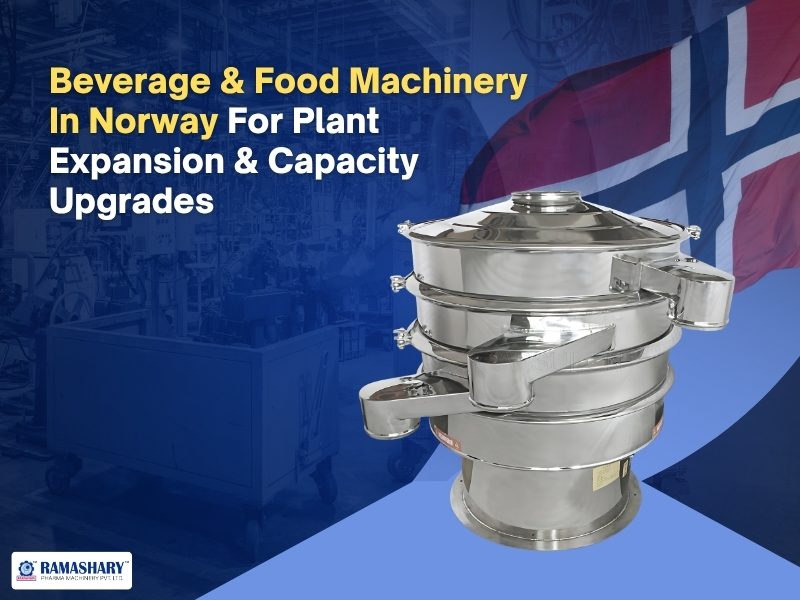
The Vibro Shifter is a high-precision sifting machine designed to classify, separate and de-lump fine powders. As a food machinery supplier in Norway, Ramashary Pharma Machinery Pvt. Ltd. provides Vibro Shifters built with high-grade SS 304/316L. It includes a screening deck, a vibration motor, tensioned wire mesh screens and springs mounted on a rigid base. Deploying a sifter machine in Rjukan, Oslo, Notodden or any facility on active processing lines ensures consistent particle size distribution.

This sifting machine removes oversized particles, foreign material and undissolved lumps from ingredients before mixing or packaging. Installing a sifter machine in Rjukan or any industrial hub allows local manufacturers to refine bakery flours, starches and powdered flavourings cleanly.

Step-by-Step Operational Workflow

  1. Raw powders or liquids feed into the top inlet port.
  2. The vibratory motor drives multi-directional oscillation across the tensioned mesh screen.
  3. Required particles pass downward through screen openings into the main discharge chute.
  4. Agglomerates and oversized materials travel outward, exiting through the other discharge port.

Applications

  • Sifted bakery flours, starches and baking agents
  • Powdered milk, whey protein and infant formula bases
  • Ground coffee, cocoa powder and fine spice mixes
  • Strained fruit juices and liquid beverage bases

4. Rapid Mixer Granulator (RMG)

The Rapid Mixer Granulator (RMG) is a high shear wet granulation machine designed to convert light powders into dense granules. The machine features a dome-shaped stainless steel mixing bowl housing an impeller and a side-mounted high-speed chopper blade.

It combines dry mixing and wet granulation into a fast single-vessel operation. It converts light, dusty powders into uniform granules with improved flowability and bulk density. Operating a Rapid Mixer Granulator in Notodden or any city gives food processing plants precise control over granule formation. Also, deploying a Rapid Mixer Granulator in Notodden, Oslo, Rjukan or any industrial hub fastens processing cycles for instant drink mixes.

Step-by-Step Operational Workflow

  1. Dry powders enter the sealed bowl through controlled loading ports.
  2. The impeller rotates at a defined speed, uniformly blending powders before granulation.
  3. Binder solution is introduced into the moving powder bed at a controlled rate.
  4. The high-speed chopper breaks agglomerates and develops uniform wet granules.
  5. Once the granulation endpoint is achieved, the discharge valve transfers wet granules for drying.

Applications

  • Granulated instant soups, stocks and bouillon bases
  • Compressible sweetener tablets and flavour tablets
  • Effervescent beverage powders and drink mixes
  • Granulated plant-based protein extracts

5. Steam Heated Paste Kettle

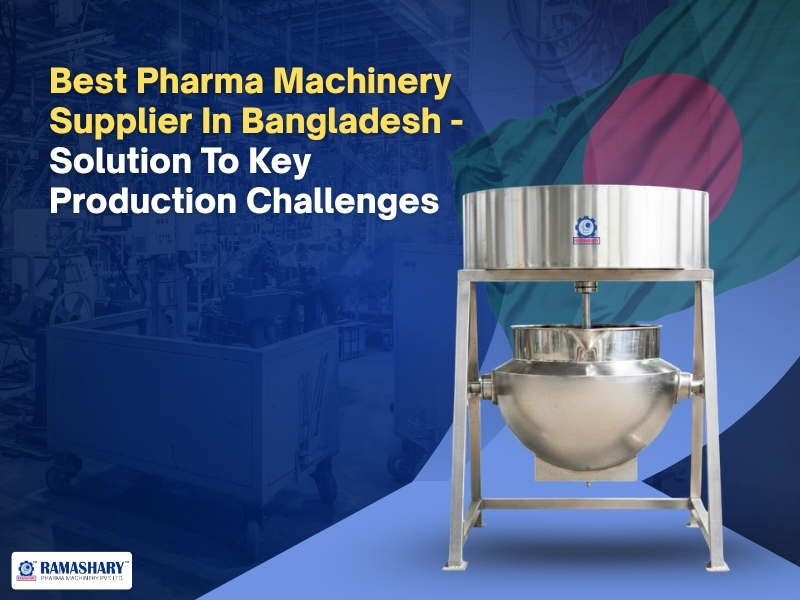
The Steam Heated Paste Kettle is a hemispherical processing vessel designed for thermal cooking, heating and blending viscous liquid bases. The vessel features an outer steam jacket, a motor-driven anchor agitator and a tilting discharge mechanism.

As an experienced beverage and food machinery supplier in Norway, we provide Steam Heated Paste Kettles with accurate temperature and speed control to avoid lumping of the product.
This kettle cooks starch bases, fruit preserves, sauces and thick binders under exact thermal conditions. It provides uniform heat transfer across the vessel surface, preventing material overheating along bottom surfaces. Utilising this food processing machinery in Oslo, Notodden, Rjukan and across any city in Norway allows plants to convert seasonal harvests into cooked jams, gels and purees efficiently.

Step-by-Step Operational Workflow

  1. Liquid bases, starches or fruit purees are charged into the kettle bowl.
  2. Steam valves open, circulating saturated steam through the outer jacket.
  3. The anchor agitator sweeps material from the walls, ensuring uniform heat distribution.
  4. Temperature sensors monitor cooking conditions to achieve consistent starch gelatinisation.
  5. Steam shuts off, cooling water circulates through the jacket if required and the vessel tilts for product discharge.

Applications

  • Cooked fruit jams, jellies and fruit fillings
  • Thickening starch pastes for bakery and sauce lines
  • Chocolate fillings, caramel bases and confectionery glazes
  • Culinary sauces, gravies and soup bases

6. Fluid Bed Dryer (FBD)

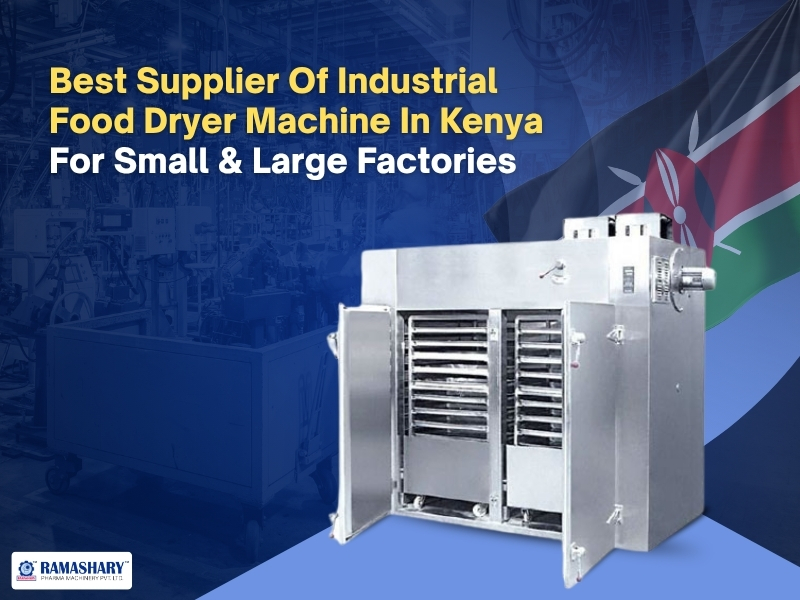
The Fluid Bed Dryer (FBD) helps reduce moisture content in granular materials and powders. The equipment consists of an air handling unit, steam heating coils, a perforated stainless steel product bowl, filter bags and an exhaust blower.

The FBD dries moist granules quickly and uniformly without degrading heat-sensitive ingredients. Drying particles while suspended in mid-air eliminates hot spots and preserves natural product flavours, colours and nutrients. Such food machinery in Norway ensures that granulated ingredients reach target moisture levels.

Step-by-Step Operational Workflow

  1. A trolley containing wet granules enters the FBD chamber and seals.
  2. The main blower engages, forcing heated filtered air through the product bed.
  3. Granules fluidise uniformly as moisture evaporates under controlled airflow and temperature.
  4. Moisture sensors indicate the endpoint; heating stops, ambient air cools the product and the trolley disengages.

Applications

  • Dried food granules and instant soup powders
  • Dehydrated herbs, spices and botanical extracts
  • Dried dairy powders, whey proteins and malted extracts
  • Granulated breading, starch flakes and seasoning mixes

7. Multi Mill

The Multi Mill is a size reduction machine designed for wet and dry milling, grinding and granulating. It is an ideal food processing machinery in Oslo, Notodden, Rjukan and all across Norway that consists of a central milling chamber, a rotor shaft fitted with swing hammer blades, a cylindrical screen and a variable-speed motor.

Multi Mill provides precise particle size distribution by shearing or impacting oversized lumps, dried ingredients and coarse crystals. In food processing, it breaks up agglomerated powders, pulverises spices and granulates bakery items. Operating a Sifter machine in Rjukan or any industrial hub alongside a Multi Mill forms an efficient closed milling and sifting process.

Step-by-Step Operational Workflow

  1. Operators select and install a cylindrical screen with the required perforation size.
  2. The motor direction is set to select knife or impact blade geometry.
  3. Raw materials feed into the top inlet hopper at a controlled rate.
  4. High-speed rotating blades shear or crush particles against the surrounding screen wall.
  5. Required particles pass through screen openings, discharging cleanly into holding bins.

Applications

  • Ground spices, culinary herbs and seasonings
  • Pulverised sugar crystals for confectionery coatings
  • Granulated breadcrumbs and crushed bakery reclaim
  • Milled marine proteins and dried seafood powders

Is Your Drying Process Providing The Desired Moisture Levels?

FAQs

1. What batch sizes can your food processing equipment handle?

We supply food machinery in Norway that handles small and large-scale batch sizes. For instance, as an ideal juice processing equipment in Norway, our Liquid Manufacturing Plant can handle capacities from 50 L to 10,000 L, while the RMG machine handles 5 L to 1,500 L.

2. Can your equipment reduce manual product transfer?

Yes, we provide beverage and food machinery in Norway that helps reduce manual product transfer and avoid contamination. Our machines can be integrated into the existing production lines or can be used as standalone equipment.

3. Can we use the same kettle for different food formulations?

Yes, the same Steam Heated Paste Kettle can be used for multiple products, provided their processing requirements and cleaning procedures are compatible. Such expertise makes us a notable food machinery supplier in Norway.

4. Can you design the equipment for limited floor space?

Yes, we can design the equipment for limited floor space. For that, we first understand your requirements and processing parameters and conduct space analysis. We also supply customised food machinery in Norway that can support your unit expansion later.

5. Are these machines compatible with IoT?

Yes, we provide IoT-ready machines that can provide real-time insights for more accuracy. Also, the required level of automation can be added. We provide detailed instructions and maintenance manuals and operator training so that our advanced machines remain easy to handle.

Conclusion

Norway’s food and beverage sector continues to expand, affected by today’s technological investments, strict food safety regulations and shifting consumer preferences. Upgrading processing facilities with advanced, high-efficiency equipment allows manufacturers across Norway to improve operations, cut labour expenses and increase productivity.
Installing high-quality and customised food machinery in Norway ensures that expanding facilities maintain consistent production quality. Facilities upgrading their bottling plants benefit from advanced juice processing equipment in Norway, while the units involved in processing agricultural produce achieve higher yields using specialised fruit processing equipment in Norway.
Ramashary Pharma Machinery Pvt. Ltd. stands out as an ideal global machinery partner for manufacturing plant establishments and expansions in Norway. Combining 40+ years of experience with in-house manufacturing, we provide high-quality beverage and food machinery in Norway engineered to exact client specifications. It is how we empower Norwegian food and beverage companies to overcome factory floor challenges and build sustainable operational growth.

Let’s connect now for a consultation.

Home
Industries
Blogs
Call us
Whatsapp

Let’s Talk

Contact Form New

I am looking to

My business belongs to

My name is

I represent

Where I hold the position of

My number is

My email is

I am planning to purchase the machine

I heard about Ramashary from

I would like a free consultation

Schedule a Call Now

Schedule a call

Fill the Form to Download Company Profile

Company Profile

Fill the Form to Download Brochure

Download Brochure